

Germanys new political reality: Polarization and instability
Sebastian Rave, Bremen, Germany
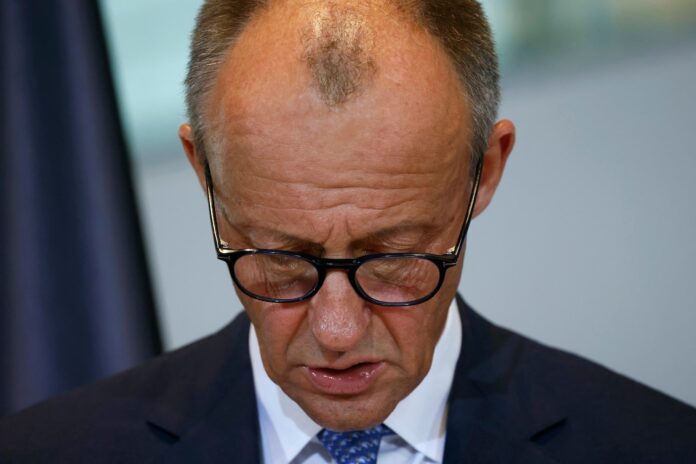
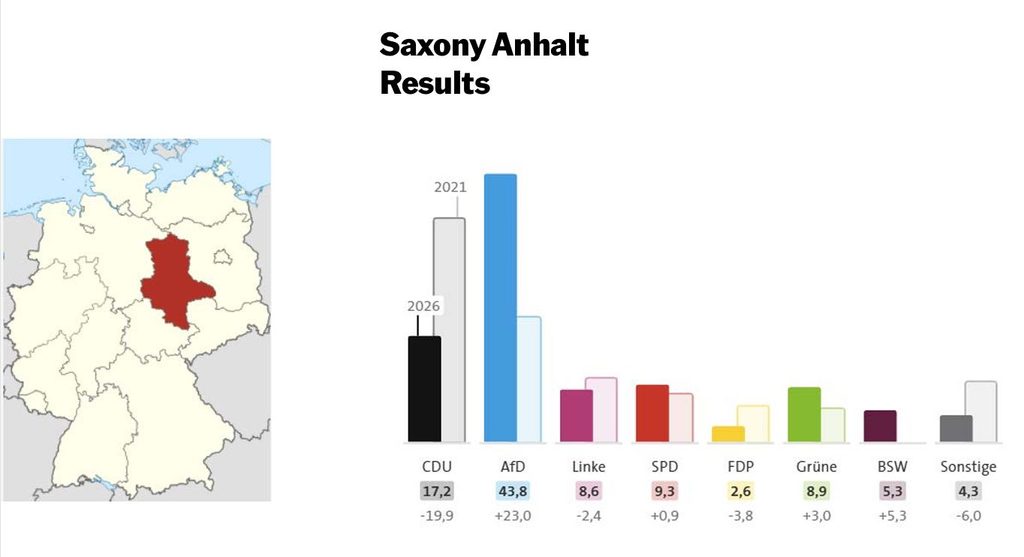
It was an extraordinary moment: Only a few moments after the polling stations closed, Chancellor Friedrich Merz appeared on the TV screens. He looked tired. Only two weeks earlier, the AfD had scored a landslide victory in the Saxony-Anhalt state election, triggering a debate about popular support for Merz’s government and its attacks on the welfare state. Reports circulated of growing unrest within the government and the ruling CDU (Christian Democrats), including speculation about replacing the chancellor or even dissolving the government. A statement by eight CDU state premiers sounded like the management of a struggling football team that expresses “full confidence” in its coach, only to sack him a week later. It seemed clear: The elections in Berlin and Mecklenburg-Vorpommern (MV) would decide the chancellor’s fate.
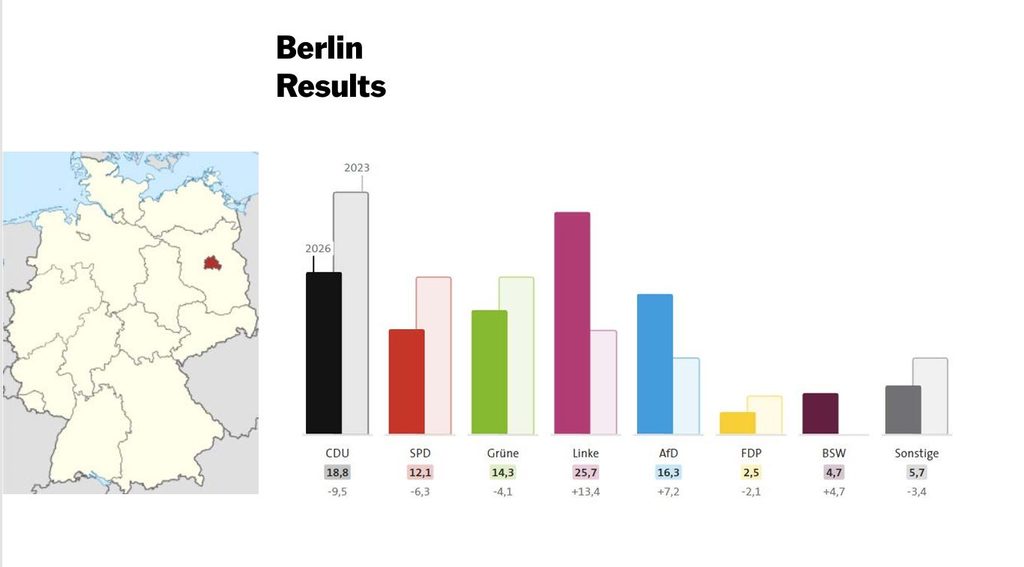
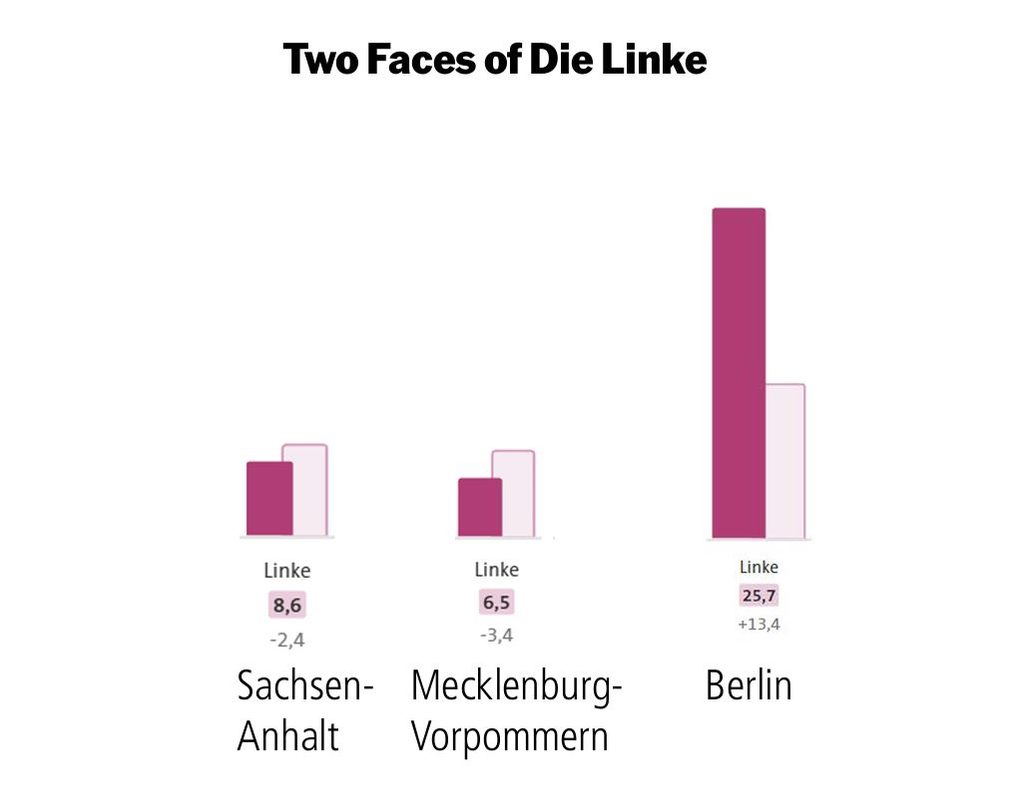
The results for the CDU were shattering. In Berlin, polling institutes foresaw a neck-to-neck race between CDU and Die Linke (The Left) – the result was 25.7% for the Left party, and a mere 18.8% for the Christian Democrats. You could see the tumbleweed rolling through the CDU’s election-night party.
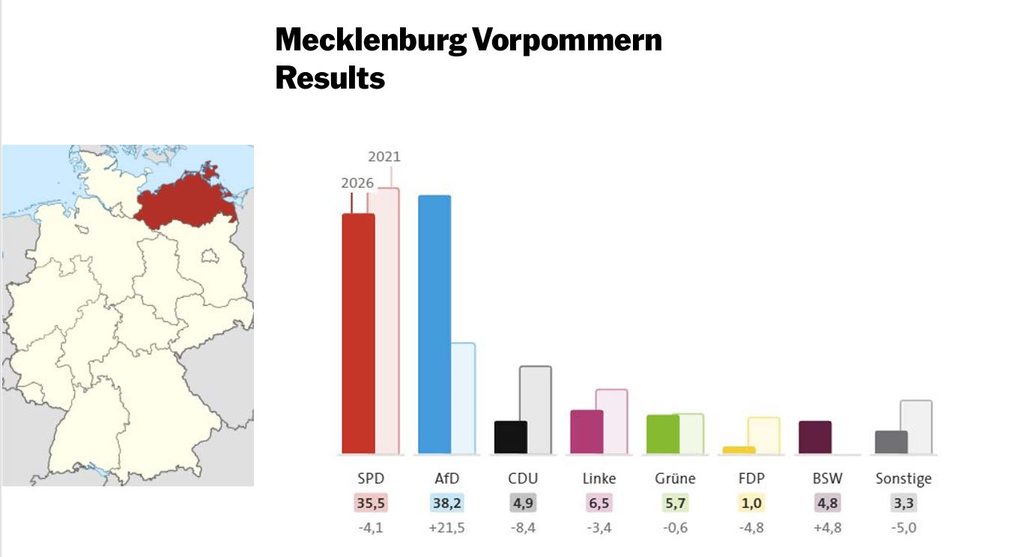
In MV it was even worse: For the first time in its history, the CDU fell below the 5% threshold, failing to enter a state parliament with a mere 4.9%.
Now, millions sat in front of their TVs, eagerly waiting for Merz to say the magic words: “I resign”. His speech dragged on. He talked about difficult elections in the past year. He correctly characterized the result in Mecklenburg-Vorpommern as a “disaster”. He said that we’re all worried about the future of our country. “Now he will say he’ll resign!”, everyone thought, but he just went on.
“The tone in our society has gotten rougher. Trust in our country’s institutions is being undermined by radical parties to the left and right.” – What are you talking about, YOU’RE undermining trust!
“The answer has to be, to make the country fit for the future… For that, we need change. This will take energy. Not everything will be applauded.” – Well, your resignation certainly would! “I take responsibility…” – YES, RESIGN! “…for the necessary reforms, that are the antidote to the poison of authoritarianism, which is penetrating ever deeper into our society as the allure of authoritarianism grows.” – Are you kidding us? Did it occur to you that your “reforms” made the far-right AfD the strongest party in the polls??? “I will do my part, as chairman of the CDU and, above all, as the chancellor of our country.” – and millions of heads exploded.
There Is No Alternative?
Numerous reports revealed that behind the scenes, CDU and SPD top politicians were discussing their options. The problem: They couldn’t find or agree on a replacement for Merz.
They’re now stuck with the most unpopular Chancellor in post-war history.
Repeatedly, his comments caused public uproar. Some were straight-up racist (“Asylum seekers come here to fix their teeth while German citizens don’t get a dentist appointment”); others were calling the populace lazy (“Performance must come to the fore again, not sluggishness, convenience, laziness, and excuses”); and recently he even felt the need to tell a pediatrician, who was critical of the government’s medical reforms, that she is a “beneficiary of the medical system”.
But Merz is not just an elephant in a China shop: he is the face of the “reforms” that, in the name of “competitiveness”, have the goal of decreasing labor costs in Germany. It’s the old “people need to tighten their belts for the greater good”. The problem is: after years of crises, inflation, stagnating wages and exploding costs of living, there are no holes left to tighten the belt. The unfolding economic crisis only comes on top.
Anger in Germany is boiling, and a polarized politicization is its main expression. People who had long lost hope in any meaningful change through elections are flocking to the polling stations. The turnout in the state elections in Saxony-Anhalt, Mecklenburg-Vorpommern and Berlin was among the highest historically. The main beneficiary was the AfD, which doubled or almost doubled its share of votes in all three cases, being able to mobilize the most former non-voters.
Political Polarization
In the rural states of Mecklenburg-Vorpommern and Saxony-Anhalt, the AfD was able to make itself the main topic of the election campaigns. Whenever political commentators felt the urge to call the AfD dangerous, it got stronger. Whenever politicians tried to conjure up the “unity of democrats”, the AfD’s claim of the cartel of the “old parties” was confirmed. They were the only party left that was seen as different from the others. That made it easy for them to win the votes of the most disgruntled. In analyses, pollsters found out that the AfD was the strongest among those who see their economic situation as bad. And, of the 50% that demand “fundamental change”, most were won by the AfD.
The other pole of this polarization is Die Linke, which won first place in Berlin with 25.7% in a rare glimmer of hope. The left party’s campaign had a strong focus on “making the city affordable”, with soaring rents as the foremost issue. The core demand, to expropriate big housing corporations, is the result of a long, extra-parliamentary campaign that ended in a successful referendum in 2021, with 57% of voters in favor of expropriation.
During the “rebirth” of Die Linke over the last one and a half years, the party doubled its membership.
Berlin is now one of the strongholds of the party that has become younger, more female, and more diverse. The party in Berlin has a more radical and activist rank-and-file than the average of the party. These activists were the backbone of a dynamic campaign: 270,000 doors were knocked on in a massive organizing campaign, resulting in Die Linke winning over 50% in some central districts, and being by far the strongest party among the youth (46% among 16-24-year-olds).
The Enemy Stands to the Left
The day after Die Linke’s victory, a barrage of shrill attacks was unleashed against the left party. A declaration signed by prominent SPD members, among them former SPD mayors and, interestingly, a few landlords, warned that “essential parts” of Die Linke are “a danger for Jewish life in Berlin” – only because the party has become more outspoken in solidarity with Palestine. Ferat Koçak, a member of the Bundestag for Die Linke with Kurdish roots, is being ferociously attacked for alleged connections to criminal “family clans”, a deeply racist trope. Other allegations include links to Islamists, and, of course, that Die Linke wants to introduce communism and rebuild the Wall. After the stocks of the big housing corporation Vonovia collapsed, Federal Minister for Economic Affairs and Energy Katherina Reiche made the stakes explicit: “A left government would be a peril for the economic location”. Chancellor Merz announced plans to prepare legislation against the nationalization of housing.
You could adapt the old introductory sentence of The Communist Manifesto to get a glimpse of the hysteria: “All the powers of Berlin have entered into a holy alliance to exorcise this spectre”. The spectacle is so bizarre that jokes about the “situation after the elections” are filling social media. One example: “Day 2 after the election. Berlin is not recognizable. The muffled sobbing of the property owners hangs over Dahlem [a villa district]. In the west, SUVs that were hastily filled with cultural capital, are stuck in traffic jams. First eyewitnesses report affordable housing. How could it come to this?”
Only a few days earlier, Ulrich Siegmund, the candidate of the AfD for state premier in Saxony-Anhalt, had clarified that he was not against the arms industry, because “we might need them for our remigration plans” – that is the deportation of hundreds of thousands of immigrants. The outrage was short-lived in comparison.
This is the Germany of today. The political “centre” has eroded. The era of relative political stability has ended. Stable coalitions are harder to form in a politically polarized landscape where one pole is occupied by a far-right party that channels anger against the establishment into racism, and the other by a left party with an active and increasingly assertive membership – and that is ferociously attacked by the bourgeois elites even for attempting social-democratic reforms.
Reform and Revolution
The pressure on Die Linke and its membership is enormous, and there is a danger that the leadership will fold under the attacks, which have parallels with those faced by the short-lived Labour leadership of Jeremy Corbyn. If the leadership holds, this pressure could increase the morale of the party and strengthen it. But it can also heighten internal tensions. A few so called “reformers” have already expressed their dissatisfaction with Die Linke developing a more radical image, which they see as a hindrance to being accepted into future state government coalitions with the SPD and Greens. But these “reformers”, who are keen to keep the party “presentable”, have a terrible record to defend. Wherever they were in government, they merely managed the status quo, accepting the pressures of tight fiscal budgets, and even privatizing 120,000 municipal apartments in Berlin between 2002 and 2006. Many of these apartments are precisely those that the party now seeks to expropriate.
On the other hand, the growing active and dissident radical-left wing of the party has gained confidence from recent victories. This wing has been strengthened by the influx of new members, but it still lacks a coherent organization, a leadership, or even a common network.
An organized opposition cannot be created from scratch, however, no matter how necessary it may be. It can only be built through the struggles – within the party and outside. In a political environment characterized by polarization and clearly opposing camps, political lessons are learned rapidly. When the situation becomes unbearable but the road to reforms is blocked, all that remains is either the far-right blind alley into barbarism, or the revolutionary path to socialism.
Either way, the reign of Chancellor Merz will probably soon be only a memory of an unfortunate chapter in Germany’s history.