

By Sebastian Rave
The following article is based on comrade Sebastian Rave’s contribution in the discussion on “Global rivalries and militarization”, at the 33rd Antinazi Zone-YRE camp
__________________
It’s a well-established fact: it is never good news when Germany militarizes. Two World Wars, both significantly driven by German Imperialism, brought devastation to Europe. After World War II, both Germanys were re-militarized as front-line states in the Cold War. After reunification, there were hopes of demilitarization: most foreign troops left the country and compulsory military service was eventually abolished. The EU was formed, promising peace and freedom in Europe.
The “New World Order” was proclaimed by US-President George H.W. Bush, an era of expanding global trade, and soon German products crossed all borders. Germany became a global economic power, and, from the perspective of German strategists, its growing economic weight required greater military capabilities to secure its interests. In 1999, the Foreign Minister Joschka Fischer of the Green Party, formerly “the party of the peace movement”, cynically justified NATO’s bombing of Yugoslavia in breach of international law with the words “never again war, never again Auschwitz. Never again genocide and never again fascism”.
Since then, the Bundeswehr (German Army) has been sent to dozens of international interventions. In 2010, German President Horst Köhler had to step down after accidentally stating the truth in an interview:
“a country of our size with this foreign-trade orientation and therefore foreign-trade dependence” must understand that, “in an emergency,” military action may be necessary “to safeguard our interests”, for example to secure “free trade routes” or prevent regional instability that could harm “trade, jobs and income.”
The antimilitarist Thomas Winklmeyer aptly called these interventions of the Bundeswehr “the camouflaged hand of the market”. [1]
Today, the German economy is caught between increasingly antagonistic global power blocs. The global economy is characterized by increased protectionism, tariffs and trade wars: the era of “borderless” free trade globalisation is history. Inter-imperialist contradictions are once again heating up, old and new rivalries are defining international relations.
Germany’s military is adapting to this new situation: The “Zeitenwende” (“turning point”), proclaimed by Chancellor Olaf Scholz in 2022, demands not merely a military capable of securing a few trade routes against “pirates” and “terrorists”, but a military capable of fighting large-scale interstate wars, with Russia identified as the principal strategic challenge.
Transforming an army from a flexible expeditionary force into a more conventional mass army requires gargantuan efforts. Soldiers need to be recruited by the hundreds of thousands, and a war industry on a completely different scale needs to be established. For that, an entire society must be convinced that re-militarisation is necessary and the economy restructured. This is exactly what we’re currently witnessing.
Firstly, we’re seeing massive ideological preparation. Propaganda on all channels, in talk shows, on YouTube, at gaming trade fairs, on trams and even on pizza boxes, keeps preaching about the necessity of militarization in the face of a “new global reality”.
The argument goes something like this: “As Russia and the US are returning to brutal imperialist policies, Europe needs to adapt to this reality” – by adopting a brutal imperialist policy of its own and backing up economic interests with the necessary means: Rifles, ammunition, warplanes, warships, tanks, drones, military satellites, long-range missile systems, and so on.
That leads to the second step. All these killing machines need to be built somehow. For that, nothing less than the transformation of the economy is taking place. As the German auto industry is in crisis, booming arms manufacturers like Rheinmetall are taking over or seeking to acquire vacant production facilities.
The former Alstom plant in Görlitz that used to build trams and train carriages, is being taken over by KNDS, which plans to produce components for military vehicles like Leopard and Boxer there. In the Rostock shipyards formerly operated by MV-Werften, warships instead of cruise ships will be built.
The driver of this economic transformation is not the mystical “invisible hand”, but the state itself.
The political regime of capital accumulation is being reshaped, as the German state turns away from the neoliberal dogma of austerity. State spending is increasing – but only when it comes to military and infrastructure spending. The new generosity is of course not meant for education, health or climate. Instead of a social and ecological “green transformation”, we’re seeing a militarist “olive-green” transformation.
Effectively, Germany is spearheading Europe’s rearmament drive. €800 billion are being mobilised for the “Rearm Europe” plan of the European Commission. A new industrial policy is being introduced: Military Keynesianism – massive state spending directed towards the expansion of military capabilities and the arms industry.
The strict cap on budget deficits, enshrined in Germany’s constitution, has been modified so that military spending above 1% of the GDP is exempt from the debt brake. Germany has also committed itself to the NATO goal of 5% of GDP in defence and defence-related spending by 2035.
Military spending on that level plus the accumulated interest payments for the debts taken up would have a huge fiscal impact on Germany’s budget and consequently on its welfare system.
Military spending suddenly is everywhere. Even investments into infrastructure are being put in the service of military use. A concrete example is the port of Bremerhaven, which for decades has been underfunded and is in severe need of renovation. Recently, the defense ministry announced an investment of € 1.3 billion, to turn the port into a central NATO logistics hub.
Die Linke, which is in the (local) state government, is arguing over whether this sudden shower of money should be accepted. While antimilitarists argue that Bremerhaven would become more exposed as a strategic military target, the pressure of “realpolitik” is huge given the economic importance of the port. This is only one of many examples in which local governments are basically being blackmailed to accept funding that will tie civilian infrastructure to military purposes.
All these investments will not mean a return to growth and prosperity. The foreseeable effect of Military Keynesianism will be an increase in inflation, but only limited additional employment. In fact, historical examples suggest that militarization can even contribute to deindustrialisation when resources, investment and skilled labour are diverted from civilian production.
Military Keynesianism doesn’t mean the end of austerity – quite the contrary. While military spending is expanding, there are major attacks on worker’s rights and social benefits in Germany. Military equipment is expensive, and German politicians are increasingly saying that Germany can’t afford the “luxuries” of the past.
“You can’t have both guns and butter”, Clemens Fuest, the president of the Institute for Economic Research IFO said in a talk-show, accidentally quoting Rudolf Hess, Reichsminister and Deputy to the Führer.
In the last months, the government has launched a general offensive against the welfare state: cuts to public services, pressure on sick leave, stricter conditions for the unemployed, changes to pensions and proposals for longer working hours.
The politicians who carry out these attacks claim that all this is necessary to “maintain peace” or to “prevent war”, but we shouldn’t be naive: militarisation is preparation for war. The struggle against militarisation therefore is one of the most important struggles of the present. A new broad movement against militarization needs to be built urgently, but it has to be built on a clear political foundation.
The peace and antimilitarist movement in Germany
Post-war Germany has a long and proud tradition of strong anti-war movements. But the peace movement of the 80s has suffered greatly from the collapse of the Soviet Union, and some long-serving peace activists are still echoing the calls for “druzhba” (Russian: Friendship), as if capitalism had never been restored in Eastern Europe. Their claim that Russia only wants peace is being ridiculed across the political spectrum. But even if this old guard of the peace activists are misguided or naive, they need to be defended against the national hysteria that attacks anyone who is not “in line” as “siding with the enemy”.
The old peace movement had the Soviet Union and the GDR [East Germany] as important reference points, and it’s an open secret that parts of the movement received funding from Moscow. But that is not the case now. If, however, Russia would offer funding for the anti-war movement in Germany, activists should reject it. Not only because the Putin regime is not interested in genuine peace, but also because it would compromise the movement’s political independence and alienate it from the large parts of the population.
Parts of BSW [officially Bündnis Sahra Wagenknecht – Sahra Wagenknecht Alliance] the party of former left politician Sarah Wagenknecht, argue from the perspective of business interests, for example those of the auto industry, which wants to sell cars to Russia and China, and seek to convince the German state that friendly relations with the current adversaries are in its interest. But the state does not simply follow orders of individual capitalists. As Marx and Engels wrote in the Communist Manifesto, “the executive of the modern state is but a committee for managing the common affairs of the whole bourgeoisie.”
Even if Daimler-Benz and BMW want to sell cars to and buy cheap energy from the East, the long-term strategy of German capitalism is to adapt to the new open imperialism – by being openly imperialist itself. Therefore, we cannot fight for peace together with the German capitalists. When BSW calls for more “German sovereignty from US imperialism” while largely ignoring German imperialism, it is no help, but an obstacle to building an independent movement against militarisation.
Parts of Die Linke reserve the word “imperialism” for Russia and the US, while arguing for a “Europe of Peace” and “for Diplomacy”. This is a liberal illusion.
The EU as an institution is deeply involved in Europe’s militarisation, and European states have pursued their own imperial interests throughout the history of European integration. In fact, from its beginning the EU has been nothing but a coalition of imperialists. Calling for diplomacy is good, but will not be enough. Even the most skilled diplomats cannot abolish conflicting interests of nation states.
We also cannot rely on any side or any camp in this new world disorder. Neither the EU, nor China, nor Russia will be on our side. We have to build independent forces, and we will need to connect internationally. Such connections would put forward a class position against war, bringing together anti-militarists across borders and opposing the warmongers of every country.
Is the far right against Militarisation?
In the far-right AfD, there’s a heated debate over whether Germany under its leadership should align itself with Trump or with Putin. The liberal response is the triumphant call: “You’re no real patriots, you have connections to the enemy” – meaning Russia of course, the liberals are far less troubled by German alignment with the US.
This response is politically helpless and even strengthens the AfD by allowing it to pose as an opponent of militarisation. But surprise: The AfD is not antimilitarist. It is strongly in favour of military expansion, and has always expressed strong support for Israel.
Like the German establishment, the far right exploits legitimate, widespread opposition to antisemitism while simultaneously blaming immigrants and promoting the idea of “imported antisemitism”. In the far-right worldview, Israel is at the forefront of a cultural war between “Western Civilisation” and “Islam”. You can bet that there is widespread antisemitism within the AfD, but as long as Jewish people are in Israel, the German far-right is fine with them and defends German “Staatsräson” (“national interest”).
Germany’s relation to Israel
Neither the AfD nor the German establishment are really worried about antisemitism. Historically, German political elites were concerned with Germany’s international image after the horrors of the Holocaust. Today, Germany is closely aligned with the US and Israel for geopolitical reasons. Therefore, solidarity with Palestine is more often than not being portrayed as antisemitic.
This idea went far into the Left. The bizzarre “leftist” current known as “Antideutsche” (Anti-German), whose stickers claimed “Antifa means supporting IDF” and responded to criticism of Israeli policy with inflationary accusations of antisemitism, were for a long time far too dominant in the German left.
It’s a shame that it took a genocide to change that, but there is a change: Overall, the majority of the German left is openly siding with Palestine. Anti-imperialism is once again back on the leftist agendas. Mass demonstrations against the Genocide have taken place, and pro-Palestine activists have joined Die Linke, changing the composition of the membership and the positions of the party towards stronger positions of solidarity with the people of Palestine.
Building a Movement against Militarisation
In order to successfully build a powerful movement against the imperialist war machine, we need a united front approach combining the material interests of the working class and the youth: Militarisation is incompatible with social equality, the protection of the environment, or even feminism. But it is very compatible with nationalism and the far right. Therefore, the potential for a united movement of trade unions, left parties, climate-justice movements, feminists and antifascists against militarization is great.
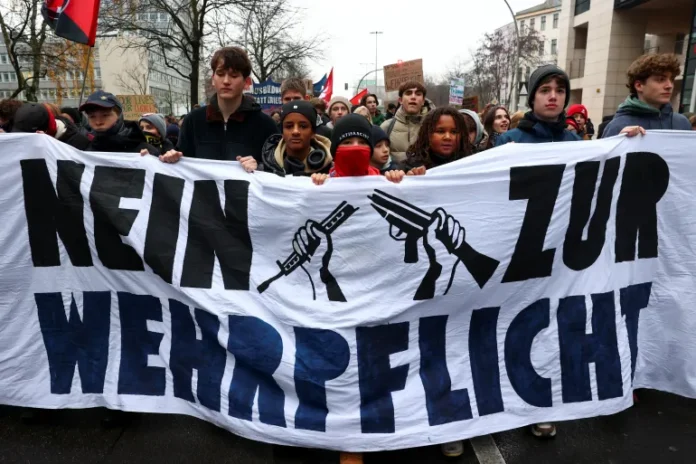
The formation of such a movement is beginning. Tens of thousands of youths went on strike against the return of compulsory military service. The states attempted a voluntary recruitment drive by sending 300.000 letters to young people. Men were legally required to respond. Yet the responses are far from sufficient. By June, only 530 people have committed to voluntary military service.
The generation that is supposed to fill the army’s ranks is the same generation that saw the first live streamed genocide, that fought against climate change with school strikes, that had to learn in an underfunded education system, and that is now asking:
“Why should we serve and potentially die for a country that didn’t do shit for us?”.
“Merz leck Eier” (“Merz, lick balls”), a slogan that has gained traction after a protester was detained and faced criminal proceedings for carrying a sign with that slogan, has become the rallying cry for a whole generation.
This movement is tapping into the massive discontent with the current government of Friedrich Merz. And it is extremely important that it becomes part of a broad opposition to this unpopular government, rather than leaving opposition to the far-right AfD.
So, the bad news is that German militarism is seeing a comeback. The good news is, that resistance is back as well.