


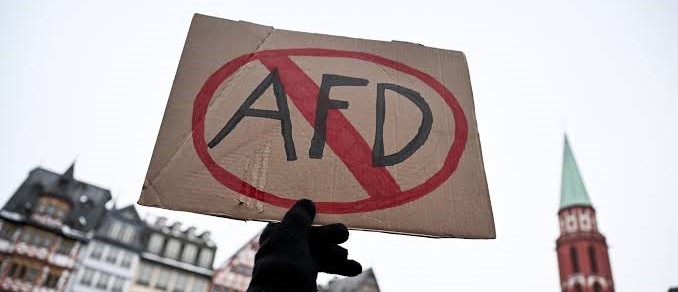
Internationalist Standpoint spoke to Sebastian Rave, spokesperson for the inner party grouping “Anticapitalist Left” (AKL) inside the left party, Die Linke, on the results of last Sunday’s election in Saxony-Anhalt, which gave a landslide to the far-right party Alternative for Germany (AfD).
__________________
- In the state elections in Saxony-Anhalt on Sunday, September 6, the far-right party Alternative for Germany (AfD) emerged victorious, winning nearly 44% of the vote. The mainstream parties and institutions in Germany and the rest of Europe appear to be seriously concerned about this result. And they have been so for quite a number of years. So, why did they fail to stop the rise of AfD? What is behind this electoral success of the far right?
The election result is a historic shock. It’s the sharpest expression of the crisis of bourgeois liberal representation in Germany – for the time being. The rise of the far right to power now seems unstoppable. Over weeks, all talk shows and reports on all channels were full of warnings, but the desired effect was not achieved, quite the contrary: The more commentators were saying how dangerous the AfD is, the more support it got. When the magazine Der Spiegel printed the face of AfD candidate Ulrich Siegmund with the headline “The most dangerous man in Germany” on its cover, he used it as a campaign prop, giving autographs on the issues that fans bought as souvenirs.
It couldn’t be clearer: The driving force behind the AfD is a widespread, massive anger against the political establishment.
The Merz government is hated like no government before, after being in office for only one year and four months. The ruling party’s, CDU politicians in Saxony-Anhalt asked Chancellor Friedrich Merz NOT to come to Saxony-Anhalt to help in the election campaign, as they knew it would further damage their chances.
But the hatred is not just against the CDU (Christian Democrats), but also against its coalition partner, the SPD (Social Democrats), and the former federal coalition partner of the SPD, the Greens. The liberal FDP, which was part of the Saxony-Anhalt state government, has been completely wiped out in the election night.
The anger is completely justified. Saxony-Anhalt is the second poorest state, and has one of the lowest average wages. Public services like transportation or schools are massively underfunded, medical clinics are thinned out. The rural areas in Saxony-Anhalt are a social wasteland.
After so many years of deprivation, it’s only natural that at some point the mood will find an expression. People are so desperate for change, they’ll happily take the most “radical” thing that is on offer. And when the only argument against the AfD is that they’re radical and dangerous, and that you need to vote for the establishment parties so that everything stays as it is, people won’t be convinced forever.
- What are the main positions characteristic of AfD on key issues like: migration, the European Union, Trump, Putin, the economy?
Programatically, the AfD is the party for the rich and middle classes, for owners of pretty homes and big cars. For people that are afraid that their spoiled kids would need to be in the same school class as migrant kids. They want to abolish integrated instruction at schools, which means a return to the segregation of kids with disabilities or language barriers.
They want to lower the taxes for the rich, break the power of the trade unions, defund public media, slash the welfare state and increase military spending.
Obviously, only a small minority would profit from their policies. So, there are constant battles within the AfD over how much of their policy is for show, to sound dangerous and radical, for example when it comes to the European Union.
The radicals in the party want to get out of the EU, but the leadership knows very well that they would not be able to keep that promise if they ever were in power, as the German economy would collapse.
Their social demagogy is another example. They use vile, rabble-rousing propaganda against migrants, to blame them for the poor state of affairs. Instead of class struggle from the bottom against the top, they are calling for a racist struggle against the most powerless, the poorest, the most exploited. Because of the weakness of the Left and the workers movement, this seems like a battle that is easier to win. There are far too many people that actually believe that a good solution against shortages in housing or in social infrastructure would be to deport 20 million people from Germany. Of course that’s absolute insanity, the economy and especially the social infrastructure would completely collapse if the workforce would be slashed like that. The likelihood of the AfD’s “remigration” actually happening is low, as the German industry that they want to serve would not let that happen, but Germany has had its experience with crazy racists losing it… But even if they only use this racist rhetoric as a tool to divert from their class nature, they will make the lives of those that don’t fit into their image of a proper German (white, healthy, heterosexual, productive and proper) more miserable.
- Despite the result, AfD failed to secure an absolute majority, which means it will need to form a coalition in order to govern the state. How likely is this to happen? What will happen if it cannot?
Ulrich Siegmund always stressed that he doesn’t want to govern in a coalition, and that the AfD would rather be in opposition than depend on another party. I think the cadres of the AfD silently know that they won’t be able to fulfill the hopes that are falsely projected onto them when they would govern the state of Saxony-Anhalt. But they absolutely dominate the political landscape now, and all liberal hopes to gather the last remnants of support for the parties of the status quo against the AfD have failed.
In the last few weeks of the election campaign, a lot of money was poured into a liberal campaign for “tactical voting”, hoping that if people could be convinced to get SPD and Greens over the 5% threshold (which they were under in the polls), that there would be a chance to prevent a majority for the AfD.
But even with SPD and the Greens eventually surpassing the 5% (at the expense of Die Linke), it may end up not being enough: BSW, a rightward split from Die Linke, also came in, and might become the kingmaker for the far right. They are tapping into the protest mood by taking over parts of the AfDs rhetoric. It is still very unclear how the election of the Prime Minister will go, as there is no majority for either side. BSW claims it will not vote for an AfD Prime Minister, but who knows what their MPs will do in the secret vote in the parliament. It’s even possible that CDU dissidents secretly vote for the AfD candidate, which would be an open break with the CDU’s policy and would lead to complete chaos in the ruling party. The political earthquake is not over. This could very well be the beginning of the end of the Merz government.
- Saxony-Anhalt is a state in Eastern Germany. Some commentators seem to suggest that the rise of the far right has to do with the experience of the GDR. What do you make of that?
The AfD is dominating the political landscape in the whole of Germany, not just in the east. In all national polls, they are at #1.
But they have clear strongholds: Rural areas, where there are more prejudices than foreigners, and deindustrialized areas, where unemployment, low wages and lack of perspectives are the everyday experience.
Saxony-Anhalt is both. Deindustrialization after the restoration of capitalism in 1990 was particularly severe in the former heart of the GDRs chemical industry. 26% of the population left the state and migrated to the West since 1990, a majority of them young women. Ulrich Siegmund successfully presented himself as a masculine, traditional easterner. For example, he organized a convoy of old GDR “Simson” motorbikes, which drew thousands of men in a bizarre show of force.
Also, Saxony-Anhalt experienced governments of all parties in the last 35 years, with none bringing any positive change. The AfDs mantra, that all the “old parties” are essentially the same (“party cartel”), resonated with the experience of the people.
There are a number of reasons why the AfD first won Saxony-Anhalt in particular, but none of them are exclusive to the federal state or for the east of Germany.
- Are there openly nazi groups within the AfD? How does the party’s leadership handle this?
The AfD is an umbrella party for a large spectrum of the far right. Every few months there is a new scandal involving (“former”) Nazis appearing in the party as employees of MPs or in elected bodies. The last one was about former members of the HDJ (Heimattreue Deutsche Jugend, “German youth loyal to the homeland”), an organisation that was an open copy of the Hitler-Youth (HJ) and was banned in the 1990s.
In the beginning, when scandals like that became public, AfD spokespeople distanced themselves from the past of such members. Now they simply attack the media for slander. The Nazi connections don’t seem to hurt the AfD anymore. That points towards the danger of normalization of far-right ideas. On the other hand, the AfD is still very eager to present itself as democratic, and reject connections to the historical Nazis.
Anyway, the recipe of simply denouncing the AfD as “Fascists” and hoping that this will stop them has utterly failed.
- Why has the party of The Left (Die Linke) failed to grow in this situation? What responsibilities does it have in the rise of the Far Right?
The strength of the right is the weakness of the Left. Even though Die Linke has doubled its membership in one year, it’s still too weak to stop the rise of the right on a larger scale. There are several reasons for that.
First of all, the rise of the right corresponds with the authoritarian development of capitalism in crisis, in which the nation-state plays a bigger role, in which traditional values are stressed, in which isolation is more prevalent than solidarity and so on. The workers movement as a whole is far away from being able to leave a decisive mark on society.
But there are other, more subjective factors as well. Die Linke is an ambivalent force. There are those that are members, because they want to fight for a socialist future. But there are also those that think it’s necessary to build coalitions with SPD and Greens, which they still see as “progressive”, despite the experience of them implementing neoliberal austerity when in government. A majority in Die Linke in Saxony-Anhalt belongs to the latter camp. The candidate of Die Linke, Eva von Angern, didn’t get tired of stressing they would do anything to stop the AfD, including collaborating even with the CDU. That only helped the AfD and proved their point of the “party cartel”.
With Die Linke not portraying itself as completely different from the other liberal and bourgeois parties, but only as gradually more progressive, it is not able to tap into the massive anger that exists. Another problem is the communication of its position on war and militarism. Even though the last national congress took a clear stance against militarisation, parts of the party don’t want to campaign on that, because it is seen as a “complicated” topic, or not as “uniting” as other issues such as housing. That left the space open for the AfD to portray itself as the party in favour of diplomacy instead of aggression towards Russia. Due to a different experience with Russia in the east, in the past, this was an important factor in the strength of the AfD.
- We recently saw mass mobilisations of the youth against militarisation in Germany. What is the response of the antiracist – antifascist movement on the rise of the far right?
For now, the dominant feeling is despair. Leftists and antifascists are shocked that 43,8% voted for an openly racist party. There were spontaneous mobilisations in the larger cities, but it felt more like a retreat into the own scene. Die Linke is making public calls to join them now, which is good, but won’t be enough without a debate on the strategy of the party and how to fight the far-right. The widespread fear of fundamental change to the worse is justified. But we can’t let ourselves be petrified by the danger and despair, but need to understand that large sections of the AfD’s voters can be won over. Just not in defense of the status quo, but by challenging it.