


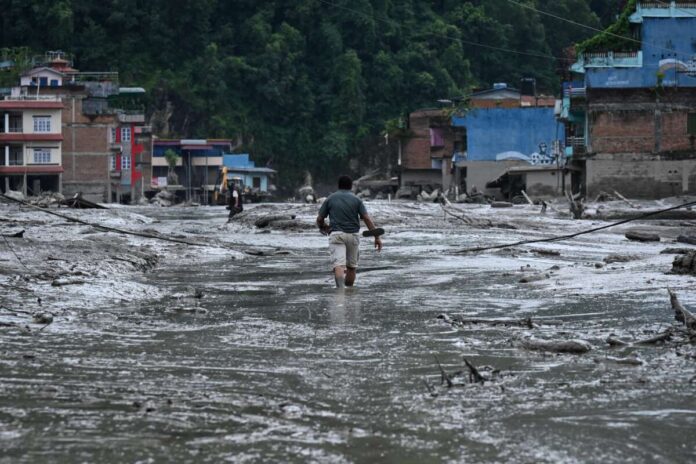
On August 26 a glacier in central Nepal close to the Chinese border collapsed, burying several towns in mud and completely destroying entire villages. At the time of writing at least 1,350 people are dead and 5,000 missing, while many workers are still trapped in the tunnels of several hydroelectric facilities.
It is expected that it will take a long time for the local economy to recover from the serious damage that was caused by the floods. Many of the areas affected are mostly agricultural, where people rely on farming and retail trade to survive. At the same time, as Nepal bases its economy on energy exports (produced primarily from hydroelectric facilities) the future looks bleak for the country’s economy as a whole. If the trend of collapsing glaciers is to continue, this infrastructure, as well as the lives of many of its workers are at permanent risk.
A threat for millions
And the trend is expected to continue. According to the UN official Kanni Wignaraja, in the coming years millions of people in the region could be affected or be at risk from similar events. In 2020, 47 glacial lakes were characterized as potentially dangerous, while today the number is believed to be considerably higher.
Journalist and author Kunda Dixit, in an interview on “Democracy Now” explains that not only the glaciers, but parts of the mountains themselves might be collapsing, since ice from the glaciers that is now melting, had been filling cracks on the rocks that were created due to seismic activity. As a result, when a glacier breaks off, it might take with it entire parts of mountains. It is possible that this was the case in the disaster of August 26: rocks and ice seem to have collapsed together.
According to a study published in “Nature” magazine last year, between 2000 and 2023, the world’s glaciers have on average lost 5% of their ice. The study also mentions that “Glacier mass loss is about 18% larger than the loss from the Greenland Ice Sheet and more than twice that from the Antarctic Ice Sheet”. Before flowing into the sea (where it will contribute to rising sea levels), water from melting glaciers can pass through human communities, causing mass deaths and destruction.
Who pays the price?
Nepal is estimated to produce 0.5% of the world’s CO2 emissions per capita while China produces 9.13%, US 13.59%, Russia 14.06%, Japan 7.79%, Saudi Arabia 17.73%, UAE 19.45% and Qatar 45.33%! Yet, its position on the world map makes Nepal extremely vulnerable to the consequences of the climate crisis. The same applies for countries like Kiribati (0.61% of CO2 emissions per capita), Vanuatu (0.9%), Solomon Islands (0.45%) and other island states of the Pacific Ocean threatened with submersion due to the rising of the sea levels. Or poor African countries, exposed to extreme drought waves and the subsequent famine (Somalia 0.05%), (Chad 0.16%) just to mention a few.
Nepal’s government demands climate compensations from the US, China and India, since they are the countries that contribute the most to greenhouse gas emissions. But despite being amongst the world’s strongest economies (as well as the world’s largest polluters) the rich countries show no intention to help the poorest ones cope with the results of their own policies.
COP promises
COP27, held in Egypt in 2022, established the “Loss and Damage Fund”, in order to address:
“…loss and damage to assist developing countries that are particularly vulnerable to the adverse effects of climate change in responding to economic and non-economic loss and damage associated with the adverse effects of climate change, including extreme weather events and slow onset events”.
The fund was supposed to be ready to start making payments in 2025. In reality, today the fund has almost 250 million dollars, while the pledges made by wealthy countries are close to 1 billion dollars and the requests from poor countries are around 3 billion. This is without counting the amount Nepal will need in order to recover from the disaster, and also to address the dangerous situation developing in the country’s mountains – only the damage made to its hydroelectric infrastructure is estimated close to 2.6 billion dollars.
Regarding the countries that Nepal is asking compensation from, China hasn’t made any pledge to the fund, claiming that it is directly assisting poor countries by investing in their infrastructure. India is itself considered an environmentally vulnerable country, which means that it is more likely to receive assistance, rather than paying compensation. As for the US, it has withdrawn from the fund, as well as from the agreements made by the UN summits regarding climate, ever since Donald Trump came to power.
Hypocrisy
But was anyone expecting these institutions to solve the problem? The recent history of climate summits is a history of hypocrisy. The summits provide an opportunity for governments from around the world and fossil fuel companies to meet to make deals on how they will continue to extract and burn hydrocarbons, trade carbon emissions and pretend to take measures for tackling climate change. In reality, the only force that can put an end to this disastrous course of action is the organized power of the workers, the poor, and the oppressed of the world. It is an urgent necessity, on an international level, to fight for:
- Immediate compensation to poor countries for damages related to the climate change, as well as prevention measures to minimise the future results – massively funded by the world’s strongest economies.
- Massive public investment in research on renewable energy sources, and the immediate implementation of a plan to utilize them in order to end dependence on fossil fuels as a matter of urgency.
- The energy multinationals must be brought under public ownership, with workers’ control and management, as part of socialist planning on a national and international level.