


By Flavia Rovella, Bilbao
“As long as the capitalist mode of production continues to exist, it is folly to hope for an isolated solution of the housing question or of any other social question affecting the fate of the workers.”
— Friedrich Engels, The Housing Question (1872)
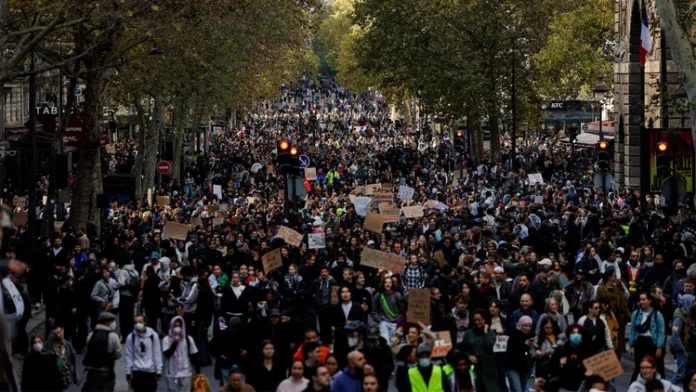
This autumn, protests have spread across Europe. The housing problem is generalized, it’s all over Europe, it’s international. Therefore it is not a matter of this or that government’s policies, it’s is a structural problem of the capitalist system – as Engels accurately explained one and a half centuries ago!
A problem is structural when it comes from how the system is built, not from who governs. The fact is that basic rights, such as housing and public education, get in the way of a system that wants to turn every need into a product bought and sold, in order to make profit. Therefore, what we see is not a failure of the system – it’s how it works.
Housing shows this clearly. The Universal Declaration of Human Rights, adopted by the United Nations in 1948, says that everyone has the right to an adequate standard of living, including housing (Article 25), and the right to education (Article 26).
Nearly eighty years later, these promises are far from met. Spain’s Constitution lists housing (Article 47) as a guiding principle, not as a right that courts enforce directly. In nearly all other countries too, housing is treated as an asset to buy and sell, not as a right to be guaranteed; and housing is becoming a financial product.
France and Spain
In France, secondary-school students began to protest on 17 September. The decline of public schools, sorting by class and race, and worsening living conditions have sparked the youth revolt which has the support of parents and trade unions.
In Spain, Maricarmen Abascal, 87, was evicted from her Madrid home on 23 September. She died in hospital on 7 October. Mass protests followed, and camps rose in the Puerta del Sol.
Housing and education were the headline demands, but they were not the only ones. In France, the students’ demands went beyond public schools to include housing, living conditions and a political system that seems closed to change.
Mass mobilizations were met with a violent response by the state. According to the French Justice Ministry itself, around 7,000 people were held in police custody, 86% of them minors.
In Spain, the two housing decrees were voted down by the right and far right, on 2 October. Three days later the prime minister Pedro Sanchez called an election for 29 November. Meanwhile the Sindicato de Inquilinas (tenants’ union) keeps up its protests.
Bilbao: protest turns into a spiral
On 26 October in Bilbao, protesters marched against an event by Vito Quiles, a far-right influencer, at the University of Deusto. Quiles cancelled at 4 pm and the campus was closed, but that evening hooded groups burned containers, at least six cars and a police motorcycle, and some shops were looted. There were 19 arrests, seven of them minors (Orain).
The violence split opinion on the left. The warning from some groups of the leftist movements was clear: anger without organisation follows a cycle of riot, repression and the next riot. The cost falls on young people, and the far right gains an excuse.
Belfast and Milan
According to the Italian magazine Codice Rosso (republished by Ant/agón on 25 October – “The Milan expropriations, the Belfast riots, hybrid war and the new class composition”), in Belfast in June, an organised effort came before the street. Networks of fake accounts and AI avatars helped turn a stabbing into anti-immigrant riots.
In Belfast, the anger of a deindustrialised working class was pointed at an ethnic enemy.
In Milan in October, it went the other way.
A cost-of-living march was called by a small, non-party network that had existed for 13 days. Masked youths took over the march, and clashes followed. Of 271 people taken to the police station, 220 were minors, and many were the children of migrants.
Italy’s defence minister called it “hybrid war” and blamed foreign influence. The fact is, the anger came from below: the city turned against its own poor young people – and they rebelled and established solidarity across ethnic lines. The real “hybrid war” is internal, not a result of foreign intervention.
Technology can be used to achieve contradictory aims, but it is not all-powerful. It works when it catches on real, material anger. Schools, like homes, are part of the same question: is there a future here?
What follows
If the problem is structural, as it is, it will not end with one decree, one election or one tough week of policing. Housing and education must be treated as rights, not as goods for sale.
This is where the left and the right part ways. The right treats housing, education and health as businesses: things to privatise, sell and speculate on. And it needs a story to justify this. So, it uses hatred of migrants. It tells people that they must be protected from foreigners who take their jobs and homes – and the question of who profits from rents and privatisation disappears. We saw this in the attacks on Maricarmen herself.
The left fights to establish different values in society: social needs must be respected, solidarity is crucial, the enemy is capitalism and its state. But how is this fight to be conducted?
In the past years and decades, we saw tremendous movements, such as the anti-globalisation movement, the Occupy movement, the Arab Spring, 15M (the Indignados Movement), 2019 with tens of revolutionary explosions across the planet, the Gen Z of last year, etc. But these movements were unable to break the gordian knot of a system that is based on greed and profit.
To avoid the same fate, movements need to spread, as they are, from country to country, and at the same time be better organized and with clear aims.
Movements need internal democracy, through structures that allow the grass roots to discuss and decide: otherwise they will be hijacked by political parties or individuals, serving their own interests, leading to compromises and sell outs.
And they need to aim at the root cause of the problems that mobilize the millions, as we have seen: the capitalist system itself.
Sources
- Carlos Prieto del Campo, Hipótesis para radicalizar las luchas antisistémicas… (I), Ant/agón, 10 October 2026
- Codice Rosso, Las expropiaciones de Milán, los disturbios de Belfast…, Ant/agón, 25 October 2026
- Las marchas contra Vito Quiles terminan con incidentes…, Orain, 26 October 2026
- Vito Quiles, Wikipedia
- Autunno caldo… scioperi venerdì 30 ottobre e 20 novembre, Tecnica della Scuola
- Muere Maricarmen dos semanas después de su desahucio, El Salto
- Sánchez baraja adelantar las elecciones tras el no de Junts a los decretos de vivienda, Euronews, 2 October 2026