


Alan Jones
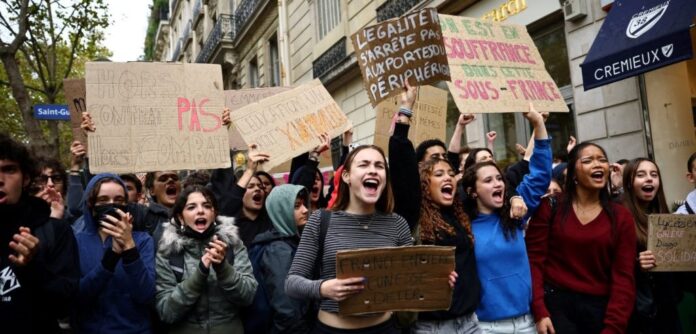
A rebellion has erupted among French young people and students. They are facing worsening educational conditions, massive repression and decline in living standards. The high school students have initiated massive protests and a school shut down across the country. On October 8th, tens of thousands gathered at the Place de la Bastille in Paris and over 300,000 were engaged in protests across the country. The student revolt started through school occupations and street blockades by the student assemblies. Students are faced with overcrowded classrooms because of teacher layoffs, the lack of facilities, and the worsening conditions of the schools with regard to heat and freezing weather. Now students are also demanding an end to police violence against student protestors.
It is significant to note that in the last weeks similar anti-government revolts of young people have erupted in at least eight countries protesting underfunded schools, housing shortages and increasingly authoritarian government and police repression. Aside from France, mass protests have erupted in Spain, Brazil, India, Belgium, Equador, Chile and most recently Albania.
In France, the spontaneous protests and blockades are multiplying around high schools, led by the students themselves, reflecting the anger that has built up over years of institutional violence, economic austerity, and deteriorating living conditions.
The Macron government response to demands for decent learning conditions and an end to social exclusion against Muslim students, has been to unleash a brutal and unprecedented crackdown, with the riot police attacking campuses, firing tear gas, carrying out thousands of arrests in aneffort to intimidate the rebelling youth. More than 5,000 arrests have been recorded since the protests began, and four students have suffered serious injuries during the crackdown.
While still in the early stages, the student movement has called for coordinated action between workers and the union movement as well as college students: in support of the blockades, the release of those detained and the dropping of criminal charges. October 17 has been set as a follow up date for joint solidarity strike actions and student protests across France.
Poverty wages, and declining living conditions
The economic crisis has hit working-class households hard. Working-class families have seen their living standards decline in recent years, with an estimated loss of about 1,200 euros per year since 2024. This is mainly due to the cumulative effects of inflation: although the rate of price increases has been slightly less than 2022 and 2023, prices for essential goods and services -food, energy, and housing- remain very high. At the same time, social benefits and wages have not increased at the same rate. Rents, mortgage payments, electricity, fuel, and insurance continued to increase, hitting hard low-income and middle-income families who have less resources to cope with the rising cost of living.
Working conditions are continuing to deteriorate with increasing exploitation in both the public and private sectors—workforces are being cut, forcing workers to work longer hours under the pretext of a kind of “flexibility” that is nothing short of open threats to job security. Workers now face a longer working life in order to secure a decent retirement. The 2027 budget presented by the government of Macron has confirmed the freezing of the civil servants’ salary index for the fourth consecutive year, thereby forcing workers to continue to bear the cost of the deficits and increasing militarization. These developments have triggered angry spontaneous mobilizations, organised on social media, similar to those in 2025. Interestingly, the current protests are increasingly referencing the historic revolt of the ‘Yellow Vests’’ struggle against the policies of Macron and calling for demonstrations throughout France on October 17.
Uniting Struggle is the Way Forward
For the students to win their demands it is critical to unite with the unions and the working class to fight for the immediate release of those detained, in support of the blockades and solidarity mobilizations alongside striking workers.
Early October saw strike actions led by transportation workers -both at the SNCF and the RATP- and there was also a civil servants’ strike on September 29, which mobilized more than 300,000 people nationwide to demand pay raises. To these important actions should be added the half a million people who turned out for the Pride march on October 3rd, to oppose the far right. The protests of recent weeks show that the will to fight is re, but this should not remain in isolated actions and symbolic 24-hour strikes called sporadically by the various unions which are clearly insufficient to force the bosses’ government to back down. If the workers and student movements do not together win a victory a dangerous turn is possible as France is a few months away from a national election in which the far right might emerge as a serious threat to the workers movement and democratic rights.
We must unify and coordinate the struggles from the grassroots up, by organizing general assemblies in every school, every college, and every workplace. France, at the heart of Europe, can inspire an explosive movement against austerity, militarization, and the threat of the far right, and challenge the rule of decaying capitalism.