

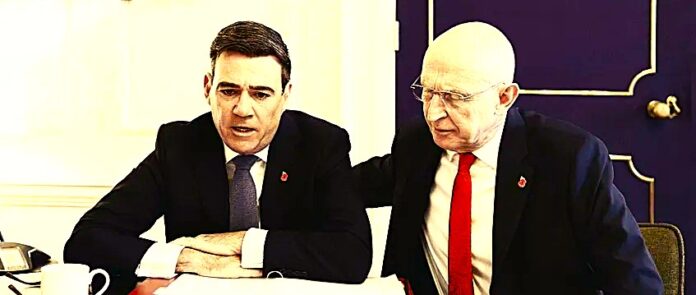
The first UK Budget from the new Burnham government and his Chancellor, John Healey has landed. The claims from Burnham that his government would signal the most radical shift in politics for forty years has been tested. If this is a mock exam for some kind of longer series of tests then Burnham has failed the first paper.
The budget tinkers around at the edges of the economy but offers no hint at a fundamental shift in content from the Starmer government. There is a clear message from The Chancellor that austerity is here to stay. Replying to a question from the BBC, John Healey said, “I do want to be honest with people, government can never remove completely the cost-of-living pressures that people feel – we can help where we can and that’s what I’m doing”. Two decades of austerity cannot be accepted and the reason these pressures cannot be removed is because this government is not prepared to make the radical changes to the ownership of the economy, taxation and investment that would produce the means of countering the austerity narrative. Professor Jonanthan Haskel from the Office for Budget responsibility, said, “…if the government keeps the commitments it has made in defence, education and health, there could be a cut by 2.6% in other government departments”. Healey also said that welfare spending would be reduced beginning with his next budget in the Spring of 2027. He will therefore aim for cuts from those least able to survive them in order to satisfy corporate greed and the contempt they hold for ordinary people of limited means.
Both the Institute for Fiscal Studies IFS and the Office for Budget Responsibility OBR seem quite happy with the budget, a worrying sign for those who hoped for some kind of significant reform. Helen Miller, Director of the IFS said, “The government has chosen a “relatively broad” package where they could have chosen to focus on lower income households, adding: “That is just a political choice”. In other words, they have neglected the poor, in favour of The City of London (an international financial centre).
In a summary of the main consequences of the budget for UK households, the Resolution Foundation (a left of centre think-tank) concluded that: energy bills will increase, and that the money allocated to support those struggling to cope with increases in the cost of living will benefit richer and poorer household almost equally, when it is the poor that needs most help.
There are one or two crumbs of comfort for ordinary people and the ending of the standing charge on energy bills will, on average, help people in smaller houses and ensure that people only pay for the energy they use, without an additional fixed cost. There are slight increases in wealth taxes (+2%). There is also a time-limited (15 months) increase of the surcharge banks pay on profits from 3% to 6% – a kind of “donation”, to attempt to help the Burnham government maintain its current level of relative popularity. The Bond Markets hold the key. The cost of government borrowing continues to rise and what is given to the Burnham government with one hand is taken back with the other.
Burnham has no answer. All he can promise -through his Chancellor- is more of the same and try to persuade us that he is a nicer chap than the seemingly sociopathic Starmer. Good intentions do not persuade the markets. The markets remain in control and the elite maintains its dominant role. A long-term commitment to increasing military spending and a ratcheting up of war rhetoric shows that it will be the poor that pays for the wars as well as suffers as a result of them. Recently Burnham has talked about existential threats to Britain’s “national security” and has been encouraging citizens to stock up with key products, including water, in case of national emergencies. Even during the bombing of the UK in the Second World War, water shortages were not a significant issue. Why then now, has the government lost such control of the private sector that there appears to be a threat today?
The unions have remained pretty silent during Burnham’s honeymoon period. There will be a discussion by the Trades Union Council Executive Committee on a motion proposed by the PCS (civil service union) and passed by the annual TUC Congress to organise a union-led weekend anti austerity demonstration. Whether this is supported remains to be seen but the big unions have provided cover for Labour and look set to continue to do so. Trade unions which are not affiliated to the Labour Party such as the NEU (teachers), PCS, UCU (lecturers), NAPO (probation officers) etc are beginning to develop strategies for on-going struggles as attacks on pensions begin. It is clear that pensions are in-line for plunder by the government. This is a back-handed and less obvious attack on living standards and Burnham hopes he can disguise the extent of its effect on ordinary people and therefore avoid a major revolt. This is a risky strategy. The groups most affected are the most unionised and quite capable of sustaining serious industrial action.
A weekend union funded demonstration would be welcome as long as Labour government apologists are kept out of the process of organising it and the rank-and-file is allowed to take the responsibility as it has done so ably in the past. The unions should sponsor coaches but not determine the political content of such an event.
Unlike across other parts of Europe and Asia, students and workers are not in revolt in the UK. However, the economic and social issues are similar and the approaches of capitalist governments to them are consistent. It is important therefore that trade unions, youth organisations and community groups broaden the struggle against the far-right into a struggle against austerity. As part of this, new and existing Left groups need to get together in a conference of the Left to outline a political strategy and begin to develop tactics.