

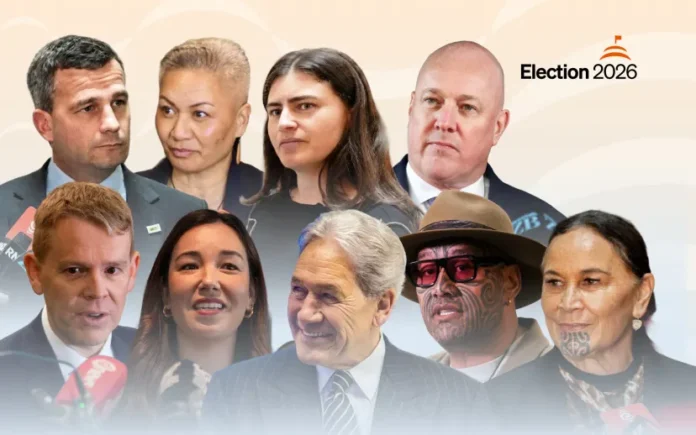
Support for the two capitalist parties that have dominated New Zealand politics for most of the past century collapsed in the General Election on November 7th. The National Party, the traditional right-wing party, received 29 percent, down from 38 percent at the last election in 2023, while the Labour Party received 29 percent, only marginally up from 2023 when it gained 27%. The combined vote for the two parties is less than 59 percent, the lowest ever. A record 40% voted for a range of smaller parties. Turnout was 75% of enrolled voters, the second lowest ever. Given that 6 percent of eligible voters did not enrol the real turnout was only 70 percent.
The final result will not be known until Nov 27th (400,000 “special” votes were cast overseas, or by people voting outside their electorate, and are not yet counted). It is projected that the National Party will end up on 42 seats against Labour on 36. National and Labour will each strive to form a coalition government with the other smaller parties: the Green Party with 16 seats, ACT on 13, New Zealand First on 12, the Opportunity Party on 7 and Te Pāti Māori, on 5.
National-led Coalition Most Likely Outcome
The National Party led the last government, a right-wing coalition government which imposed austerity measures, cut thousands of jobs across the public sector, increased student fees, reduced benefits for young people, and imposed real wage cuts on teachers and healthcare workers.
Despite its record a coalition of the National Party and its far-right allies, ACT and NZ First, with a projected 67 out of 131 seats in parliament, is the most likely outcome this time around. The ACT Party which proposes major cuts in public spending and a three-year freeze in the minimum wage, increased its vote share from 8.6 percent in 2023 to 10.9 percent. The right-populist NZ First Party increased its vote from 6.08% to 9.78 percent.
Whilst a right-wing coalition may well be the final outcome of the election this is despite a fall in the combined support for the outgoing coalition partners: the total National, ACT and NZ First vote has fallen from 52.7 percent three years ago to 49.9 percent. The total right vote would have fallen further except for the intervention of New Zealand’s richest family-the Mowbray family-which ran a campaign encouraging right-wing voters to “split your vote” by voting for National’s individual candidates and then giving their party vote to ACT or NZ First.
Labour Party Move Further Right
A Labour-led coalition is not ruled out now but will require at least four parties. That it will be a coalition of cuts has already been signalled when on the night of the election Labour leader Chris Hipkins declared that the results “require all of us to compromise, to work together and to find a common ground.” The Labour Party offered no opposition to austerity when in opposition and in effect has promised to continue cutting spending if it gains power. There were national strikes by university and polytechnic workers, retail workers, firefighters and public servants in late 2025-the peak came in October 2025 when 100,000 teachers and healthcare workers went on strike. The Labour Party worked with the union leadership to re-direct anger and told workers to place their hopes on the election. Labour and National are also in agreement over a plan to double New Zealand’s military budget. The last Labour-led government was in power from 2017 to 2023. The Green Party was in coalition with Labour across all 6 years, and NZ First for the first three. During its period in power social inequality, homelessness and child poverty increased.
The most obvious Labour partner if it is to return to government is the Green Party which received 13.3 percent, its best vote ever. The Greens’ campaign used left phraseology, attacking the “super-rich”, but in practice proposes very modest measures such a wealth tax. Even this modest proposal will be ditched if it joins the coalition-in the 2017-2023 government the Greens supported the austerity budgets put forward by Labour.
A new formation, The Opportunity Party (TOP) won 5.96 percent and 7 seats. TOP is a pro-business party, funded by multimillionaire tech “entrepreneurs”. It stated before the election that it was open to joining either a National- or Labour-led coalition-a clear illustration that the business class see National and Labour as options, and fear neither. TOP could well be the party which ultimately decides who will lead the next government.
The Māori nationalist party, Te Pāti Māori (TPM), won 5 of the 7 special Māori electorate seats (Labour candidates won the other two), a drop of one. TMP has indicated that it would prefer to enter a Labour-led coalition government, but it was part of a National-led coalition from 2008 to 2017 and will enter such an arrangement again if it is in the interests of the Māori bourgeois and petit-bourgeois layers it represents.
“The Alliance Party” Returns
There was no credible left alternative on the ballot for most workers. The election was notable however for the return of the Alliance Party, a formation which has not stood in elections since 2015, but which put up candidates in a dozen seats. Alliance claims that “its origins [are] in the left of the labour movement, the Alliance Party remains an unbroken link to the founding of the New Zealand Socialist Party in 1901, a legacy we claim with pride”. Its political journey is much more complicated than this statement implies, however.
Its origins lie in the 1989 split from Labour to form the “New Labour Party” in opposition to the neoliberal economic attacks on working people popularly termed “Rogernomics” (after the Labour Finance Minister Roger Douglas). In the 1980s New Zealand (NZ) Labour imposed harsh monetarist policies which were to the right of Margaret Thatcher’s government in Britain and the Reagan administration in the US in important ways. The actions of NZ Labour was an early warning sign of what was to come as labour, social democratic and communist patties across the advanced capitalist countries threw off any pretence of defending working people and capitulated fully to neoliberalism in the 1990s.
Events in NZ also fore-shadowed the later attempts to form new mass parties to the left of the old workers parties, from the Arthur Scargill-led split from New Labour in Britian, to form the Socialist Labour Party in the 1990s, to the formation of Syriza, Podemos and the Left Party in Germany in this century. The New Labour Party initially attracted a layer of left activists and was met with enthusiasm from many workers, sick of years of attacks on their wages and conditions. It moved to the right quickly however, expelling members of several left groups which had entered its ranks. And under its leader Jim Anderton (a charismatic figure who was opposed to the worst excesses of neoliberalism but who himself owned a small factory) moved to adopt positions which were acceptable to the ruling class.
The NLP formed a coalition in 1991 with three other parties-the Green Party of Aotearoa/New Zealand, Mana Motuhake and the Democrats-and created the first version of the “Alliance”. The Liberal Party, formed by two former National MPs, joined the Alliance in June 1992. In the 1993 general election, under a first-past-the-post system, the Alliance won 18.2% of the popular vote but only two seats. In New Zealand’s first MMP (mixed member proportional system) election, the Alliance won 10.1% of the vote and 13 seats, becoming the third-largest party in Parliament. The Green Party left the Alliance in 1997 and went on to contest elections in under its own name.
Previous Betrayals
In 1999–2002 the Alliance entered a coalition government with Labour, with leader Jim Anderton serving as Deputy Prime Minister. It claims today that its “key achievements included the establishment of Kiwibank [a publicly owned bank], returning banking to public ownership, and the introduction of Paid Parental Leave, both lasting legacies that continue to benefit New Zealanders”. In 2002 Alliance split over New Zealand’s involvement in the Afghanistan war. Most Alliance members opposed the deployment of NZ military, but Jim Anderton supported it and split the party taking several MPs to form the Progressive Party. The Alliance contested the 2002 election but did not win any seats.
Alliance fell into a period of declining activity and in 2015 was deregistered as a party for elections but not dissolved. Its website states however that “the ideas, the networks, and the need for a genuine left alternative never went away” and this year the Alliance Party (AP) re-emerged as an electoral party.
It stood in a dozen seats but gained 1500 votes in total. Party Leader Victor Billot argues that while the Alliance received a small number of party votes, the party achieved its primary goal of getting back on the field and running a credible campaign. he argued that “driven by a desire to get the Coalition out, most voters went for the ‘less bad’ option in what was a negative election defined by low expectations”, an argument with some validity.
Some of the language of Alliance in 2026 is radical, and even anti-capitalist “No matter what arrangement emerges from the negotiations, the problem is bigger than any one Government. It is the entire system that has to be changed, as the current one is destroying economic security for the working class, undermining our national resilience, and wrecking the planet.” The programme of Alliance includes demands “for full employment, job security, comprehensive tax justice including a wealth tax, free healthcare and education, state housing, and the return of essential assets like power, water, and transport to public ownership”. Its constitutional objectives include “the democratic socialist principles of democracy, equality, and social ownership.”
Alliance states that it is building for the long term and will continue to organise outside Parliament, alongside unions and community campaigns. In an important step the Maritime Union of New Zealand (MUNZ) has affiliated to the AP after a decision formalised by the MUNZ National Council on 3rd June. Under the new agreement, MUNZ will take up a formal affiliation, including a voting position on the Alliance Party National Council. Again, Victor Billot used class language in describing the affiliation as “a massive step forward for working-class politics in New Zealand.”
The Maritime Union is keeping options open however and will maintain its long-standing affiliation to the Labour Party. A strong class message is diluted by Alliance’s seeming openness to working with others: “This affiliation [to Labour as well as Alliance] is an acknowledgement of the MMP environment, and the Alliance is committed to working with other opposition parties to remove the Coalition Government.”
The Way Forward: for a mass Party of the Working Class
Despair and alienation are the lot of many working-class people in New Zealand. More than one in five children lives in poverty, one in 10 people rely on food banks, and 112,000 people are “severely housing deprived.” More than half of the country no longer sees New Zealand as “a land of opportunity”, according to an annual social cohesion survey. Record numbers have been emigrating, often to Australia.
The recent upsurge in industrial struggle, the low turnout in the election, and the votes the Green Party gained as a result of its left veneer, all indicate that there is a political vacuum in society-a gap that an anti-austerity, and pro-working-class party can fill. The New Zealand workers’ movement has a proud history-in 1935 it formed a majority government and introduced significant reforms in education health and housing, many years before such developments in other comparable countries.
The period ahead is likely to one of turmoil with a weak government unable to tackle any of the social and economic problems faced by the working class. A new mass party of the working class is required. The stand taken by the Alliance Party is important, despite its modest vote. It may succeed in growing its vote in future elections, especially given its commitment to campaigning outside elections. If it can convince working class voters that its words have meaning it could be part of the future creation of the party that is needed.