


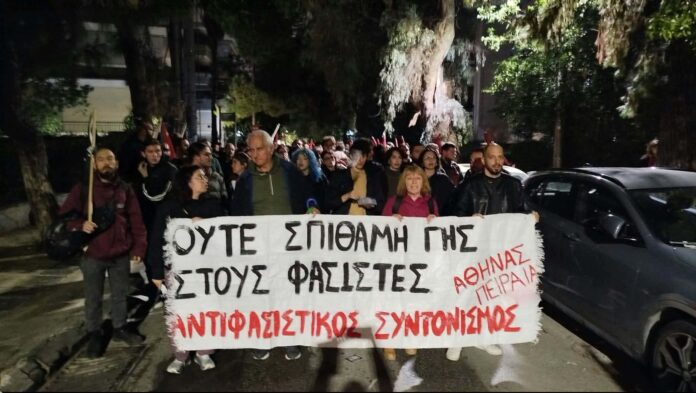
On October 8, 2026, in Elefsina (an industrial suburb west of Athens), an anti-fascist activist was attacked outside his home by two fascists, who stabbed him several times on the legs. The attack which could have cost him his life (he spent several days in the hospital and had to undergo surgery) was yet another warning that the fascists in Greece are back on the streets.
In an immediate response, on October 10 approximately 2,000 people took part in a massive and militant anti-fascist march in Elefsina. The rapid mobilization showed that there is both the will and the capacity to mount a collective response to fascist attacks. What is needed from now on, is to transform such reactions into a sustained, organized, and mass anti-fascist movement, especially in a period with increased racist and fascist violence.
Fascist attacks increase while the police tries to cover them up
Just a few days after the attack in Elefsina, an 18 year old school student from Egypt was also attacked and stabbed in the center of Athens. He was hospitalized for days and underwent lung surgery. While the police’s first response was to say that the racist motive is not being investigated, nearly a month later it became known that during the attack the student was subjected to racist insults – indicating exactly the opposite of what the police is claiming. The Omonia Police Station, which is handling the case, has a troubled history, as it has for years been linked to serious allegations of abuse, torture, and the deaths of people (mainly immigrants) in police custody.
In the case of Elefsina as well, the police initially announced that they were investigating the possibility of a robbery. Shortly after, the perpetrators were identified, had to turn themselves in, and it became clear that they belonged to a neo-fascist organization, while various types of weapons, as well as nationalist leaflets, were discovered in their homes.
To prove once again their friendliness for every kind of nationalist and fascist groups, on October 28th (a day linked to the antifascist struggle of the Greek people against the invasion of fascist Italy in 1940) the police attacked antifascists in Thessaloniki, the second largest city. They were protesting against the provocative presence and speech of the recently released from prison Ilias Kasidiaris, a former leader of Golden Dawn, convicted for directing a criminal organization.
On November 3 in Patra, the third largest city of Greece, dozens of neofascists attacked a school student, member of the Communist Party Youth, outside her house, seriously injuring some of the people who rushed to help her. The police arrested both the attackers and those who were trying to help the student, and spoke about a “clash” between groups, equating fascists with anti-fascists.
Golden Dawn has not disappeared
Golden Dawn is the neo-Nazi party that entered Parliament in 2012 and its leadership was convicted and jailed for several years for “directing a criminal organization” after the murder of Pavlos Fyssas (an anti-fascist rapper murdered in 2013 by GD members).
Their criminal actions, that led to their conviction in October 2020 in a landmark court ruling, included a huge number of attacks on immigrants, trade unionists, and anti-fascists.
This court ruling was a historic victory for the anti-fascist movement. However, it did not mean that the ideas, networks, and people fueling fascist activity had disappeared. In recent years, neo-fascist groups have been attempting to regroup, regain a presence in the public sphere, and recruit school students and young people. Golden Dawn and other neo-fascist groups are trying to seize every opportunity to make a comeback.
The global rise of the far right is creating a space for fascists
The effort to rebuild Golden Dawn and other neo-fascist groups is developing in a period of far-right parties gaining ground internationally, promoting nationalism, racism, anti-immigrant rhetoric and authoritarianism as supposed solutions to social problems.
The targeting of immigrants and refugees is presented as a normal political option, while authoritarian practices and attacks on rights are legitimized in the name of security and order. In this environment, fascist groups feel they are gaining more room to operate, recruit young people, and reemerge as a supposedly “anti-establishment” force.
Schools in the Crosshairs
One of the main areas where neo-fascist organizations are attempting to reemerge is schools.
According to the Anti-Fascist Education Network (a nationwide network of high school teachers and parents formed in 2026 to document and expose fascist activity in schools) from April 2025 to February 2026, 20 fascist incidents were recorded in schools across 13 neighbourhoods of Athens. By October 2026, the number of recorded incidents had risen to 35, indicating that the phenomenon is escalating. Golden Dawn itself highlights such actions on its website to demonstrate that it maintains a presence and organizational activity.
These actions are an attempt to present fascist ideas as normal, to intimidate those who resist, and to create organized cells within the youth. Fascists are attempting to exploit the frustration and anger of young people by cloaking racism and authoritarianism in a false anti-establishment guise.
Kasidiaris with a New Facade
The effort by Ilias Kasidiaris to return to the political scene following his release from prison in September 2026 is part of this same trend. For years, Kasidiaris was a member of Golden Dawn’s leadership and one of those who trained its assault squads. His involvement in the leadership of the criminal organization was documented during the trial that resulted in the conviction of the party’s leadership.
His violent past includes a physical attack on a female Communist Party MP during a live television broadcast, as well as the orchestrating of a racist pogrom in Athens during which an immigrant from Bangladesh was killed and more than 100 others were injured. During the Golden Dawn trial, photographic evidence was presented in which Kasidiaris is depicted with Nazi symbols and Wehrmacht flags, giving the Nazi salute, and participating in military-style training sessions with Golden Dawn members.
Through his new party, the Alliance of Greeks, Kasidiaris is now attempting to present a more carefully crafted political profile. He is trying to present himself and his new party as a force that clashes with the system, while in reality they identify with its most reactionary characteristics. For example, Kasidiaris is proposing the establishment of a Greek version of the U.S. Immigration and Customs Enforcement (ICE) agency, which he calls the “Invasion Response Service”. At the same time he is trying to distance himself from Golden Dawn’s violent past, even though he was part of its inner circle.
The new packaging does not negate the political substance of his platform. The attempt to combine nationalism and authoritarianism with certain people-friendly economic announcements against high prices and austerity policies, does not alter the nature of his policies. It only shows how the far right is trying to exploit discontent over the high cost of living, low wages, and the deterioration of public services, without challenging the social relations that give rise to these problems.
We Need an Organized Anti-Fascist Response
In the face of this situation, piecemeal reactions following each attack are not enough. We need a steady, mass, and unifying anti-fascist movement, organized where people live, study, and work.
We need to establish anti-fascist committees in schools, neighborhoods, colleges, and workplaces. These committees must be open and democratic, bringing together students, teachers, parents, college students, labor unions, local associations, immigrant communities, anti-fascist and left-wing organizations, as well as anyone who wants to resist the rising of fascist groups.
They should organize informative campaigns, at the same time as being able to defend themselves, exposing the true nature of the neo-fascists’ political positions, and carry out systematic outreach in neighborhoods and schools, as well as organize public discussions, film screenings, festivals etc.
Local initiatives must coordinate with one another and link up with broader mobilizations. Mass participation, unity in action, and a consistent presence within society are essential prerequisites for isolating the fascists and preventing them from reestablishing their presence.
The fight against Golden Dawn and neo-fascist groups cannot be confined to Greece’s borders. The rise of the far right is an international phenomenon and requires an internationalist response. The Left and the anti-fascist movement must combine united and militant action in the streets with a comprehensive political proposal. This means waging a daily struggle against far-right rhetoric and practices in every country, as well as coordinated pan-European and international actions.
For the struggle against fascism to be effective, it must be linked to the fight for decent wages, affordable housing, public health, and education, and it must boldly and decisively put forward a radical plan to overcome the protracted crisis of the capitalist system, in the interests of workers and youth, against a system that itself fosters and cultivates divisions and hatred—that is, the very ground on which fascist forces thrive.