


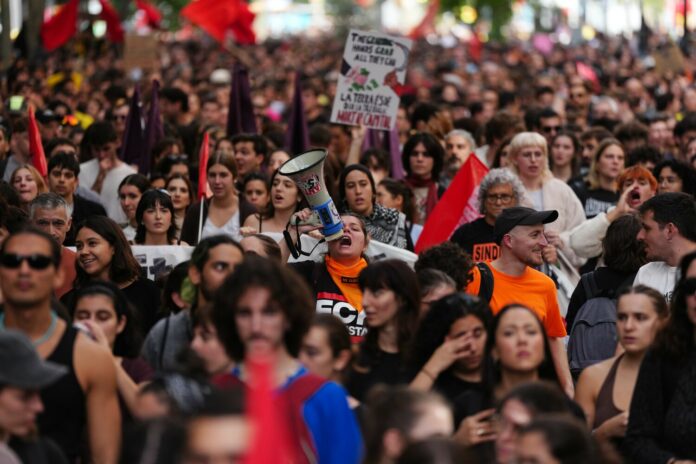
Flavia Rovella, Bilbao
“The mass strike is not artificially ‘made,’ not ‘decided’ at random, not ‘propagated,’ but a historical phenomenon which, at a given moment, results from social conditions with historical inevitability.”
— Rosa Luxemburg, The Mass Strike, 1906
“Ahora hacemos una huelga general, pero tendremos que escalar la presión.”
(“Now we are holding a general strike, but we will have to escalate the pressure.”)
— Alicia del Río, Sindicato de Inquilinas de Madrid, in an interview with El Salto, 9 November 2026
On 11 November, millions of workers joined Spain’s first general strike in 14 years, leading to widespread disruption and evening unrest across the country.
Hundreds of thousands took to the streets (see below), with the “official” numbers given by the police grossly underestimating the magnitude of the mobilizations. Once again the police used foam bullets, tear gas and pepper spray, and the authorities reported dozens of arrests.
The strike was backed by the UGT and CCOO national Trade Union Federations, and by the tenants’ associations, angry at rents that have almost doubled in a decade.
It followed weeks of protest after the eviction and death of Maricarmen Abascal, 87, and parliament’s rejection last month of government decrees on evictions and rents, which led Prime Minister Pedro Sánchez to call the 29 November election.
“Salarios, vivienda y precios”
That is a different scenario from the usual one, in which the unions plan the strike and the movements join it. It was the first 24-hour general strike backed by CCOO and UGT since 2012, under the slogan “salarios, vivienda y precios” – wages, housing and prices.
Rather than a typical top-down labor strike planned exclusively by the union leadership with social movements joining later, this specific mobilization was heavily co-pushed and rooted in housing activism, notably the Sindicato de Inquilinas and broader tenant/housing movements, making housing rights a central axis of a general strike for the first time.
Massive demonstrations took place across the country:
- Madrid: 120,000 according to the government delegation. The tenants’ union gave a figure that grew through the evening, from 400,000 to 600,000 and then 750,000.
- Barcelona: 400,000 according to the tenants’ union in Catalonia; 55,000 according to officials (Sky News, El Correo).
- Bilbao: about 50,000 according to the municipal police. For a city of roughly 350,000 people, that is a very strong turnout..
There were clashes in several places. In Madrid, CCOO says 13 people were treated after police used pepper spray on pickets at Mercamadrid, and unions report at least eight injured in a charge at the bus depots. In Barcelona, protesters blocked Sants station and the AP-7 motorway near Girona. In the Basque Country there were 16 arrests and nine Ertzaintza officers hurt; in Bilbao’s old town about 100 picketers attacked open shops. Charges or arrests were also reported in Valladolid, Málaga, Granada and Toledo. In the evening the Madrid march was cut short by police charges and gas near Plaza de España, and in Barcelona hooded groups burned containers and smashed shops on Passeig de Gràcia after the march. In Vigo, UGT’s office was attacked with an explosive device during the march. Arrest counts rose through the day, from at least 27 at midday to more than 50 in the evening report, and Barcelona’s mayor later put the city’s own arrests at about 50.
The motive force came from below
The push came from below. In early October about 500,000 people marched in Madrid for housing, and as the press had to admit the crowds were pressing the unions to call a strike.
The eviction and death of Maricarmen Abascal, 87, became the symbol. The tenants’ union and other social groups then called the strike, and CCOO and UGT had to join.
The tenants’ union described it as a strike against landlords, employers and all governments, including the current one.
For the first time, the traditional unions did not initiate the strike; they joined a protest born in the housing movement. It is a new kind of unionism, in which the clash between landlord and tenant becomes a central feature of social conflict and, in time, the political one.
The government publicly recognised the legitimacy of the strike and expressed support for its demands, yet picketers and trade unionists faced police intervention, including the use of riot police, pepper spray and other crowd-control measures.
The importance of the unions
The unions brought the workplaces – that is where the ijportance of the Unions lies. A tenants’ union cannot stop a port; striking workers can.
By the unions’ own figures, CCOO put participation at 70% in Madrid, Andalucía and Aragón and 84% in Catalonia, and ports were at about 90%, meat processing at 85%, waste collection at 82% and energy at 75%, with total stoppages at Volkswagen Navarra and Seat. Industrial electricity demand fell by about 25%, and Barcelona’s metro and buses were off until the afternoon. Employers reported low participation in hospitality.
In the Basque Country, ELA, LAB, ESK and Steilas made their own call and marched separately from CCOO and UGT. LAB itself said the impact was smaller at Mercedes and Michelin. The pro-independence left press backed the strike openly: NAIZ, the digital home of GARA, skipped the paper edition on Wednesday and ran special coverage. It described a housing emergency that closed factories, schools and shops across the four Basque capitals, and in Bilbao it reported pickets, closed shops and a large march along Gran Vía to the chant that housing is a right, not a business. Employers call the strike a failure; the unions call it a success.
The demands
The main demands of the strike were:
- Housing: rent and price controls, an end to speculation and more affordable homes. News coverage cites a deficit of about 750,000 homes; the employers’ group Cepyme spoke of 700,000.
- Wages: provide pay that allows people to live where they work. According to the Youth Council, as cited in news coverage, an average rent of €1,176 equals 98.7% of a young person’s salary.
- Prices and public services, and a message to every government, of every party. In the Basque Country, ELA also calls for a ban on evictions without an alternative home and for rent caps.
The next step: the 29 November election
The strike actually marks the starting point of the electoral campaign, while the presence of young people on the picket lines reflects a growing discontent that could lead many voters to reconsider their political choices.
The strike, taking place just hours before the start of the election campaign, must be understood within the wider political context of the upcoming vote.
The PSOE’s objective is to finish ahead of the PP and establish itself as the only state-wide opposition force to the Right, while a combined PP-Vox majority could potentially reach between 180 and 200 seats (out of 350 for the (lower house”).
The debate within the Spanish Left increasingly revolves around the question of whether voters should once again opt for the so-called “lesser evil” or support a political alternative that more closely reflects their own convictions. The PSOE’s appeal for progressive voters to unite behind its candidacy risks reinforcing the idea that the left must always rally around the Socialists to prevent a government led by the PP and Vox.
However, this approach raises an important question: how long can left-wing voters be expected to prioritise electoral strategy over political demands that remain largely unmet? The answer is that the Left and particularly the anticapitalist Left must aim to provide their own independent alternative, in society and electorally, and not be tailending PSOE, despite the possible pressures they may be facing.
The trade unions call 11 November “the first step” but no second strike date has been set.
UGT Catalonia says it wants to influence the vote, and CCOO Euskadi says that whatever the result, they will keep mobilising. Opponents say the strike is “electoral” (PP’s Azcón) or “preventive” (CEOE’s Garamendi), and Vox leader Santiago Abascal called CCOO and UGT “unions of crime and subsidy”. Labour minister Yolanda Díaz called the strike “a success”, while Podemos’s Irene Montero demanded the resignation of Interior Minister Marlaska over the police action.
The government maintained a relatively low profile during the strike, while within the Socialist Party there is a belief that the aggression displayed by the right could ultimately mobilise left-wing voters and encourage greater electoral turnout.
This interpretation reflects the PSOE’s electoral perspective, viewing the strike and the political climate surrounding it as potential factors in the mobilisation of progressive voters. By contrast, the strike can also be understood within the broader struggle for political influence on the Spanish Left, where the PSOE, Podemos and the emerging Frente Amplio face the challenge of defining their respective roles ahead of the elections.
Beyond its immediate social demands, the strike has therefore become part of a wider debate over electoral strategy, political representation and the future direction of the left.
Sources
- elDiario.es live blog
- El Correo: live coverage of the general strike
- Sky News: “Fiery clashes erupt in Spain as millions join general strike”, 12 November 2026
- Infobae/EFE: Madrid march
- Infobae/EFE: Euskadi arrests
- Orain: Basque unions register the strike
- Euronews: 3 October march in Madrid
- Artículo 14: crowds press the unions
- Pablo Iglesias, interview on El Tablero, 11 November (video supplied by the author)
- NAIZ (GARA): Vitoria-Gasteiz march, from Bilbo plaza to Andre Maria Zuria
- NAIZ (GARA): housing shakes Bilbo, pickets and closed shops
- NAIZ (GARA): the housing emergency closes factories and shops across Basque cities
- NAIZ: ELA proposes banning evictions without an alternative and capping rents
- NAIZ: no GARA edition on Wednesday, special coverage of 11N
- El Salto: interview with Alicia del Río, Sindicato de Inquilinas de Madrid