


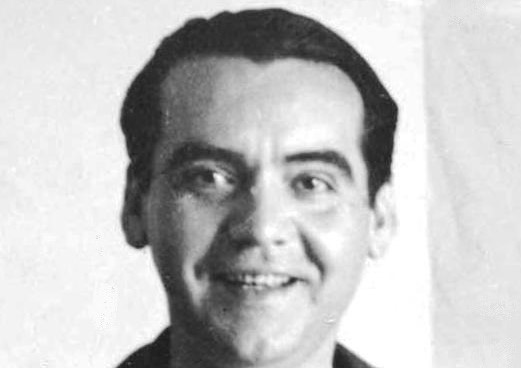
Federico Garcia Lorca, 1898 – 1936, has been rightly described as Spain’s most celebrated dramatist and greatest modern poet.
It is generally acknowledged that Lorca, both a socialist and a gay man was murdered by fascists on 19th August 1936. Although his remains have never been located, various searches for his body have been undertaken from 2009 to the present day.
At the time of his murder, Lorca was living in Granada and knew he would be targeted because of his outspoken socialist works but also because he was known to be a gay man. Granada was in a state of turmoil and no-one had dared to take the position of mayor for several months. When Lorca’s brother-in-law Manuel Fernandez-Montesinos accepted the job, he was assassinated within a week and Lorca, along with three of his comrades disappeared, to be almost certainly summarily executed on the same day. The executions probably took place at a place known as the “Great Spring”, on the road between Viznar and Alfacar.
Lorca began his artistic life as a musician and in his youth studied piano and composition. Later he developed an interest in Spanish folklore, a theme that would heavily influence his work as a poet and dramatist.
Lorca began writing and moved to Madrid where he became involved in the artistic and literary world that was developing at the time. He became close to Luis Bunuel and Salvador Dali. He was influenced as a poet by the poet Juan Ramon, and as a dramatist by the playwright Eduardo Marquina and George Martinez Sierra, the director of Madrid’s Teatro Eslava. Although already writing poetry, it was at this stage that he began to write plays. His first play “The Butterfly’s Evil Spell” (1920) was a modernist piece that reflected the wider European feel of writers such as: The Brothers Capek (Czechoslovakia) and Vladimir Mayokovski (Russia) but was laughed off the stage after only four performances. This set-back influenced Lorca’s approach to drama later on and he didn’t write another play until Mariana Pineda (1927).
Lorca produced several collections of poetry but it was the success of The Gypsy Ballads in 1928, that brought him tributes throughout the Hispanic World. It was only later that he attracted the same sort of attention as a playwright. In June 1929 Lorca travelled to the United States and was there to witness the Wall Street crash, which made a profound impact on his work. The poetry he produced at this time Poeta en Nueva York (not published until 1940) explores experimental poetic techniques. These were polemical, in their condemnation of capitalism and less influenced by the more lyrical folk-style he had deployed previously.
Lorca’s return to Spain in 1930 coincided with the fall of the dictatorship of Primo de Rivera and the birth of the Second Spanish Republic. In 1931 Lorca was established as the director of a student theatre company, Teatro Universitario La Barraca (The Shack). It was funded by the Second Republic’s Ministry of Education and its role was to tour Spain’s rural communities to introduce audiences to classical Spanish theatre free of charge. The theatre used portable stages and equipment. Lorca said “Outside of Madrid, the theatre, which is in its very essence a part of life of the people, is almost dead and the people suffer accordingly, as they would if they had lost their two eyes, or ears, or a sense of taste.” This insight into the need for artistic fulfilment in people indicates a deep understanding of what human beings require for happiness and good mental health. Lorca wrote, “theatre is a school of weeping and laughter, a free forum, where men can question norms outmoded or mistaken and explain with living example the eternal norms of the human heart.”
It was at this time that Lorca produced his great plays: Blood Wedding (1933), Donna Rosita the Spinster (1934), Yerma (1935) and The House of Barnarda Alba (1936). Through these plays, Lorca explores the human condition often through the eyes of strong female protagonists trapped in a patriarchal world that stifles them and from which they want to escape. Lorca writes in a heightened poetic style and music is used to deepen the emotional energy of the work. Lorca’s murder, two months after the completion of The House of Barnarda Alba cruelly curtailed what would have inevitably been more great works buried forever beneath the Andalucian soil.
Prophetically, Lorca seemed to predict his eventual murder and disappearance. In the final verse of his poem, “The Fable and Round of the Three Friends.”, he writes:
“Then I realized I had been murdered.
They looked for me in cafes, cemeteries and churches
…but they did not find me.
They never found me?
No. They never found me.”
In the opening lines from Lorca’s Play, The Dream of Life, which has been described as “an act of revolutionary drama where theatre itself is destroyed”, the author says,
“…I am not about to raise the curtain to cheer up the audience with a play on words or a panorama in a house where nothing happens and on which the theatre shines its light for entertainment, and then have you believe, that that is what life is all about. No. The poet with all his five senses in a state of perfect health, is going to have, not the pleasure exactly, but rather the sorrow of showing you a little corner of reality…”
The artistic world owes Lorca a great debt. His insight into the human condition and his humanity make him a name that will live on, especially for socialists. May his plays be widely performed and his poems widely read for generations to come.