

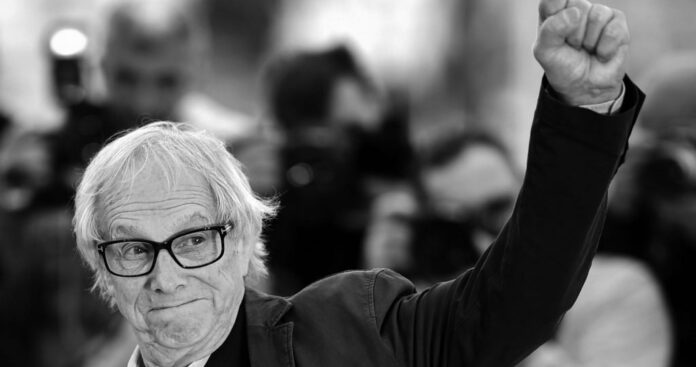
This article is to celebrate the life and work of one of Europe and the UK’s most significant film-makers, on the occasion of his retirement and his ninetieth birthday (June 2026). Ken Loach’s work carried political as well as artistic significance and he had firm principles both politically and artistically, that mark him out for special recognition.
Loach’s Early Career
Kenneth Charles Loach was born in Nuneaton, Warwickshire, England on 17th June 1936. He attended state schools and studied Law at Oxford following a brief period in the Royal Air Force. At Oxford, he joined the Experimental Theatre Club and this is where his interest in theatre began to develop.
Loach worked as an actor in regional theatre companies and later as a director for BBC Television. This was in a period when the BBC was promoting plays made for the screen and encouraging new artists and innovative subject matter. Loach directed 10 plays for the BBC’s Wednesday Play anthology series. These included the highly significant works: Up The Junction (1965) and Cathy Come Home (1966). Television at that time had a huge reach and influence with only three television channels available: BBC 1, Independent Television ITV and BBC 2, which began transmissions in April 1964. ITV had already been screening the soap opera Coronation Street since December 1960. This soap dealt with a working a class community in Salford, in the North of England, portraying the realities of peoples lives as well as containing some political content. It was incredibly popular, with episodes being watched by almost 10 million people throughout the 1960s.
The prominence of programs such as Coronation Street, was partly why The BBC felt it had to have plays dealing with working-class issues. Loach, along with other film-makers was, for a period, given the artistic freedom to deal with social issues in a direct way.
Loach was influenced by theatre and at this time there existed a movement supporting political and experimental work with artists such as Peter Brook and Joan Littlewood, in the theatre and playwrights such Samuel Becket and Eugene Ionesco championing what became labelled absurdist theatre. The plays of Bertold Brecht, Becket and Ionescu were being widely performed and the early modernist plays of Alfred Jarry, and Georg Buchner were being rediscovered. Devised plays such as: Oh What a Lovely War (Theatre Workshop) and US (Peter Brook) were being developed for the theatre and a range of political, experimental and niche theatre companies such as Hull Truck and Belt and Braces were about to emerge. In film, European influences were prominent, with modernist film makers still producing a large body of work before being challenged by the reductionist post-modernist movement. In an interview in 2010 Loach said that the three films that influenced him the most were: Bicycle Thieves (1948), Loves of Blonde (1965) and The Battle of Algiers (1966). He went on to say that Bicycle thieves influenced him particularly strongly because, “It made me realise that cinema could be about ordinary people and their dilemmas. It wasn’t a film about stars, or riches or absurd adventures”.
Loach would probably not describe himself as an absurdist or even modernist film-maker. His films in general are biographical and realistic. Loach’s only absurdist film: The End of Arthur’s Marriage, was not a success and Loach said about the film that he “was the wrong man for the job”. This indicated a sympathy for modernist work but an understanding that what came to be known as the social realist style of film making was where his strengths lay.
Loach’s Method
Loach’s film-making method was to prove fundamental to his work and would heavily influence later practitioners, including: Mike Leigh, and Shane Meadows. The filmic method Loach deployed contained a range of approaches, which could be broken down into the following elements: realism, naturalistic performances, social commentary, collaboration with writers and actors, the use of many non-professional actors, exploration of human relationships, an un-polished visual style, political engagement, a minimalist soundtrack and hope amidst despair.
Much of Loach’s work was devised with the actors, to be written as a shooting script later on. Loach worked in close collaboration with screen-writers throughout the production process. The use of non-professional actors meant they could bring their lived experiences to the work, thereby deepening its authenticity. What this method also did was reveal that acting is not a magical formula, reserved for attendees of acting schools, but the expression of a basic human drive towards art and performance, so often denied to working class people.
Loach’s films can be characterised by their focus on people struggling against the limitations society imposes on them and this is often shown through conflict between the chief protagonists and elements of the establishment. One of Loach’s early films, Kes, tells the story of a young boy who adopts a kestrel and this frees him from the psychological limitations of a life in a dysfunctional home and oppressive school. The political drive comes from the assumption that the boy will be compelled to work in a coal mine – against his own wishes. The film faced problems with distribution because the actors used a local dialect and many audience-goers could not understand the dialogue. It was later to be sub-titled, as were many of Loach’s films. In spite of this Kes was voted seventh best film of the twentieth century by The British Film Institute in 1999. Loach felt it important for actors to speak in their own voice in order to realise more deeply the identity of the character they played. Loach is quoted as saying, “If you ask people to speak differently, you lose more than the voice. Everything about them changes.”
Loach’s Documentaries
As Loach’s career developed it became apparent that the films he was making clashed with the establishment’s view of what films should be about and how they should be made. This meant that Loach had difficulty getting films distributed or shown and that some of his work has never been seen by the public. During the 1980s Loach concentrated on documentaries, rather than dramas. He made a series of documentaries, many of which were critical of the British establishment, as well as, in the case of, “A Question of Leadership”, critical of some trade union leaders who compromised too easily or collaborated with the establishment. His series, where he interviewed workers about their views of their trade union leaders, Questions of Leadership, has never been released. Other documentaries made for TV as well as charities were mothballed and never released by TV companies. In an interview with Τhe Guardian, Loach said,
“It makes you angry, not on your own behalf, but on behalf of the people whose voices weren’t allowed to be heard. When you had trade unions, ordinary people, rank and file, never been on television, never been interviewed, and they’re not allowed to be heard, that’s scandalous.”
Loach maintained that the lives of working-class people are inherently dramatic, and offer huge potential for film makers,
“They live life very vividly and the stakes are very high…because they are in the front line of what we came to call the class war.” Loach said.
Loach’s Later Work
Later in his career, Loach moved back into making dramas and these included works on a far bigger scale than previously, including: Land and Freedom (1995) about the Spanish Civil War, Bread and Roses (2000) about the Los Angeles Janitor’s strike, The Wind that Shakes the Barley (2006) about the Irish Civil War and Route Irish (2010) about the occupation of Iraq. At the same time, he continued to make films of a more intimate nature including: Raining Stones (1993), My Name is Joe (1998), Sweet Sixteen (2002), Looking for Eric (2009) Angel’s Share (2012), Jimmy’s Hall (2014) and I Daniel Blake (2016). Loach won Palme d’Or at the Canne Film Festival for: The Wind that Shakes the Barley (2006), The Angel’s Share (2012) and I Daniel Blake (2016). Loach’s last film, The Old Oak (2023) received a ten-minute standing ovation at the Canne Film Festival in recognition of Loach and the film’s subtle and sympathetic social commentary on the issue of immigration.
Loach’s Political Life
Loach believed that meaningful change to society could only come from below, “it won’t come from people who have a lot to lose, it will come from people who have a lot to gain”, he is reported as saying.
Loach was a member of the Labour Party from the early 1960s until leaving it in the mid- 1990s. As a member of the Labour Party, he associated himself with a radical element critical of the leadership. He was also a member of or close associate with the Socialist Labour League (later the Worker’s Revolutionary Party), the International Socialists (later the Socialist Worker’s Party) and the International Marxist Group. He was involved in Respect – The Unity Coalition and was elected to the National Council of Respect in November 2004. When Respect split, he was associated with the George Galloway faction Respect Renewal, before ending his relationship with Respect.
Later, Loach supported the Trade Unionist and Socialist Coalition TUSC in the London Assembly election in 2012. In March 2013 Loach launched a campaign for a new left-wing party, Left Unity. Left Unity was set up as a new left party but never developed a significant following, tending towards an uncritical support for European new-left formations springing up at the time and diluting the energy of the anti-austerity movement. Loach re-joined the Labour Party in 2017 in order to support Jeremy Corbyn. At the Labour Party Conference in September 2017, Loach said he had been, “going to Labour Party, trade union and left-wing meetings for over 50 years and had never heard antisemitic or racist remarks, although such views certainly existed within society.” Loach was also actively involved in supporting the Palestinian struggle and was a supporter of the Palestine Campaign for the Academic and Cultural Boycott of Israel. Loach described the witch-hunt inside the Labour Party around the issue of antisemitism as a “red herring”. Loach was expelled from the Labour Party in 2021 for refusing to condemn Labour members who had been expelled.
In 2025 Loach got involved in supporting the formation of Your Party. He associated himself with the left of the Party, built around Naomi Wimborne-Idrissi and others, later to be characterised as the Grassroots Left.
In Conclusion
Ken Loach is one of the most important film-makers of the last sixty years. His films and documentaries depicting the lives and struggles of ordinary working-class people are of considerable artistic and political merit. It is a tremendous pity that few of his films, other than his early work for TV, reached a mass audience. This was due to the establishment and the British film industry acting against his work and refusing to give it the coverage it merited or put many of his films on general release. At the same time, Loach maintained a political engagement which gave an authority to the films he made. His films never judged characters, they simply reflected back to the audience the truth that lies within them, born out of the dilemmas they faced in their daily lives.