


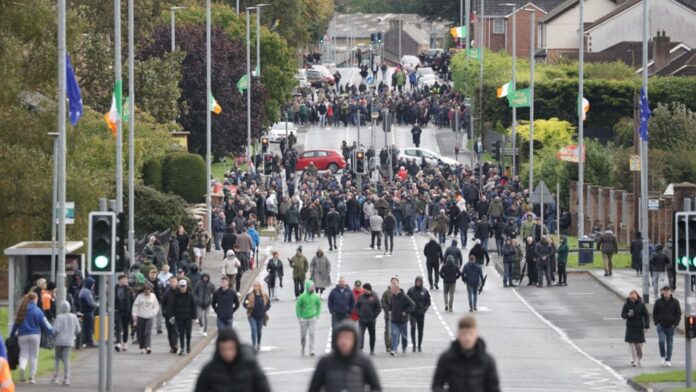
In the second half of the 1990s, Northern Ireland came close to all-out conflict on several occasions, as disagreement and tension over the routes of contentious parades spilled over into widespread rioting for days at a time. In this tense period, more than 20 people were killed in connection with a standoff between the Orange Order (an organization of the Protestant community which supports the place of Northern Ireland in the UK) and residents on the Garvaghy Road in Portadown.
The Orange Order has always insisted on parading from Drumcree Church to the centre of Portadown along the Garvaghy Road and argues that it has the right to do as it is a “traditional route” (used since 1807). The parade has been contentious for decades as it involved up to 800 Orange Order members accompanied by several bands playing inflammatory anti-Catholic tunes, and hundreds of supporters. Parades were often triumphalist, which, of course, enraged the local Catholic residents.
A Return to the Past
The Garvaghy Road is an “arterial route” – that is a route used by local residents from both communities to go to work or to use other amenities such as shops. By the 1990s however the population who lived in the immediate area of the Garvaghy Road was overwhelmingly Catholic. The provocative nature of the Orange Order parades meant that the majority of Catholics along the route were prepared to mobilise in opposition to the parades.
In 1995 residents held a sit-down protest to stop the parade, resulting in a violent standoff at Drumcree between the police and British army and thousands of Orangemen, along with their supporters Eventually a compromise was reached, allowing the march through.
In 1996, police banned the parade in advance resulting in another violent standoff. After five days of widespread rioting in Protestant areas and road blockades which practically shut down large areas of the North, the police let the march through. This could only be achieved by violently forcing protestors off the road, and fierce rioting and shooting broke out across Catholic areas. In 1997, the housing areas along the Garvaghy Road were locked down before dawn, and the march was allowed through. Again, the result was widespread protests and violence in Catholic areas across the North.
From 1998 onward, the march was banned from the Garvaghy Road and there was protest and violence in Protestant areas. One result was the horrific death of three young Catholic brothers (Jason Quinn age 9, Mark age 10 and Richard age 11) who died after their home was engulfed in flames as a result of a petrol bomb attack.
No Solution
Since 1998, the Orange Order have protested at the banning of the parade by submitting applications to parade once a week, and on each occasion, they were turned down. The situation appeared to be unresolved to the Orange Order, but the local Catholic community simply assumed that there would never again be a parade, or even serious consideration that one might happen.
All of this changed when a court decision in August declared that the body established to decide on the conduct of parades, the Parades Commission, had erred in points of law and was potentially biased against the Orange Order.
In the aftermath of the court hearing, the Orange Order applied for a march on Sunday September the 27th, involving 60 members of the Orange Order, but with no bands or no supporters to accompany them. The Parades Commission took several weeks to make a decision about the march, and only did less than 48 hours before the proposed day and time. It imposed conditions: it declared that it could only go ahead with 35 members of the Orange Order, and at 8:00 a.m. on the Sunday morning, rather than the 1 p.m. that the marchers had asked for.
Immediately both sides went to the courts. The march was successively banned by the courts, and then once again allowed in a decision announced at 2.15 a.m. on Sunday the 27th. Local residents mobilized and blocked the road. The state decided not to force a way through and the Orange Order members waited all day. At the time of writing (Wednesday, September 30th) the stand-off continues.
Increased Tension and Division
The period prior to the Sunday march saw heightened tension, which was accentuated sharply on the day of the march. Nationalist politicians, both from Sinn Féin (the main nationalist or pro-United Ireland party) and the SDLP (Social Democratic and Labour Party – also a nationalist party) joined residents. Michelle O’Neill, Sinn Féin vice president and first minister of Northern Ireland publicly declared the whole peace process to be at risk. Sinn Fein President Mary Lou Macdonald talked about a “primitive” throwback to the past in language which can only be seen as demeaning by most Protestants. Cara Lockhart, the local Democratic Unionist Party (DUP-the main unionist party which favours Northern Ireland remaining part of the UK) member of Parliament, traded insults, calling the protesters a “rabble”.
Events of the last few days illustrate what we have always argued: the peace process and the subsequent Good Friday Agreement (a peace agreement reached between political parties representing the Catholic and Protestant communities in Northern Ireland in 1998) and further inter-party agreements since, cannot solve the problems faced by working-class people in Northern Ireland. Division and separation, on the ground, have been accentuated over the course of the last three decades. Attitudes have not changed, especially at the time of heightened tension.
Role of the Workers Movement
The workers’ movement-primarily the trade unions with their quarter million members in both communities but also small left political parties and groups-is the only force which has the authority and the power to change society for the better.
The trade unions represent workers in their day-to-day struggles over wages and conditions in the workplace, but also represent, at an elemental level, workers’ aspirations to live in peace and to reach compromise with their neighbours in each community. The trade unions unite the two both communities-it is noteworthy that over the last fifty years of conflict no significant strike has been defeated because of sectarian division.
In the 1990s, we (Marxists organised in the Socialist Party and other activists) argued for compromise, dialogue and agreement as the only way forward. At first this was a minority position: on both sides sectarian forces were pushing for confrontation in search of outright “victory” over the other community. In time, however, those who had gone to the brink of a destructive conflict pulled back, entered into dialogue, and reached compromises.
We argued that contentious orange parades should not be allowed to go through what were clearly Catholic residential areas which rejected their presence. We further argued, however, that arterial routes (main roads) in cities, towns, and villages were a different matter. If, for example, a local Protestant community went into the local village or town centre every day of the week to shop and to use other facilities or on their way to their place of work, that could properly be described as an arterial route. Of course, geography is complicated and arterial routes may go through areas which are largely Catholic or Protestant, but their character cannot be simply defined by the who lives in the adjacent houses.
This is a question of a conflict of rights. The Orange Order has the right to parade. We argue this whilst describing the Orange Order as a reactionary, backward-looking organization, and one which, in time we hoped will decline and disappear. As we have always pointed out attacks on the Orange Order, and challenges to its right to march in multiple areas, actually bolstered its position in the Protestant community, even whilst its membership continued to decline.
The right to march is relative however, and the Orange Order does not have the right to deliberately create tension or to insult local residents. As this argument became more widely accepted contentious Orange parades tended to become smaller and would agree not to play music along part of their routes (when passing a Catholic church, for example).
We also argued that residents had the right to oppose sectarian marches through their areas and this must be absolute in certain circumstances (residential areas) but relative when it comes to arterial routes even when through areas which are largely Catholic. Again, these arguments came to be widely accepted and helped in the resolution of contentious parades.
Finally, we put forward the idea that there is a third right: the right of the working class and society as a whole not to be subjected to increases in tension and division and violent conflict, which may result in multiple deaths. The only way to overcome the difficulties posed by contentious parades is through dialogue, negotiation, and compromise.
We reject the slogan of some organisations that there should be “no Orange feet” on certain roads. It makes no sense to enter into dialogue if in advance all compromises have been excluded, which is what the slogan “no Orange feet” means. Similarly, we reject the position of some in the Orange Order, that it can do as it wishes, marching wherever it wants with no rules imposed regarding the number of members, supporters, and bands on a parade. Again, the Orange Order and similar organizations must enter into negotiations in good faith and allow for the possibility that it will not achieve its initial demands.
The late 1990s and the early 2000s eventually saw the resolution of many contentious parade disputes, including in Derry, Bellaghy, Rasharkin, the Lower Ormeau Road in South Belfast, and the Ardoyne area in North Belfast. In each case the compromises arrived at were different, and there was unhappiness on both sides, but nevertheless, compromise was achieved, and it helped to contribute to a period of relative peace and stability over the course of the last 15 years. Last weekend’s events illustrate that this relative peace can fall apart quickly. It is the duty of the workers’ movement, and especially the most active, left members of the movement, who claim to stand in the Marxist tradition, to put forward an independent working-class position. In today’s context, that can only mean arguing in favour of dialogue and compromise, even when the possibility of compromise seems to be very remote.
What happens now?
The standoff at Drumcree in 2026 illustrates that in many ways Northern Ireland has not changed since the previous standoffs in the 1995 to 2000 period. Then, as is now, the majority of Catholics robustly support the residents’ right to object to the march going along the Garvaghy Road.
The majority of Protestants –even though only a minority are members of the Orange Order– support their right to parade. The fact that this is a “church parade”, taking place on a Sunday, with no bands and no supporters, means that most Protestants do not consider the request for a march to be provocative.
In the days prior to the march, there was much talk of the possibility of a mediation process to allow for a compromise between the marchers and local residents. Talks did not commence as the residents rejected the proposed mediator, though the Orange Order did engage briefly.
A number of possible scenarios may now unfold. The state may decide to “uphold the law” by forcing protesters off the road to allow the Orange Order to pass. This could only be achieved with considerable force, including bringing in further police reinforcement from England or Scotland (200 have already arrived).
This would result in widespread protests in Catholic areas and almost certainly rioting. The result would be an increase in tension and possibly the collapse of the Stormont Executive (the devolved government in Northern Ireland) if Sinn Fein withdraws. It is very unlikely that the state will act in this way.
A second scenario is that a standoff continues for days or even weeks. Eventually the status quo would resume: that is, the Orange Order would remain at Drumcree Church in protest at their failure to be allowed to continue their parade. The 28 years would become 29 and then 30 years.
This would be to the great satisfaction of most Catholics and the dissatisfaction of the majority of Protestants. It would help to reinforce the growing view amongst Protestants that they are an embattled minority on the island of Ireland. It would provide ammunition to the leaders in the Protestant community who argue that all the talk of a “new Ireland” (a phrase used by some who argue for a united Ireland), in which Protestants will be cherished, is so much hot air. And it may result in the collapse of the Executive also – in this case because the DUP may withdraw.
Third, a process of genuine mediation could commence in the coming days or weeks. As already stated, if there is to be mediation, the possibility of a parade must be on the table; otherwise, there is no basis even to commence talks. Of course, the possibility of no parade must also be on the table.
Compromise may involve a parade down the Garvaghy Road. Imaginative approaches are possible. It has been mooted that the Orange Order march could be accompanied by young people wearing Gaelic Athletic Association (a sporting organisation association associated with the Catholic community) insignia. If an agreement is arrived at in the coming weeks and months, the Left should support compromise and not support the “no orange feet” position of the more extreme elements in the Catholic community.
If the compromise is for a parade to take place it would need to be restricted: for example, the number of marchers and the conduct of the marchers. A counter protest may well be part of such an agreement. It is important that the conduct of the parade, and of any counter protest is controlled by the protesters themselves and their stewards, to take the forces of the state out of the equation. A compromise which does not involve the parade going down the Garvaghy Road is possible, but difficult to conceive of at this stage-however it is possible that the Orange Order will accept some other acknowledgements of their rights and accept that there is no parade.
The first and second scenarios would bolster each of the sectarian camps and the political parties which are based on sectarian division. Assembly and local council elections are due in May 2027, and both Sinn Fein and the DUP (and the more extreme Traditional Unionist Voice) are likely to benefit at the expense of moderate nationalist and unionist parties. The imminence of the elections is playing a part in the unfolding scenario-division builds support for hardline sectarian forces and these forces are consciously creating division.
The third scenario would be in the interests of the wider working class and ought to be argued for by the workers’ movement, including the leaders of the trade unions. The alternative is weeks or months of sectarian tension, intimidation and street violence, against a background of ongoing poverty and neglect of working-class areas.
As in the 1990s there are two roads to take. One points towards increased division and renewed strength for sectarian forces which will take us back to conflict. The other towards a renewal of the relative peace of the last decade. The former scenario is not in the interests of the working class as a whole. The alternative road-of compromise on difficult sectarian issues-would allow space for the emergence of united working class movements, on wages and conditions in the workplace, or in defence of our health service, and ultimately for the struggle to create a mass, anti-sectarian, party of the working class. There is only one road for serious left activists to take.