

By Sophie Scholl
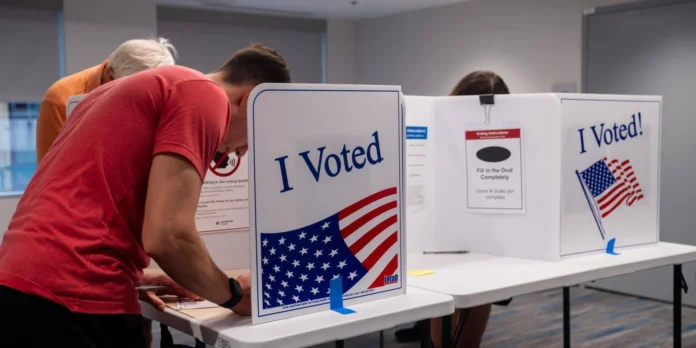
All across the U.S., the American people just delivered an overwhelming rebuke to Trump and right-wing Republican candidates. Starting at the beginning of next year, the Democrats will control both houses of Congress with solid majorities in both. Democrats won control of both chambers of the US Congress in an electoral landslide that amounted to a rejection of Trump, reflecting widespread voter discontent with the state of the US economy and the war in Iran.
Across the country, Democrats scored victories in GOP strongholds, flipping at least seven Senate seats and winning House races in districts Republicans had easily carried in 2024.
Several news organizations projected that Democrats would win the House with victories in Indiana, Iowa, Virginia, Texas, Nebraska, New Jersey and Pennsylvania, among other states. NBC News estimated that Democrats would end up with 258 House seats compared to 177 seats for Republicans – an 81-seat majority. In a sign of how deep the losses were for Republicans, the head of the House GOP’s campaign arm, Representative Richard Hudson, was projected to lose his seat in North Carolina according to NBC News. In the Senate, the Democrats will now hold at least 54 seats, with just Alaska and Mississippi still unresolved. Currently, Democrats have 47 Senate seats, including two independents who caucus with the party. The election result sets up the first real check on Trump’s power in Washington since he returned to the White House last year, as the party rode a wave of voter dissatisfaction driven by the cost-of-living crisis. The incoming Congress is sure to investigate Trump, his administration and businesses and stymie his legislative agenda.
What Caused the “Blue Wave?”
According to Bloomberg News, exit polls showed huge numbers of Black and Hispanic voters returning to the Democratic Party after moving sharply in Trump’s favor in 2024. The Voter Poll, a comprehensive exit poll conducted for The Associated Press and major television networks, found only 9% of Black voters and 35% of Hispanic voters supporting Republicans. Comparable exit polls in 2024 found Trump got the support of 13% of Black voters and 46% of Latinos. Significantly, Republicans also lost vote share among white voters, from 57% in 2024 to 51% in 2026. As Eric Blanc correctly wrote on Labor Politics:
“Remember when centrist pundits insisted Trump’s 2024 victory meant America had become permanently conservative? That narrative hasn’t aged well. Roughly 70 percent of young voters backed Democrats in this election, with the margin among young people swinging by about 32 points since 2024. Millions of Americans are angry at an economic and political system that keeps failing them. There’s an enormous opening for an alternative that can actually deliver.”
The Democratic Party also made important gains on the state level, including winning state senate and assembly along with governorship in at least 5 states, and coming out of the election, the governorship of most states is now in the Democratic Party’s hands.
A strong turnout from voters favoring the Democratic Party was the most likely outcome – Trump himself told voters to act like he was on the ballot, and nationwide they overwhelmingly did. The “blue wave” that materialized was not the result of voter confidence in the Democrats but the result of the widespread anger over Trump’s intolerable economy, his unpopular imperialist war with Iran, and his racist campaign of terror against immigrants. From this standpoint alone, many working people are breathing a sigh of relief today in the hopes that, now that the Democratic Party will have control of the Senate and the House of Representatives, they will check Trump’s policies. This election, especially when combined with Lula’s victory over Flavio Bolsonaro in Brazil, was a blow to the far-right internationally.
It is significant to note that Trump suffered a series of defeats, starting in January of this year when working people and immigrants defeated ICE in Minneapolis in a citywide shutdown. This was followed by setbacks and a clear failure to defeat Iran and open the Strait of Hormuz as well as Trump’s inability to end the war in Ukraine. The cost of living crisis that re-emerged under Trump, driven forward by his trade wars, tariffs, and the global shipping bottleneck that he created by attacking Iran, has even created cracks in his MAGA base and an embarrassing 32% approval rating for Trump days before the elections.
The Democratic Party was thrust into office all over the country, not out of hope for bipartisan “statesmanship,” but to challenge Trump and his agenda. Millions took to social media in celebration, anticipating everything from impeachment, to criminal trials, to sweeping legal changes that would undo the harm Trump and his cronies have caused since his reelection. It is not clear how this will unfold beyond gridlock and crisis as a lame duck Trump tries to salvage his presidency and the oligarchs around him. The Democratic Party establishment is already showing signs that they are unwilling to go all out in the fight against Trump in appearances on news programs across the country, and they will not have the numbers to even impeach Trump without help from Senate Republicans – despite their overwhelming control of the House. While Trump’s popularity is at an all-time low, he still has a stranglehold on the Republican Party, and his base would be unlikely to support Republican lawmakers who break with him in this way at this moment. Furthermore, much of the damage Trump has done was through his own executive power, which he has utilized to sideline congressional approval whenever possible despite having enjoyed a Republican majority in both the House and the Senate. Trump will likely veto legislation that he or the oligarchs and Wall Street do not approve of.
In the absence of pressure from a mass movement in the streets, this electoral victory may end up resulting in a prolonged stalemate period rather than the total-war against Trumpism that most voters were hoping for. But that remains to be seen depending on how things unfold as there are serious challenges for US imperialism in the economic, political and geopolitical horizon.
Democratic Candidates Turn Towards Populism
While it’s true that the election was a referendum on Trump’s policies, there were more complex factors at play below the surface. An important new feature of this election nationwide was the growing populist rhetoric some Democrats running for office across the country placed on “corporate greed,” a “rigged economic system” and the “billionaire oligarchy’s control over politics” in their speeches and campaign material. This important political shift (which increasingly took center stage after the self-described socialist Zohran Mamdani’s spectacular mayoral victory in New York City last year) at least in rhetoric, represents a significant departure from the mainstream assumption that Democrats can only win by “running to the center,” at least when it comes to economics. However, it is also important to note that this focus on economic issues and the cost of living crisis was also paired with a retreat on many important issues related to fighting oppression, such as many Democrats dumping the demand of abolishing ICE or coming out against gender-affirming healthcare or in favor of anti-Trans sports bans.
This shift in the direction of economic populism can best be seen in the case of Texas, where former mainstream Democrat James Talarico defeated the Republican Ken Paxton in a state that Trump had won by 14 points in 2024. Talarico ran on what Eric Blanc calls a “Bernie-lite economic platform, arguing that “Republicans and Democrats alike sold the false Gospel of trickle-down economics.” As he declared in his victory speech:
“We just sent a message to every billionaire megadonor, every trillionaire megadonor, every corrupt defender of this broken political system: in this state, in this country, power belongs to the people.”
It is worth noting that despite his populist rhetoric, Talarico was among the Democrats who adopted certain parts of the Republican Party’s program on Trans people, including supporting placing legal restrictions on Trans healthcare.
Texas’s new Democratic governor, Gina Hinojosa, has been similarly explicit about the economic situation working people in the U.S. face today: “The one fight in this country is about economic power, and populism is about economic power.”
California Representative Ro Khanna reflected these changes when he advocated a program of Medicare for All, a $25 hour minimum wage, an end to the Iran war, taxing the billionaires and zero aid to Israel. Considering the looming $900 billion in Medicaid cuts, these issues can catch fire despite the intentions of the conservative, establishment wing of the Democratic party.
Many establishment Democrats who ran on a program of deepening U.S. support for the Israeli regime or taking the party’s furthest-right stance on Trans rights –including opposing transgender healthcare being covered by Medicare, Medicaid, and the ACA (Obamacare)– were clearly on the defensive and often came under severe fire on social media and at in-person campaign events from protesters angry at their blatant sellouts. While this election was a repudiation of the Trump regime, it was far from a vindication of the policies of Chuck Schumer or Hakeem Jeffries.
There were also a number of left wing populists and self-described Democratic Socialists, many of whom were backed by the Democratic Socialists of America (DSA) and its campaigning machine.
In addition there was Abdul El-Sayed, who despite rejecting the label of socialist ran on economic populist demands while also refusing to give an inch on issues of Trans rights. El-Sayed easily won Michigan’s Senate race despite a viciously racist campaign against him to become the first Muslim Senator in history.
Over 50 DSA candidates won across the country while several other left liberal and economic populists scored victories nationwide – clearly a new important national trend.
Two recent polls, one from Fox News and one from NBC News, have found that nearly half of young people view socialism favorably – the Fox poll reported 48% of adults ages 18 to 34 view socialism favorably, while the NBC News poll reported that 47 percent of voter respondents ages 18 to 29 had a negative outlook on capitalism, while 42 percent viewed socialism positively.
It is no surprise that young people are fed up with the capitalist system and looking for alternatives – it is not just a result of the current cost of living crisis, but the fact that these young people have lived most of their lives in an era of deep crisis for the capitalist system, and have also lived through a number of movements which have set themselves the task of changing things for the better. On top of that, many of these young people are witnessing a genocide being carried out on the other side of the world in real time via social media, and being faced every day with the real human cost of imperialism and war. All of this, and especially the economic situation, has created a deep polarization along class lines as these young people are increasingly searching for a way out of the crises they are faced with every day, and it is no surprise that young people are looking to socialist ideas as a solution.
The Left has made important gains since Bernie Sanders reintroduced the word “socialism” to the U.S. political scene, and despite the fact that left-wing movements have also suffered failures and setbacks, the ruling class has not been able to turn young people away from socialism. It is on this basis that future steps forward will be taken.
DSA and the Elections
DSA’s electoral gains in this election were important in the grand scheme of the election results. It would be easy to write off DSA’s gains especially when taken in context of the broader trend of DSA electeds in Congress refusing to truly challenge the Democratic Party establishment. However, as Kim Moody correctly points out in his article, only looking at these numbers and not the unique political force behind them would be a mistake:
“what makes the ‘DSA Seven’ (the DSA leading group at the Congress) different from most progressives, however, is not so much the issues and programs most ran on, but that they will have behind them a semi-mass, by now electorally experienced –though politically contradictory– semi-mass organization.”
DSA was revitalized in 2016 after it suddenly grew in membership by roughly ten times following Bernie Sanders’s campaign for president, and in the years after it began to develop as the closest thing the U.S. far-left had to a mass socialist force in recent history. In 2020, after Bernie’s second capitulation to the Democratic Party establishment, DSA’s membership went into decline for some time. More recently, after the election of Zohran Mamdani as NYC’s mayor, which was shortly followed by a number of other local electoral successes, DSA has seen a sudden surge in membership to upwards of 120,000 dues payers, which even surpasses the membership of the Socialist Party and the Communist Party at their respective heights in the United States in the past.
DSA has built an impressive canvassing and campaigning operation, but it has so far failed to exert itself as an independent working class political force in society, beyond the ballot box.
While it’s true that DSA activists and chapters have played a role in various movements, DSA has yet to have a single successful attempt at regional or national mass mobilization in the streets. Many DSA activists are also committed and experienced union and labor movement activists, but the organization itself does not take on the role of labor organizer or strategically intervene to build and drive forward the labor movement. Shamus Cooke of Portland DSA recently wrote an article that explains why this is such a problem:
“Any group that avoids organizing demonstrations can become hesitant or even incapable of doing so. This hesitancy becomes a major problem when certain, urgent issues come to the fore that demand collective action in the streets, for example the Iran War or Israel’s ongoing genocide in Gaza.”
In the same article, Cooke also writes:
“There is also no example in history of a revolutionary movement that doesn’t prioritize mass mobilizations of various types. In fact, revolutionary movements are defined, in large part, by sustained mass demonstrations that spill over into all parts of social life — the workplace, universities, government buildings, neighborhoods, the military, etc. The spillover effect only occurs when a large movement inspires groups to take action to link-up with the mass movement. Every working class victory in US history – rights won by labor, women, African Americans, the LGBTQ community, etc. – have prioritized collective mass action.”
This is quite right – while Socialists should not abdicate or avoid electoral struggle, it is also important to recognize that the legalistic and bureaucratic maze that is the capitalist government is in many ways actually the least favorable terrain for the working class to advance its interests. While we should not fail to fight on this terrain, it is important to recognize that, if they do not have close ties with mass movements fighting back in the workplace or in the streets, even the most stalwart representative of the working class will not be able to accomplish much with their elected office alone.
Despite its growth, DSA has not succeeded in maintaining any of the massive grassroots networks it has built after the election results are in. For example, when Mamdani ran for mayor in NYC he had a grassroots volunteer network of more than 100,000 New Yorkers volunteered to help – most of those did not join DSA and because these community networks were not maintained, most of these volunteers fell back into political passivity or pure electoralism.
It is also true that even when DSA representatives managed to get elected in Congress, they have been subject to the whims of the Democratic Party establishment and reigned in by committee appointments that are designed to keep them from making headway on popular demands like ending U.S. aid to Israel, Medicare for All, etc.
Unfortunately, DSA representatives regularly support the party’s corporate establishment when voting for things such as Speaker of the House in hopes of extracting future favors, but the result is they end up voting to elect the party leadership who will then politically hogtie them for the next several years. Unless this is challenged this pattern is set to repeat soon – most DSA electeds, including Zohran Mamdani as NYC mayor, have endorsed Hakeem Jefferies as Speaker of the House despite his role as a devout enemy of Medicare for All and his longstanding commitment to deepening the U.S.’s support for Israel’s Zionist genocidal wars and policies.
Important Tests Coming Our Way
The social democratic DSA candidates who ran in these elections, and especially those who won their elections, answered the demands of U.S. voters for not just an alternative to Trump, but for an alternative to the rotten politics put forward by the Democratic Party corporate establishment. There is a real danger that instead of challenging the corporate establishment and campaigning for a real working class alternative, DSA could end up increasing illusions that the Democratic Party can somehow be used as an engine of progressive social change.
Eric Blanc, in his last article in Labor Politics, correctly points out that we have entered an “unusually fluid political moment, and not a ready-made roadmap.”
There are tremendous opportunities for the creation and development of a new mass socialist and working class movement to transform the U.S. The devastating blow to Trump’s prestige and the serious setbacks of the MAGA base in the face of rising economic populism across the country confirms this. There will be important opportunities for the Left to grow and challenge both the billionaires and their political servants. This should include organizing in the unions to replace the conservative officialdoms that bent the knee to Trump’s regime and to challenge the corporate oligarchy. The newly-elected progressives heading into congress will undoubtedly link up with AOC, Ilhan Omar, and other members of “the Squad” and will have opportunities to not just fight for the interests of working people in congress, but also to act as leaders on the national stage where they can use the authority many of them have with millions of working and young people who want transformative change.
The election of these candidates will provide opportunities to build powerful movements, test out new ideas concretely, and drive forward the fight to challenge capitalist rule along with raising the hopes and expectations of working and young people all across the country. There is no doubt that there are limitations to the reformist politics and illusions that are currently dominant on the US Left, especially that the Democratic party can become a vehicle for working people. However, the question for revolutionaries is how we can most effectively show these limitations while also building a mass movement of working people around concrete demands.
We can and must applaud positive steps from the re-emerging Left, even if these steps are taken on shaky legs that are struggling to regain their strength after decades of defeat, while also not failing to challenge, and criticize, our movements and leaders when they falter.
The U.S. working class still faces enormous obstacles. The billionaire capitalist oligarchy, a hostile Supreme Court, a far-right Republican Party that will seek an opportunity for revenge and will fight fiercely for their corporate overlords and worst of all, a corporate Democratic establishment that seeks to preserve a decaying US imperialism. The extraordinary victory against Trump and the policies of racism, war and reaction on November 3rd, can also be the beginning of the rebuilding of resistance and a vision of a new, socialist United States.