

Introduction by Luke Eckenrod
Article by Kip Hedges (retired Machinist and baggage handler) and Cynthia Sarver (St. Paul Federation of Educators, AFT Local 28)
______________
In December of 2025, the Trump administration began an unprecedented mobilization of more than 4,000 officers to the Twin-Cities (Minneapolis and St. Paul, Minnesota), a militarized force nearly three times the number of local police officers. These agents–mostly employed by the offices of Immigration and Customs Enforcement (ICE) and Customs and Border Patrol (CBP) under the Department of Homeland Security (DHS)–invaded the Twin-Cities under the directive Operation Metro Surge. Agents patrolled the cities, going house to house and business to business, abducting anyone they suspected of being in the country without documentation. Many rightly draw comparisons to the Gestapo and the Ku Klux Klan (KKK, a fascist, white supremacist organization founded following the end of the US Civil War).
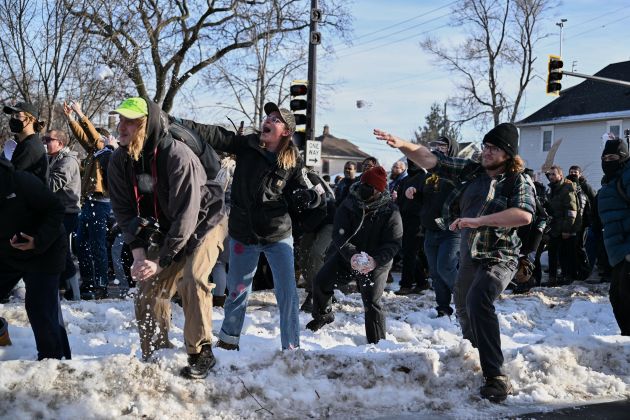
In an equally unprecedented manner, the working class of these two cities organized at the neighborhood level to repel the occupation. Protests, organizing meetings, and clashes with federal agents happened daily for months. The resistance reached a high point following the murder of Renee Nicole Goode.
Under pressure from below and revolutionary activists in the labor movement, labor leaders called for a “Day of No Work, No School, No Shopping.” Without declaring it openly, the country understood this as a call to general strike. While actual work stoppage fell far short of a true general strike (i.e. shutting down major industries and city operations), the mass demonstration of more than 100,000 on January 23rd renewed the idea for the first time in generations. In the weeks following, the entire country watched Minneapolis. Socialist organizations and unions felt the pressure to continue the fight. May 1st (International Workers’ Day) was set for a nationwide “Day of No Work, No School, No Shopping.”
Fearing that the movement would grow, CEOs of 60 Minnesota-based corporations wrote an open letter calling on Trump to deescalate. They worked behind closed doors to bring Trump and the Democrats to the table. Democrats used their connection to unions and non-profit organizations to hold back the movement. The result was a “drawdown”, leaving behind more than 800 federal agents as operations were diffused into neighboring suburbs. With the imminent threat of occupation gone, May Day had a far lower turnout than many had hoped.
Despite being an incomplete victory, this was a stinging defeat for Trump. It forced his white supremacist administration and gestapo-like agencies to retreat and regroup. In the months since Trump has poured billions into constructing a massive network of concentration camps, laying the ground for stealing the Midterms, and spreading DHS operations around the country. Feeling that the movement had subsided, Trump determined the time was right to retaliate against the Twin-Cities movement.
The statement below was written by revolutionary labor activists in the Twin-Cities, responding to the arrest and indictment of 15 leaders in the movement. Not coincidentally, many are labor activists who played leading roles in organizing the movement at the grassroots level. More than an act of vindictiveness, this attack strikes at the heart of the anti-authoritarian resistance by attempting to criminalize the basic right to organize. It exposes the real intentions of the Trump administration’s anti-immigrant terror campaign: to divide the working class and break the back of the only reliable resistance to authoritarianism.
This case is part of a larger project to criminalize and isolate the anti-capitalist left and it is a test for the anti-authoritarian movement that we cannot fail.
Workers Resist Statement on the Federal Indictments of Anti-ICE Activists
The recent federal indictments of fifteen Minnesota activists must be understood for what they are: a serious escalation in the government’s effort to criminalize resistance to ICE operation, intimidate those who have stood up in defense of their communities, and to attack our basic right to organize.
Many of those charged have long records of community service and activism. They have been active in their unions, rapid response networks, mutual aid efforts, immigrant defense campaigns, and community organizations. Time and again, they have been willing to put themselves on the line to defend their neighbors and protect vulnerable members of their communities.
The federal government’s portrayal of these individuals stands in stark contrast to the reality that Minnesotans experienced during months of ICE operations and federal occupation. Throughout that period, residents were subjected to repeated acts of violence, intimidation, and repression. Yet there has been no meaningful accountability for the murders of Alex Pretti and Renee Good or for the many serious assaults and abductions reported during that time.
These indictments should concern everyone. The charging documents do not focus solely on specific actions by specific individuals. They repeatedly reference “coordination,” “communication,” and “collective efforts” to interfere with ICE operations and prevent the enforcement of federal immigration policy. Taken at face value, the logic of these indictments could potentially implicate thousands of people across the Twin Cities who participated in rapid response networks, immigrant defense efforts, school patrols, demonstrations, and other forms of collective action.
For that reason, these prosecutions must be viewed not simply as cases against fifteen individuals, but as an attack on the broader movement that emerged to defend immigrant communities and resist authoritarian policies. If the government succeeds in establishing that organizing, coordinating, and mobilizing communities in defense of their neighbors can be treated as criminal conduct, the implications will extend far beyond these defendants.
The labor movement has a special responsibility in this moment. Many of those targeted are union members, and some have served as elected leaders within their unions. More fundamentally, unions have historically been among the most important defenders of democratic rights, free speech, civil liberties, and the right of ordinary people to organize collectively against injustice.
These Draconian charges aim to lacerate the backbone of organized resistance to authoritarianism. They are a direct retaliation to the events of January 23rd when unions and workers mobilized across the country in the hundreds of thousands to participate in the “Day of No Work, No School, No Shopping.” It was this type of action that forced the Trump administration into retreat.
With our right to organize on the line, the labor movement has to consider what it is willing to do to defend this basic right for all of its members. Unlike the Democratic Party leaders of Minnesota who collaborated with ICE during Operation Metro Surge (despite their public proclamations to the contrary), unions cannot allow the sacrifice of even a few. The movement in Minneapolis proved to us all that “nobody is coming to save us but us.” Therefore, the labor movement should take a leading role in defending these activists and opposing any attempts to criminalize community resistance.
We call on unions, community organizations, faith groups, civil liberties advocates, and all supporters of democratic rights to stand with these defendants — the Minnesota 15. We must raise funds for their legal defense, organize public meetings, educate our communities about the stakes of these prosecutions, get resolutions of support passed in our unions, and mobilize broad public opposition to these attacks.
We should have no illusions that this will end with these fifteen defendants. Similar movements have emerged in Chicago, Portland, Los Angeles, Newark, and communities across the country where residents have organized to protect their neighbors from ICE raids and deportations. If these prosecutions succeed, they are likely to be followed by additional indictments aimed at broader layers of activists and organizers — in other words, the rest of us are next on the menu.
The defense of these fifteen activists is therefore about more than a single case. It is about defending the right of working people and community members to organize, speak out, protect one another, and resist policies they believe are unjust. It is about defending the democratic rights upon which all movements for social justice depend.