


By Ecco Musica
The following article by comrade Ecco Musica was initially published on refoundation.us and was written before the tenants union in Spain won Maricarmen ‘s right to return to her home, before her death and before the recent, tragic train crash in Spain. The article describes elements of the mass movement in Spain regarding the housing crisis that can work as lessons for the movements and workers’ unions in the US.
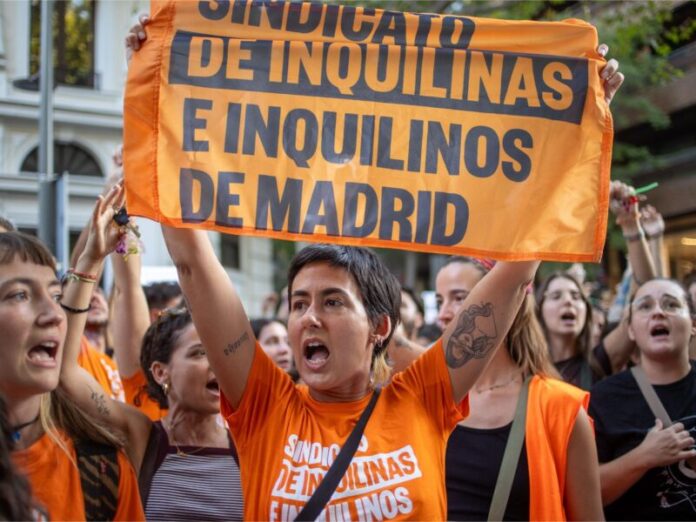
A social explosion has forced the government of the Spanish state to call snap elections. Initially sparked by the high-profile eviction of the 87 year old María del Carmen Abascal, known best as “Maricarmen”, the movement has since flooded the streets, forming occupy-style encampments in Madrid. Maricarmen, who was immobile and had been living in her apartment for 70 years on a disability payment of €1,350 (roughly $2,200), was evicted by court order after a private equity firm that bought her building and more than tripled her rent from €500 to €1,650.
The price of housing in the Spanish state has grown significantly in the past years, as private equity has bought up the housing. Barcelona in particular has increasingly undergone “turistificación”, or “touristification”, driving housing costs up. While the ideal percentage of income spent on housing is said to be 30%, in the Spanish State a single worker spends 50% to 65% of net income on rent. When we talk about the youth – students and those under 30 – it gets even worse: single workers under 30 spend an average of 98.7% of single net earnings on rent in major urban centers as reported by Consejo de la Juventud de España (CJE). That is insane!
Landlords have also reduced the total number of renters to avoid rent regulations. In fact there’s been a 28% drop in long term rentals in Barcelona alone! according to Cámara de la Propiedad Urbana de Barcelona (CPUB).
The Movement
While the movement may seem spontaneous, the eviction of Maricarmen was only a spark. There is a strong existing network of tenants unions in the Spanish state, which has no parallel in the US. The Tenants Union of Madrid was intimately involved in fighting Maricarmen’s eviction from the beginning. When they were unable to beat the eviction, they immediately began organizing the occupation of Puerta del Sol, a major public square, and began to call for a general strike.
The encampment was explicitly built in homage to The Indignados Movement of May 15 2011 (also known as 15M) and Occupy. During the encampment they were able to even stop an eviction in Madrid. The Tenants Union there has been very vocal about the need to continue to fight for more than just fair housing. The tenants union has demanded automatic renewal of rental contracts, just cause for eviction, limitations on short term leases, and protections against scams.
The tenants unions are correct when saying: we must not rely on the government, they have failed us; our only path is towards the general strike; we will not wait for the government to act! As protests continue, there have been no signs of stopping and more signs of combative organizing and unions leading the charge. This is a great example for the left in the US, where the movement against ICE’s occupation of Minneapolis developed into a mass strike. There is inspiring potential for this sort of resistance to continue to grow!
The elections also create an opportunity for the left and the working class to advance its demands in elections while also building movement leverage through a general strike on the streets. Elections are likely to broaden the focus of the class struggle, as the movement has insisted that it’s about more than housing, and the right attempts to use the opportunity to attack migrants. While right wing parties like the Partido Popular claim to be the parties of anticorruption and decency, they call the housing crisis unsolvable, and along with Vox and Junts voted ‘No’ for housing reform!
The tenants unions are leading this charge, not the traditional labor unions, But they are calling for a unified front with other labor unions in preparation for the general strike on November 11th. They have drawn in the biggest labor unions: UGT and CCOO have both joined the strike,with more unions joining daily or expected to join. This is the first time in 14 years that there has been a unified general strike throughout the whole of the Spanish State.
Prime Minister Pedro Sanchez of the center-left Socialist Party (PSOE) initially responded by pushing the “Decree of Maricarmen”, a proposal which adopted some but not all demands of the movement. The decree did not pass when presented in parliament due the right-wing parties PP, Vox and Junts, forcing Sanchez to call snap elections. The sustained pressure from this movement has shown what working class power can do. The Unions forced the government to adopt some of their demands, and in the face of cooptation, said no we are not done. There’s an understanding that this is only the beginning and the fight is only getting started. They achieved more in the span of six days through mobilizations across the country than they had in four years.
Where 15M resulted in a growth of the new left party Podemos, this movement has the potential to strengthen the tenants and labor unions. 15M brought about the end of the two party system of PP-PSOE and brought Podemos into power, changing Spanish politics forever. The current movement, led by the tenants unions is much more organized and combative. These tenant unions are making sure at every turn that the Spanish working class is involved, including the teachers, labor, and student unions, that they are also educating as to why there is a need for a general strike. By doing so they have built a sturdier foundation than new left formations like Podemos did, which has allowed them to pressure the current government, bring in the labor Unions and keep momentum going for the strike and the continued protests across the Spanish state.
Lessons for the American unions and American Left
US tenant unions at present do not have a structure similar to those present in the Spanish State and Catalunya. But that doesn’t mean one cannot be formed: while these protests have been happening, tenant unions have pushed for people to join these unions as well as labor unions, along with using that momentum to build the general strike.
The US tenant and labor unions at present are much weaker,.but the working-class power is there, the anger is there, but the organizational capacity is not. Over the past two decades we have seen explosive, spontaneous social movements, but they have not crystallized into lasting organizations. We have seen the Democratic Party co-opt them. In the case of the George Floyd movement, we saw some police budgets grow in reaction to the movement.
DSA in both these instances had the potential to push for a new political party. DSA’s main impact has been electoral, and it is just getting its feet wet in the labor movement. DSA hasn’t been able to establish itself as the voice of the American working class. In the US we’ve also seen smaller organizations form around struggles for housing, immigration, healthcare, wages and workers rights, women’ s rights, trans rights, etc. Many of these organizations last months to years. These groupings are showing that the working class itself is looking for answers. Trying to find ways to better organize through trial and error. While sometimes the working class wins demands, and at others it loses, every time a lesson is learned. Through these attempts is how a new, working class party will indeed develop over time. The role DSA can play in these continued struggles can be an important one. From learning from each of these instances and gaining a better understanding of how to orient towards the working class. It has shown it can do this when it comes to elections and that it can gain the attention and involvement of the working class with candidates like Mandami in New York City. While it continues to work within its current limitations and within a strategy that politically has shown to work mainly in an electoral sense it must push further.
This general strike will be a historic day in Spanish working class history. Although it remains to be seen as to what will be the true fruits of this general strike it is correct to remain optimistic. We should be optimistic in the US too, where the UAW has proposed unions align their contracts for May Day 2028 for a general strike. While all contracts are not aligned for May Day as originally hoped, there is still potential given the year’s worth of contract struggles lined up for 2028. This is an opportunity to create a big, dynamic moment, and to build all sorts of working class organizations in solidarity. Movement energy from broader society will be needed to make the most of this effort, and the example in the Spanish State is a great example.