


Marco Veruggio
Plenty of first-year students, plenty of young women leading their school contingents, but above all a stronger awareness of the risk of conflict: voices, slogans and some contradictions at Rome’s 16 October march.
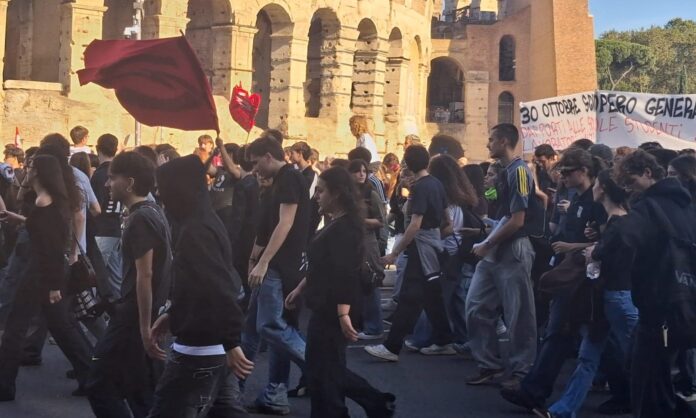
In the long, noisy march winding between the Esquilino and Trastevere districts, with students joining along the way from all over Rome, there are many very young students of the first classes, and many young female students leading their school contingents, megaphones in hand, chanting slogans. Amid the somewhat confused mix of issues raised by voices, banners and homemade placards — anti-fascism, Palestine, more funding for state schools, opposition to the cap on the number of foreign pupils per class imposed by the Meloni government few weeks ago — the message against war comes through more clearly this year. It is expressed not only in slogans such as “More classrooms, fewer bombs”, but also in an explicit rejection of rearmament, of the reintroduction of compulsory military service, which hangs over Europe’s young people, and, more generally, of the idea of sacrificing themselves on the altar of a Fatherland that offers these young people, in return, precarious, poorly paid jobs, homes they cannot afford, inefficient public services and, after all that, meagre pensions.
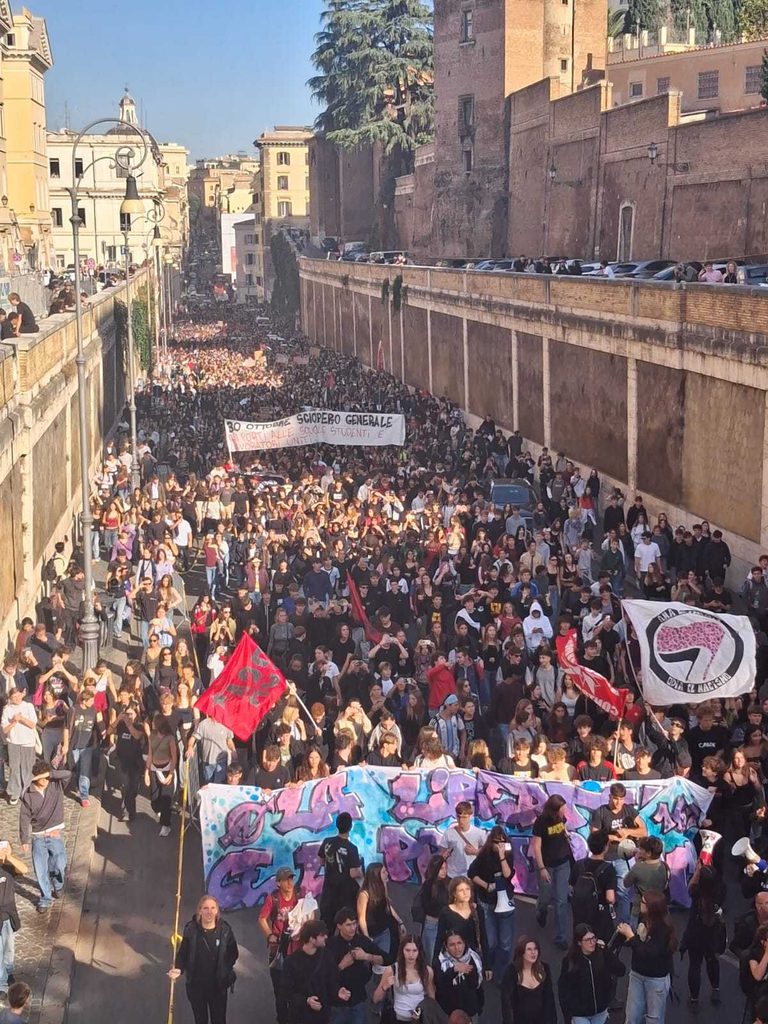
Before the march sets off, I come across a small group of students from the Caravaggio, an arts-focused upper secondary school. One of them holds a placard calling for more classrooms and fewer bombs. “What do you mean by that?” I ask. “We mean”, two young female students reply, “that at our school there’s a fallen tree branch that nobody has bothered to remove, and we have a broken window, but there’s never any money to get anything fixed. Yet they always find the money for bombs”. “And military service? People are talking about it in Italy too. Have you heard about that?”. “Of course, and that worries us as well.”
“You must prepare yourselves to lose your children in a war against Russia”, the head of the French armed forces declared a few months ago. Meanwhile, Germany”s Chancellor Merz, hailed by the liberal press as the standard-bearer in the fight against the “Nazis of the AfD”, has announced to the world that Germany “will have the strongest armed forces in Europe”. I ask some of the students whether they have read these statements. No, they say, but images of demonstrations by German and French students have been circulating on social media and have reached them.
“NO TO REARMAMENT”, reads a placard held by a student from the Augusto upper secondary school. “We’re against rearmament because it’s the first step towards war”, he explains. “We need to find other ways of managing international tensions”, another student chimes in. Their school has organised meetings with Ukrainian students, some online and others in person. “They came over from Ukraine for a day. They told us how they’re trying to carry on living a normal life even though they’re at war.” The conclusion they’ve drawn? More weapons are not the answer. If anything, “We have to do everything we can to avoid ending up in the same situation as them”.
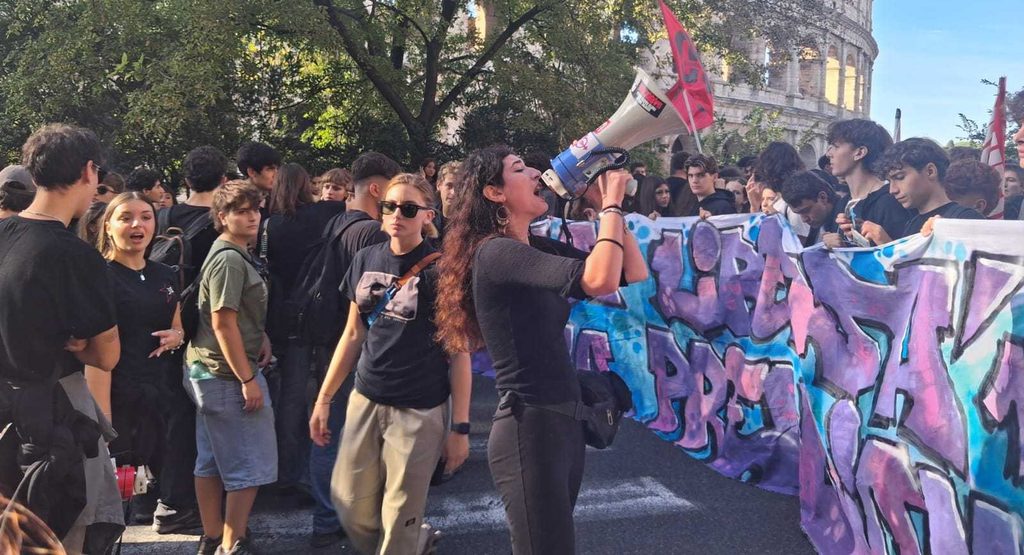
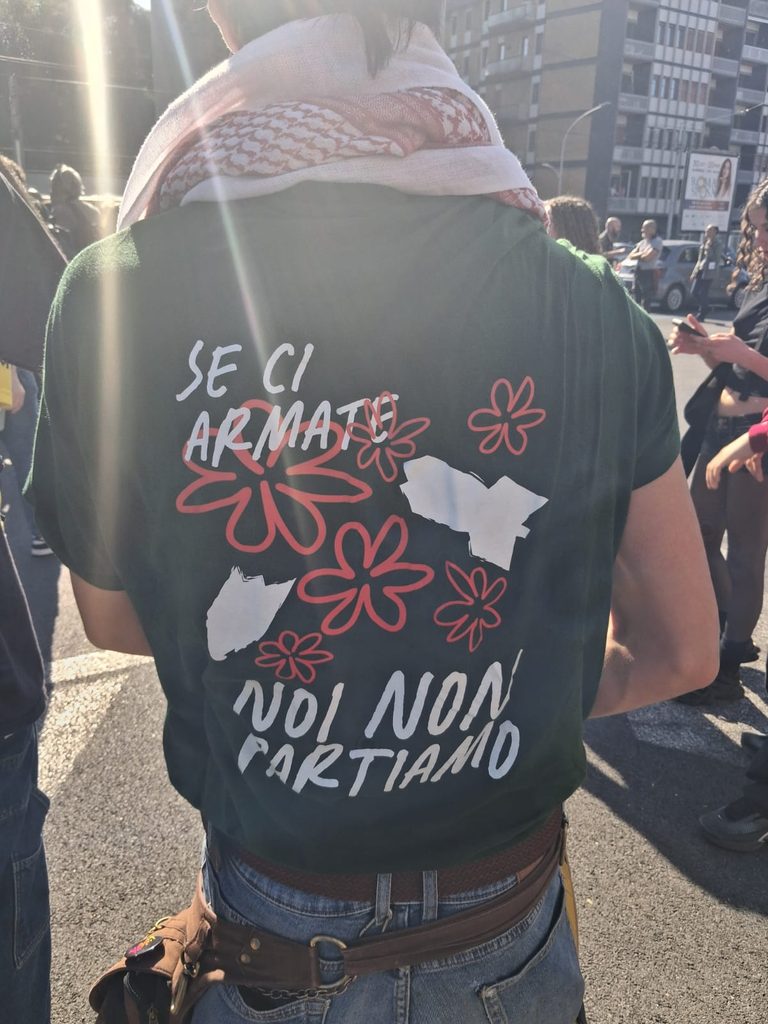
“We need more classrooms, not more bombs”, chants a young woman through a megaphone, fitting the words to a tune borrowed from the terraces of Italian football grounds. “We don’t want war,” declares another, standing in front of a banner reading “No to War”, with around ten placards behind her repeating the same message. But communication is also conveyed through T-shirts. “Youth is the most living flame of the Revolution. Lenin” I read on the back of one young woman’s shirt. On the back of a young man who looks a little older than most of the crowd, I read: “If you arm us, we won”t go”. “I’m a university student”, he confirms. “I’m a member of the Rete della Conoscenza (Knowledge Network – a leftist student union, which regroups university and secondary school students). Even among university students, the prospect of an approaching war is becoming a growing concern, and demonstrations in other European countries are helping to bring the issue into sharper focus. That”s why we’re working to ensure a strong turnout in Italy too for the international day of struggle on 20 November”. The following day, from the stage in Piazza del Popolo, Landini, General Secretary of the CGIL, the biggest trade union confederation in Italy, will announce that the CGIL will also take part on the same day, calling a general strike.
“Why is war such a prominent issue this year?” I ask a group of students from the Socrate upper secondary school. “Because schools are falling apart. There’s never any money for education, but they always find money for weapons”, replies one student who belongs to the Dante Di Nanni student collective [Di Nanni, 19 years old partisan, killed by the fascists] and is also a member of the Communist Youth Front (he makes a point of clarifying that he is here purely as a student). “Doesn’t the possibility of compulsory military service being brought back make you even more anxious?” I ask. “Well, it’s hard to rank these things. Between having to go into the military and a lifetime of insecure, badly paid odd jobs, I don’t know which makes us more anxious. Everything makes us anxious”.
There are also a few “contradictions among the people”, as we used to say in the past, but the paths taken by political consciousness are notoriously tortuous, today more than ever. “We get no help at all with buying schoolbooks, which can cost us as much as €1,200 a year”, says a female student from the Giorgi school when I ask her why she has come to demonstrate. “Then we have teachers who are getting older and older because they can’t afford to retire”. “And what about military service?”. “Oh well, I’m not against that, actually. I think it could be useful, an educational experience, especially for boys, but not as preparation for war”. “What? “exclaims a boy from the Levi Civita school, one of the upper secondary schools occupied by students this year. He is walking alongside us and has been listening to the conversation. “Rearmament and military service have nothing to do with education. They’re about preparing for war, and we don’t want to go to war. Nor do we want war brought into the classroom. Last year, our school was discussing a partnership with Leonardo (state owned company, one of the biggest across the world in the defense industry). In the end, nothing came of it, but we’re against schools organising work experience programmes or other activities with a company that manufactures weapons”.
As the march crosses Testaccio and heads towards Trastevere to reach the Ministry of Education -renamed the Ministry of Education and Merit under Meloni’s government- the first bangs ring out before arriving to the bridge: firecrackers, perhaps even cherry bombs. Several hundred students at the front of the march turn and run back in fear. “Are the police charging?” someone asks. After a few minutes, the demonstration resumes its normal flow.
This time, however, instead of merely parking police vans on the ramps leading up to the ministry and deploying a couple of riot police units on Viale Trastevere, the police headquarters has cordoned off the entire surrounding area, starting from the opposite bank of the Tiber. Even before the bridge, side streets have been blocked off by units from the State Police, the Guardia di Finanza and even the Penitentiary Police.
A hundred metres before the march emerges onto Viale Trastevere and turns left towards the ministry, another burst of explosions rings out, followed by another panicked retreat by the students. The march breaks apart. Several hundred continue towards their destination and, once there, gather outside the Ministry. Meanwhile, a group of masked youths target the officers deployed in front of the building with firecrackers, homemade explosive devices and foam from a fire extinguisher.
The rest of the march comes to a halt in Via Induno, outside the Troisi cinema, behind a banner, while the bulk of the crowd disperses. Walking back along the road, I come across groups of students debating whether to carry on. Some are on the phone with people at the spot where the firecrackers are being thrown. “It’s chaos, guys. I don’t fancy getting into trouble. I’m going home”, says one young woman.
I head towards Piramide to catch the B line. Three female students are walking beside me. They too are returning from the march: one is wearing a hijab, one is Black, the third – according to the criteria that Education Minister Valditara will apply to distinguish foreign and Italian students to implement his cap, should be “Italian” – or so I assume. “Regà” (Guys in Roma’s dialect), begins the one wearing the hijab, “you’ll see the news channels won’t say a word about this”. “No, La7 channel will cover it. TG1 won’t,” the others reply. “Yeah, but instead of explaining why we went on strike, they’ll just say there were clashes and people threw firecrackers. Whatever, sticazzi” (“who gives a damn” in Roma’s dialect) concludes the Black girl.
They laugh, and leave me with the final thoughts of the day. The first is that they understand how the system works. Things will unfold exactly as they predict. Local news outlets all lead with firecrackers, homemade bombs and “hooded demonstrators”. National outlets have a more mixed approach, but that is enough: the government condemns the “violence” of the protesters, while the “opposition” responds that, of course, “violence” must always be condemned, but that the demonstration itself was “peaceful”. Beyond the political theatre, the facts remain: the explosions effectively drove away most of the students who had taken part in the march. To what end?
My final thought regards the three young female students. If Valditara had happened to walk past, like any ordinary member of the public, I could have asked him which of the three he considered “foreign” and which he did not.