


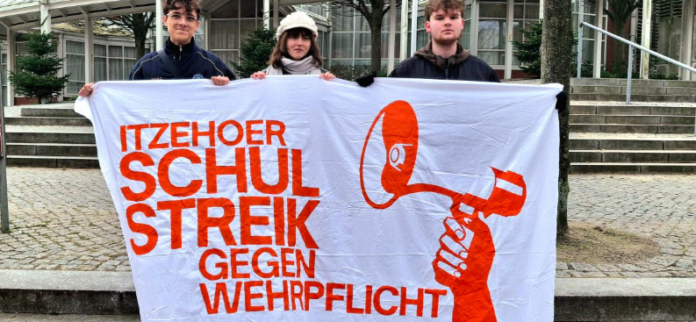
An interview with Lisa, a student activist with Schulstreik gegen Wehrpflicht
On Friday September 25, German students took to the streets for the fourth time to protest the new military service championed by Chancellor Friedrich Merz. More than 45,000 students and youth took part to the protest, shredding conscription surveys.
This interview, taken by Marco Veruggio was first published two days before the protest, on September 23. Lisa discusses the movement’s strategy for the new school year, the AfD’s ambiguous position on conscription, and how students in Italy can support their struggle.
- Friday will mark the first Schulstreik of the new school year. After a year of mobilization, how would you assess the movement’s experience so far? What are its strengths and weaknesses? And what is your strategy for the year ahead?
Friday’s action will be our fourth school strike against the reintroduction of conscription. Around 50,000 students from more than 100 German cities took part in each of the first three strikes. That shows there is strong opposition to the idea that young people should once again be forced to serve in the military.
Our strength is that we are a young movement that emerged from schools and is firmly rooted in them. We have also started building links with trade unions, workers and other social movements.
There is a clear connection between military service, rearmament and cuts to social spending. While billions are being poured into weapons and the military, money is being taken away from schools, housing and public infrastructure.
Of course, we also face challenges. We need to build stronger organizational structures in even more schools and bring more people into the movement.
Our strategy for the coming period is straightforward: we want to broaden resistance to both conscription and the mandatory medical examinations that precede it. These are not just some harmless administrative formality, but rather a prerequisite for drafting young people into the Bundeswehr. That’s why we reject them.
At the same time, we want to push the Bundeswehr out of schools. Schools should not be places for military propaganda or recruitment. They should remain places of education and independent thought.
- How much does it strengthen your position that only 530 of the 300,000 18-year-olds contacted by the Bundeswehr have volunteered to enlist, while Chancellor Merz appears to be losing credibility?
The figures show just how little interest young people have in the Bundeswehr. If only 530 out of around 300,000 18-year-olds voluntarily join the armed forces, it is clear that the federal government cannot solve its staff problems simply through advertising, job fairs or visits to schools.
That is why we can expect the government to move further toward mandatory medical examinations and the restoration of compulsory military service.
The growing dissatisfaction with Merz also shows that many people understand that dismantling the welfare state, imposing cuts and increasing militarization are not in our interests. While more and more money is being spent on weapons, resources are being taken away from schools and social security, and young people are being denied the prospect of a decent future.
That said, our movement is not about targeting individual politicians. Whether it is Merz, Pistorius or anyone else, if they continue down the path of rearmament, militarization and the return of compulsory military service, we will make our voices heard and organize resistance.
- How do you view the rise of the AfD, which voted against the government’s conscription plans in the Bundestag but nevertheless advocates military service for young Germans in its party platform?
We work with anyone ― individuals or organized groups ― who consistently opposes military service, mandatory medical examinations and militarization. The AfD is not one of them.
Its opposition to the government’s current plans to reintroduce conscription does not mean that it is fundamentally opposed to compulsory military service or rearmament. Quite the opposite: the AfD advocates military service for young Germans and supports an authoritarian and nationalist political agenda.
In other words, the AfD is not opposing the government’s plans because it rejects conscription. On the contrary, they clearly believe Merz’s policies do not go far enough.
At the same time, the AfD supports policies that benefit the wealthy and cuts those coming at the expense of working people. Its political positions are therefore clearly at odds with the interests of young people like us.
Therefore, we will not allow right-wing forces to present themselves as part of the peace movement. We are struggling against conscription and against a militaristic, pro-war agenda on behalf of all young people, regardless of their background, passport or nationality.
- Historically, opposition to war and militarism has been a central political battleground, but it has also been a source of division within the left. Today, part of the political left supports militarization and an aggressive foreign policy. How should this be dealt with?
For us, the priority is to take concrete action against conscription, mandatory medical examinations and militarization. We want to focus our efforts on organizing young people, promoting strikes and defending our rights.
Policies of rearmament that fuel war are often presented with an apparent veneer of progressivism. But militarization creates neither peace nor security.
It is not in our interest to fight against young people in other countries who share the same basic interests as we do: a safe life, a good education, social security and a future without war.
That is why we work with everyone who takes the struggle against conscription seriously. An aggressive foreign policy, rearmament and compulsory military service threaten peace and our security and this is not just a German issue: it is an international one.
- Is there anything that Italian secondary-school and university students, as well as anti-militarist activists, can do to support your struggle?
Italy is also moving toward greater rearmament. In many respects, then, we are fighting the same battle.
We need to build international solidarity and fight, each in our own country, to put an end to military service, rearmament and policies of war.
On a practical level, we would be very happy to receive messages of solidarity on Instagram and other social media. That would help show that our resistance is not isolated.
It would also be important to organize joint actions, exchanges between student movements in schools and universities, and mutual support when strikes and protests take place.