


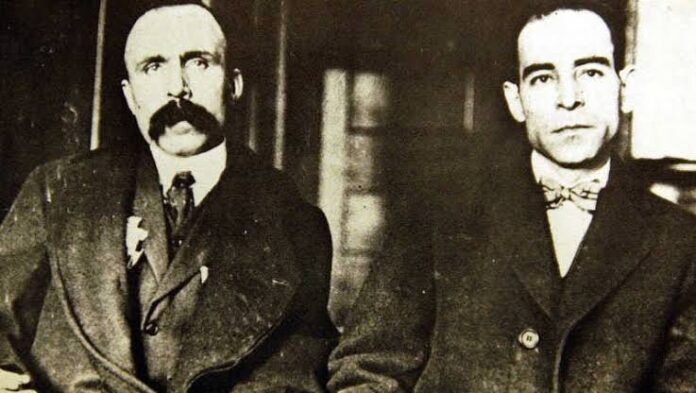
“If it had not been for these things, I might have lived out my life talking at street corners to scornful men. I might have died, unmarked, unknown, a failure. Now we are not a failure. This is our career and our triumph. Never in our full life could we hope to do such work for tolerance, for justice, for man’s understanding of man as now we do by accident. Our words – our lives – our pains – nothing! The taking of our lives – lives of a good shoemaker and a poor fish-peddler – all! That last moment belongs to us – that agony is our triumph”.
Bartolomeo Vanzetti
On August 23, 1927, after a legal battle lasting several years, Nicola Sacco and Bartolomeo Vanzetti were executed in Boston, Massachusetts, having been convicted of robbery and two murders. They were Italian immigrants to the U.S., poor laborers, and anarchists. Millions of people around the world watched with outrage as the sham trial led to their conviction, many took part in solidarity demonstrations and demanded their acquittal in the U.S. and elsewhere, while at their funeral—which turned into a mass protest and became known as “march of grief,” was attended by thousands of people, despite the overwhelming presence of large police forces; according to newspapers of the time, at least 200,000 people watched it.
This is one of the most famous trials of all time, as well as one of the most blatant acts of injustice against two immigrants who were, in fact, at the forefront of the struggle to overthrow the system. Sacco and Vanzetti spent about seven years in prison, waging a fierce battle against the U.S. judicial and political systems, and were ultimately executed despite a global outcry, because they were immigrants and because they spoke openly about the need to overthrow the system at a time and in a country where the slightest deviation was brutally persecuted.
Optimism and Fear
The 1920s were a period of euphoria for the United States. After the end of World War I, industry, construction, and the economy as a whole were booming, earning the decade the nickname “the Roaring ’20s.” At the same time, although the ruling class felt great self-confidence, the triumph of the October Revolution in Russia sparked fear and concern about the possible spread of subversive ideas to the United States. Thus, alongside the carrot of economic growth and the emerging “American Dream,” the stick of terrorism and the curtailment of democratic rights also prevailed.
The first episode of the so-called “Red Scare” that was dominant in the U.S. in the early years following the October Revolution (which would recur even more intense after World War II during the Cold War) included, among other things, the promotion of the idea that enemies of the American nation and the capitalist economic model were everywhere. These enemies were identified as communists and anarchists, who were primarily found among immigrants from Southern and Eastern Europe. Calvin Coolidge (U.S. president from 1923 to 1929) is known both for his hardline stance toward labor unions and the labor movement, and for the 1924 law that restricted immigration.
From Italy to America
During the same period, among the European working class -particularly among the poorest segments of the southern European countries- the prevailing belief was that emigration to the United States could offer significant opportunities to improve the standard of living for those who dared to make the journey. Even before the immigration restriction laws of 1921 and 1924 (which primarily targeted immigrants from countries such as Greece and Italy, while placing almost no restrictions on immigration flows from Canada, Mexico, etc.), there was essentially no numerical limit on the entry of immigrants into the U.S. Thus, it is estimated that between 1880 and World War I, approximately 25 million immigrants arrived in America.
Sacco and Vanzetti were among those who managed to reach the U.S. before the restrictive laws of 1921 and, especially, 1924. They both arrived (independently of one another, as they met several years later) in 1908. Nicola Sacco, who came from a relatively well-to-do farming family, became a shoemaker upon arriving in America, while Bartolomeo Vansetti, after holding several factory jobs, became a street fishmonger.
The “American Dream” was not what they had expected. Sacco describes how, upon arriving in the U.S., he discovered that people live “not in America, but under America”, and concludes that the system of exploitation must be overthrown. Both men embraced radical, anti-capitalist ideas and anarchism, aligning themselves with the ideas and actions of Luigi Galeani, a leading figure in American anarchism at that time.
The Charges and the Trial
On April 15, 1920, the paymaster of a shoe factory and the guard accompanying him and the cash shipment he was transporting were murdered during a robbery. In early May, Sacco and Vanzetti were arrested for the crime, and their trial began about a year later, in late May 1921. By July of that same year, they had been found guilty by a jury, following the tireless efforts of Judge Webster Thayer, who pursued their conviction with great zeal.
The evidence on which their convictions were based was, in fact, nonexistent. Initially, Thayer managed to convict Vanzetti of participating in another robbery that had taken place a few months earlier, on December 24, 1919. This happened despite the fact that more than ten witnesses testified that they had seen him elsewhere at the time of the robbery (on Christmas Eve, Italians eat eel, and Vanzetti had been at work all day supplying immigrant families with their traditional dish). The court did not take the Italian witnesses’ testimony seriously and sentenced him to fifteen years in prison. Thayer Knew -after all, he had planned it this way- that this initial conviction would prove particularly helpful for what was to follow.
In the second trial, in which Sacco and Vanzetti were charged with the murders and robbery of April 1920, the display of arbitrariness continues. Witnesses are pressured to testify against them, while others blatantly lie (for example, one person claims to have seen Vanzetti driving the car used in the robbery, even though it was well known that he does not know how to drive). Evidence related to the defendants’ weapons appears to have been fabricated by the prosecutors, who, moreover, turned the ideology of Sacco and Vanzetti into a central focus of the trial, completely disregarding the search for the truth and making it clear that this very ideology -and not the murders- is the primary reason they are on trial. Even the confession of Celestino Madeiros (a Portuguese prisoner) regarding his involvement in the robbery and murders, as well as his statement that Sacco and Vanzetti had nothing to do with it, was not enough to warrant a retrial.
A historic struggle against injustice and brutality
In the years between the conviction of Sacco and Vanzetti in July 1921 and their execution on August 23, 1927, they and their lawyers, labor unions, anarchist and left-wing organizations and parties around the world, as well as broad sections of the global working class, waged a great struggle -both in the courts and through social movements- demanding justice. Among other actions, they filed a series of appeals against the ruling and organized mass demonstrations and strikes on every continent.
They were fighting a battle against a system determined to impose its will, even though the whole world knew that this will had no solid foundation other than its clear intention to punish and terrorize anyone who dared to oppose it. A system that ultimately managed to win that particular battle, yet was left exposed in the eyes of societies across the globe, and of course failed to halt the labor and social movements, union activity, and resistance to injustice.
This resistance and perseverance were best described by Bartolomeo Vanzetti a few months before his death. Among other things, in his final statement to the court in April 1927, after explaining that he had in fact been convicted for his radical ideas and his background, he said:
“…but I am so deeply convinced that I am right that, even if you could execute me twice and I could be reborn two more times, I would live again to do exactly what I have done up to now.”