

The following text is a written contribution by the Revolutionary Socialist Movement (the ISp affiliate in Nigeria) to the 4rd Internationalist Meeting, which took place in Paris, May 15-17.
Africa as a Strategic Geopolitical Arena
Africa is increasingly becoming a crucial terrain of global geopolitical rivalry. The growing competition between major imperialist powers is reshaping political developments across the continent and influencing the consciousness of workers, youth and social movements.
In the 21st century, Africa has emerged as an arena where global powers compete for influence. Except the traditional colonial states of the United States, UK and the European Union, now China, Russia, Turkiye and other emerging powers are expanding their presence. Their interests are concentrated around key strategic areas: access to natural resources such as oil, gas, cobalt, uranium and rare earth minerals; control of trade routes and ports; military partnerships and “security cooperation”; and political influence.
This rivalry has effectively turned Africa into an important theatre of the emerging multipolar world order. Unlike the Cold War period, however, where the choice was mostly binary, African governments today attempt to balance relations among competing powers rather than relying on a single dominant partner. Many regimes pursue a policy of “multi-alignment”: cooperating with China on infrastructure, maintaining security and financial relations with Western states, while also cultivating links with other powers such as Russia.
These geopolitical shifts are deeply influencing political debates across the continent. Among sections of youth and activists there is renewed interest in anti-imperialist ideas and Pan-African traditions associated with figures such as Kwame Nkrumah, Thomas Sankara and Patrice Lumumba. Many recognize that formal political independence has not been matched by genuine economic freedom, due to the neo-colonial grip that still holds African countries down.
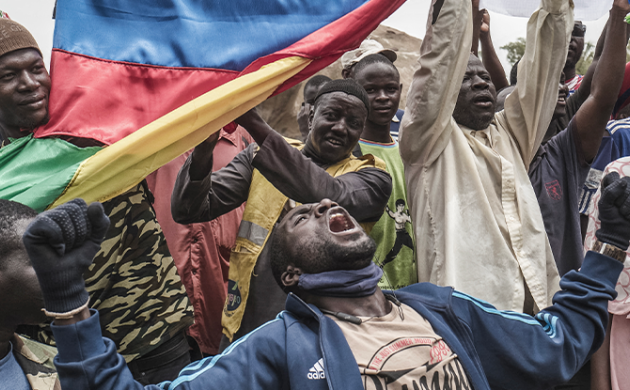
Across Africa, social and political struggles increasingly centre on key issues such as control of natural resources, external debt, foreign military presence and the demand for democratic and social rights. In regions such as the Sahel, opposition to foreign military intervention has intensified amid ongoing conflict and instability. Military regimes in parts of the region have exploited this sentiment while forming alliances that challenge the influence of traditional Western powers especially France.
Nigeria and the Crisis of the Neo-Colonial Model
Nigeria illustrates the broader contradictions of African capitalism. Despite being Africa’s most populous country and one of its richest in natural resources, the majority of Nigerians face unemployment, poverty and deteriorating living standards.
Since independence in 1960, the Nigerian economy has remained heavily dependent on crude oil exports. Multinational corporations and global financial institutions have played a decisive role in shaping economic policy, reinforcing Nigeria’s position as a supplier of raw materials rather than a producer of industrial goods.
This pattern reflects the neo-colonial structure anticipated by Kwame Nkrumah, who warned that political independence without economic control would reproduce new forms of domination. The influence of the IMF and World Bank has been particularly decisive. Structural adjustment programmes implemented from the 1980s onward liberalized the economy, weakened state industries and drastically reduced public spending.
The consequences have been severe: deindustrialization, rising inequality, declining social services and the erosion of productive capacity. The civilian governments that have ruled Nigeria since 1999 have largely continued along the same neoliberal path.
Nigeria’s political system reflects these economic processes. Political power remains concentrated in a tiny elite linked to global capital, oil rents and state patronage networks. Although formal democratic institutions exist, the political system functions in the interests of these dominant economic forces. The police heavily cracks down on dissent, protests and strikes.
The crisis therefore goes beyond issues of governance. It is rooted in the structural limitations of the capitalist model of Nigeria and Africa in general.
Africa in the Global Capitalist System
Africa possesses enormous economic potential due to its large population, abundant natural resources and expanding urban markets. Yet most African economies remain trapped in a position of dependency within the global capitalist system.
Almost all countries continue to rely heavily on commodity exports while industrial development remains weak. This is not an objective development, but a conscious policy on the part of the imperialists and the local ruling classes. Aside all the talk about the need to “develop” Africa, imperialists view it as a source of cheap raw materials and labour, and plan to keep it that way. African capitalists go along with this policy, satisfied with a slice of the cake.
These patterns are not accidental. They originate in colonial economic structures designed to integrate African territories into the world economy as suppliers of raw materials and consumers of manufactured goods. After formal independence, these patterns were largely preserved through global market relations and financial institutions.
As a result, most African economies remain highly vulnerable to external shocks and fluctuations in global markets.
Rising Social Resistance
Despite decades of promises by capitalist governments and international institutions, mass poverty remains a defining feature of the global system, and it is increasingly concentrated in Africa. Today around 800 million people worldwide still live in extreme poverty, surviving on less than $3 per day. While global poverty declined significantly after the 1990s—largely due to rapid growth in parts of Asia—this trend is now slowing and is projected to stall in the coming years. Actually, some projections predict that after 2030 extreme poverty will be on the rise again, due to falling GDP growth or recession. What is most striking is the geographic concentration of poverty: Sub-Saharan Africa, which contains only about 16% of the world’s population, now accounts for roughly 67% of all people living in extreme poverty. In other words, the epicentre of global poverty has shifted decisively to Africa.
The deepening social crises have produced growing resistance across the continent. Workers, youth and students increasingly challenge neoliberal economic policies and fight against cuts in social welfare.
Mass protests and social movements have erupted in several African countries in recent years, from Nigeria to Kenya and beyond. These struggles often emerge around rising living costs, unemployment, corruption and the failure of governments to provide basic services.
Trade unions, youth organizations and grassroots networks are increasingly debating alternatives to neoliberal economic policies. Many activists instinctively draw inspiration from earlier traditions of Pan-Africanism and proto-socialist thought that emphasize public control of resources, regional cooperation and development in the interests of the majority.
At the same time, parts of these movements advocate initiatives such as a borderless Africa or a single continental currency. While these proposals reflect legitimate aspirations for unity, under capitalism they would not resolve the underlying problems of inequality and dependency, but rather change their form (as the EU did not solve any of the problems of European workers).
The Need for a Socialist Alternative
For Marxists, the crisis of African development cannot be solved within the framework of capitalism. A fundamental transformation of the economic system is required, trough a socialist revolution.
Such a transformation would involve the nationalization of multinationals, natural resources and the commanding heights of the economy, under social and workers control and management; industrialization based on social needs rather than profit and within and environmental-protective framework; massive public investments in education, healthcare, agriculture and infrastructure. Economic planning under democratic workers’ control would be essential to break the cycle of dependency.
These processes cannot be fruitful in the long term on a national basis. Genuine integration across the continent would need to take the form of a voluntary socialist confederation capable of coordinating development and utilizing Africa’s resources for the benefit of its peoples.
The crisis facing Nigeria is therefore inseparable from the broader African struggle for economic liberation and social justice. The growing resistance of workers and youth across the continent demonstrates that the search for alternatives is already underway.
The task of socialist organizations is to help transform these struggles into a conscious movement capable of challenging capitalist domination and building a socialist future.
The Revolutionary Socialist Movement (RSM), the Nigerian section of Internationalist Standpoint, is committed to contributing to this struggle.