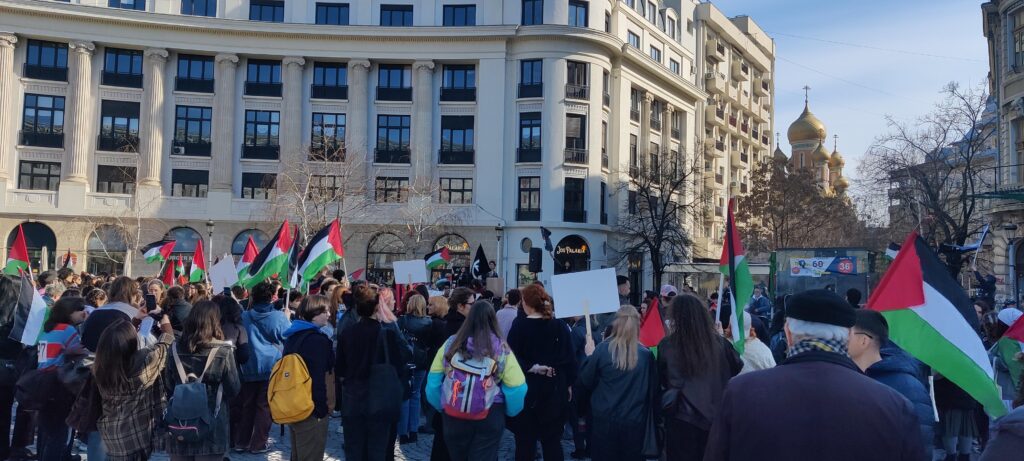


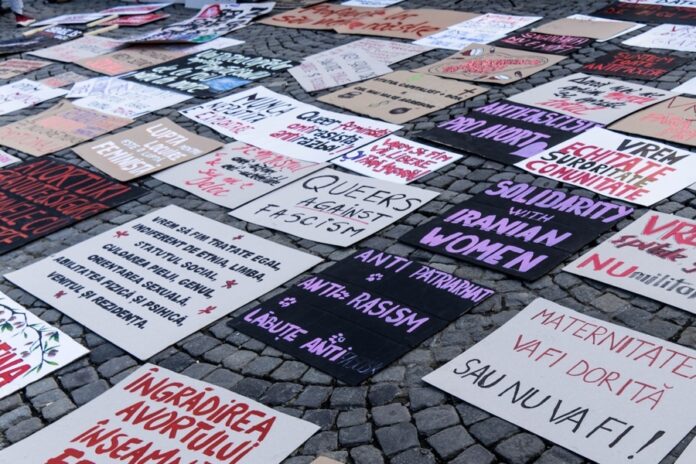
This speech was given by members of GAS (Socialist Action Group- the ISp affiliate in Romania) as part of the 8th of March demonstration in Bucharest, which was organized by multiple feminist groups, with the help of the “Mulțumesc pentru flori” (Thank you for the flowers) collective.
Today we do not resort to an abstract celebration, we are marking a day of historical revolt of women who understood that their oppression is no biological accident, but an economic necessity of the capitalist system. Our labour – be it waged or domestic – is put into the service of the production and reproduction of capitalist (dis)order, not because we want it to be this way, but out of a social compulsion.
Shelter, the emancipation of housework and child care, wage equality, ending sanitary poverty, defending reproductive rights and body autonomy, ending the epidemic of femicide, these are all problems that capital or the state takes little or no interest in, since they do not ensure profit. Yet all of these problems arise out of our place in the social organization of labour – they are the result of the social division of production based on gender.
Society punishes our very reproductive function. What we refer to as maternal “leave” is, in fact, an exhausting period of labour and essential in order to make possible the reproduction of society and of the workforce, which capital sees only as a resource worthy of exploitation. We no longer accept being reduced to this: we want control over this process. Instead of being recognized, this labour is sanctioned through cynical regulations: although parents who are on parental leave no longer have to pay in advance in order to keep their insurance, the state will still hold back 10% of their monthly pay as a contribution to CASS (the Romanian social health insurance system). Even though the beneficiaries of this type of labour are the employers, the state, as their tool, takes away from the little help that’s been fought for by the people who have decided to bring a child into the world.
Employees that require medical leave are no longer paid on their first day off. Although this is the case for all employees, regardless of gender, women are more affected, since in Romania, women are usually the ones who take days off to care for sick children. Moreover, women occupy more positions in lower-wage sectors. For someone with a minimum or medium wage, the loss of a full-day’s wage has a much more significant impact on their monthly subsistence budget than for someone with a higher wage.
Statistically speaking, women are more predisposed to certain autoimmune or endocrine disorders that can cause short-term crises. Many pregnant women need certain days off for medical check-ups or illnesses that do not require lengthy hospitalization, but do require rest. Each of these needs now require a day of unpaid leave. Women already have a more fragmented professional path due to maternal and childcare leave. Introducing an additional financial barrier punishes us for having an essential role in the reproduction of society. The system needs to renew the workforce, but it throws the burden of care on the shoulders of hardworking women. While capital secures its profits, we count unpaid work days and the costs of health insurance.
This lack of institutional protection is evident in the role of the police: the main goal of law enforcement is to protect the private property and the privileges of the rich, not the safety of the average woman. Femicide is not an isolated event, and social inequality facilitates a context in which violence is permitted. A financially precarious woman becomes an easy target for the aggressor. Institutions do not fail, they are doing their duty in protecting capital, while ignoring the woman. For the state, our safety is too great of a cost. It sees violence as a “private matter”, without considerable investments in logistics or protection.
While we are being told that “there is no money” for hospitals, health insurance, for daycare or for shelters for the victims of domestic violence, there’s always billions allocated to defence. This accelerated militarization is not about our safety, but about the protection and export of capital. Militarization always brings about austerity for the working class: resources are being redirected from the health and education budgets to fuel war machines. The truth is that a working-class woman has more things in common with a working-class woman from another country than they will ever have with the national capitalist class. We do not need a “patriotism” that calls for us to make sacrifices whilst the capitalists take away our health insurance. Our interests do not stop at the borders that are traced on maps. While capital globalizes in order to exploit us more efficiently, we call for the internationalization of resistance!
Our fight is not for flowers, but for life, for safety and for having control over our work and our resources. We refuse to be a commodity, used to enrich the capitalist class and to defend their interests. Our only border is solidarity, and our only way is class struggle.
Feminists, socialists, anticapitalists!