

This is a translation of an article initially published in Persian on Militaant, the website of the Iranian Revolutionary Marxists’ Tendency. Read more material on the 2026 war in Iran here
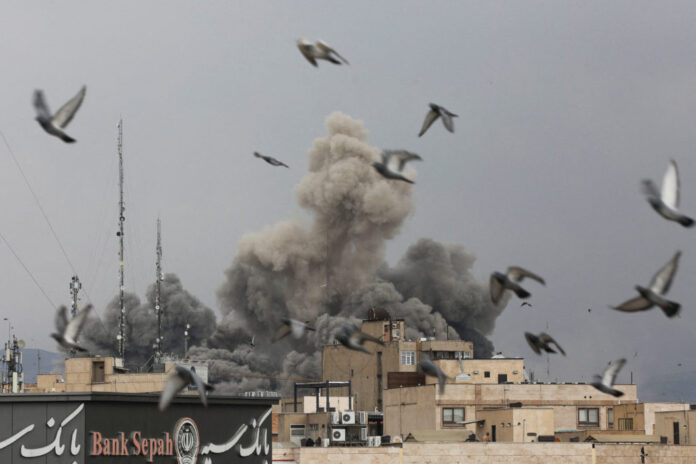
Amid the escalating military tensions between the Islamic Republic of Iran, the United States, and Israel, we are simultaneously witnessing a new wave of domestic repression inside Iran: arrests, executions, and the physical elimination of dissidents. Yet these acts of repression are often either marginalized in international media coverage or obscured beneath dominant geopolitical narratives. This raises several crucial questions:
Why do large sections of the so-called anti-imperialist or “Axis of Resistance” left remain silent about these repressions, or dismiss them as secondary? Why do they emphasize the supposedly anti-imperialist character of the Islamic Republic to such an extent that the regime’s forty-seven years of crimes are pushed into oblivion, while its supporters feel emboldened to march through the streets of Europe, the United States, and Australia carrying the flags, slogans, and portraits of their criminal rulers alongside sections of this anti-imperialist left?
Given the Islamic Republic’s long record of suppressing workers’ struggles, banning independent labor organizations, imprisoning, torturing, and even murdering militant workers, can it seriously be regarded as an anti-imperialist force? And can opposition to imperialism have any real meaning if it is detached from the struggle against capitalism itself?
Finally, does the current conflict involving Iran, the United States, and Israel bear any genuine relation to the struggle of the Palestinian people? Does rejecting the reactionary nature of one imply denying the legitimacy of the other? What, in fact, is the relationship between this war and the Palestinian liberation struggle?
In Socialism and War, Lenin explains that under imperialism, because of the global interpenetration of capital, most wars assume a reactionary character, expressing the rival interests of competing bourgeois classes.
At the same time, however, he distinguishes such wars from genuinely liberatory struggles, including the struggles of the exploited against their exploiters and the wars of oppressed nations against colonial domination, which can possess a revolutionary character. Although, with the transformation of classical colonialism, such national liberation wars appear less frequently today.
Accordingly, Lenin emphasizes three essential criteria for determining the nature of any war.
First, the objective content and aims of the war: a war waged for territorial expansion, domination, the division of lands, or the suppression of other peoples is a reactionary war. Lenin insists that wars must not be judged according to the patriotic or emancipatory slogans proclaimed by their instigators, but according to the real historical and economic aims pursued by the ruling classes behind them.
Second, which classes are carrying the war forward: if a war is directed by the bourgeoisie, the ruling capitalist classes, on one or both sides, and serves their interests, then it is a reactionary war. Even when workers are mobilized into such conflicts, they are not acting in pursuit of their own class interests, but are instead transformed into instruments of the ruling class.
Finally, the outcome of the war must be evaluated in relation to the interests of the proletariat. If the result of a war strengthens capitalism, consolidates imperialist domination, or reinforces different forms of oppression, then the war is reactionary because it stands in opposition to the historical interests of the working class. Under such conditions, workers have no reason to support their “own” state; their task is to oppose the war and confront their own ruling class.
With this framework in mind, we can examine the nature of the current conflict.
But first, it must be emphasized that, contrary to the claims of “anti-imperialist” and “Axis of Resistance” currents, which attempt to equate an Iranian victory in the present conflict with a victory for the Palestinian people, this war is fundamentally different in character from the Palestinian struggle. Recognizing the reactionary nature of one does not mean denying the revolutionary dimensions of the other.
On the surface, Iran presents itself as one of the principal supporters of the Palestinian movement, though in reality its support is directed primarily toward organizations such as Hamas. Yet the central purpose of this support is the expansion of Iranian capitalism’s regional hegemony.
The struggle of the Palestinian people, in its broad historical character, is a struggle for national liberation and the recovery of occupied lands. It possesses a genuinely emancipatory dimension and bears no essential relation to the current conflict between the Iranian state, Israel, and the United States, a conflict between competing capitalist blocs over regional hegemony, control of resources and maritime trade routes, and a larger share of the immense profits generated through energy and labor exploitation.
The leaders on all sides of this conflict, in Tehran, Washington, and Tel Aviv alike, are direct or indirect representatives of ruling capitalist classes. The contradiction between them is not a liberatory contradiction but an internal conflict within the global capitalist order itself. Under such conditions, the victory of any side will not improve the lives of workers and the oppressed, nor will shifts in the balance of power among these states alter the exploitative character of the prevailing economic and political structures.
Within this context, the claim that the Islamic Republic is “anti-imperialist” requires serious criticism. In the contemporary world, opposition to imperialism cannot be separated from opposition to capitalism as a whole. A state founded upon the exploitation of labor power, the systematic repression of the working class, and the destruction of all independent organization cannot simultaneously be regarded as a progressive force against imperialism. The conflict between the Islamic Republic and the United States and its allies is less an ideological or emancipatory confrontation than a dispute over the terms of integration into global capitalism and the distribution of its benefits.
Likewise, the Islamic Republic’s support for forces such as Hamas and Hezbollah must be understood within the framework of the regime’s geopolitical and regional interests. These policies serve less to advance the interests of the Palestinian or Lebanese peoples than to expand Iran’s regional influence and strengthen its bargaining position internationally. As a result, such strategies not only fail to contribute to genuine liberation, but by empowering authoritarian and reactionary forces, they also weaken the possibility of independent and emancipatory mass movements emerging within these societies.
At the same time, domestic repression, including the execution of protesters, cannot be understood separately from the logic of a capitalist state. These acts form part of a broader strategy aimed at suppressing labor and social unrest, producing an atmosphere of fear and terror, and stabilizing the existing order. The Islamic Republic understands very well that sooner or later agreements will be reached, and that imperialism, at least for the present, does not seek regime replacement. Consequently, once the current condition of “neither war nor peace” subsides, economic and social crises are likely to deepen further. It is therefore attempting, through naked violence and systematic intimidation, to eliminate any future possibility of independent organization within society. In this context, much of the Western anti-imperialist left, by reducing global contradictions to a simplistic confrontation between “imperialism” and “anti-imperialism,” effectively reproduces the official narratives of states such as the Islamic Republic. By ignoring domestic repression and the class character of these regimes, this approach not only generates dangerous illusions about their role, but also obstructs the formation of an independent political front rooted in the struggles of workers and the oppressed.
The consequence of such politics is the weakening of independent organization, the marginalization of class demands, and the postponement of any horizon of radical social transformation. Moreover, tying the Palestinian struggle to the policies of states such as Iran intensifies the danger that this struggle itself may be redefined within a reactionary framework and diverted from its emancipatory path.
Ultimately, distinguishing between the reactionary wars of states and the liberatory struggles of oppressed peoples is a necessary condition for any coherent Marxist analysis. Without such a distinction, progressive forces risk becoming, however unintentionally, instruments in the reproduction of the very order they claim to oppose. The historical responsibility of the left is not to choose between competing blocs of power, but to stand alongside the working class and support its independent and emancipatory struggles.