

Abel Ribeiro – Belém (PA)
Raphael – Rio de Janeiro (RJ)
Brazil experienced an historic election in October 2026, marked by the come-from-behind victory of Luiz Inácio Lula da Silva (Workers Party, PT) over the far-right candidate, Flávio Bolsonaro (Liberal Party, PL), who was supported by Donald Trump’s U.S. imperialism and by sectors of Big Tech companies. Despite its defeat in the presidential race, the far right demonstrated electoral strength in the first round, winning state governments and expanding its representation in the National Congress, both in the Chamber of Deputies and the Senate.
The election took place in two rounds. In the first round, Flávio Bolsonaro received 56,104,503 votes, compared to 53,879,538 for Lula. The result initially created a sense of pessimism and defeat among broad sectors of the left but also ushered in a new political dynamic. At the start of the second round, a process of social mobilization began, initially driven by student protests and later expanded to include different sectors of society. The threat of a possible return of the far right to power led to a movement of protest on the streets and social media, contributing to a historic electoral turnaround.
In the second round, Lula received 64,256,232 votes (51.79% of valid votes), compared to 59,826,041 votes (48.21%) for Flávio Bolsonaro. Although opinion polls had indicated Lula as the favorite, the first-round result surprised much of the left. The high abstention rate of 21.08% and Flávio Bolsonaro’s significant share of the vote highlighted the difficulties faced by the PT campaign. In the second round, however, following an intense campaign on the streets and on social media, changed the political landscape. The abstention rate fell to 19.22%, one of the lowest rates recorded in the last two decades.
These figures must be understood in light of the popular mobilization, the efforts of artists, intellectuals, students, and workers, and the pressure exerted on Lula’s campaign to adopt more left-leaning positions on certain issues. Also significant was the effort to reach voters who had not turned out for the first round, including the elderly and people with disabilities, who—despite the difficulties—participated in the election to defend democracy and social rights threatened by the far right.
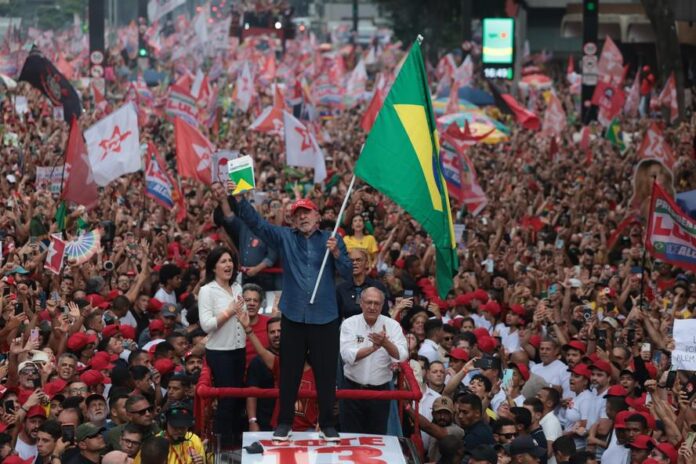
The sense of defeat in the first round ultimately served as a catalyst for a process of mobilization and politicization. Lula’s victory was not only the result of institutional coordination among the parties, but also of the mobilization of sectors of the masses who took to the streets and social media. The campaign took on a new dimension as it confronted Big Tech, Meta, financial capital, agribusiness sectors, and major media outlets. A “red wave” swept across the country, with demonstrations in numerous cities involving students, workers, artists, digital influencers, and millions of people determined to break through the Bolsonaro bubble.
One of the hallmarks of this campaign was the use of social media as a tool for political mobilization. Federal Deputy André Janones, through the WhatsApp channel known as “Exército do Lula” (Lula’s Army), brought together millions of participants and organized communication efforts and the dissemination of content supporting the PT candidate. This initiative took on the characteristics of a national digital mobilization structure, enabling the left to compete for a space historically occupied by the far right. This included overcoming the restrictions imposed on digital platforms and thus expanding the campaign’s reach into sectors that had not been reached in the first round.
Public pressure also brought issues related to income, labor, and social programs onto the campaign agenda. The debate over online gambling (bets), the expansion of the Bolsa Família (“Family Budget”) program, and the reduction of the workweek—including the end of the 6-on-1 shift schedule—took center stage. It is necessary, however, to distinguish between the proposals announced during the campaign and the measures that were actually approved and implemented.
Flávio Bolsonaro, for his part, attempted to curb the rise of the Workers’ Party (PT) candidate and sought to incorporate part of Lula’s social agenda, promising to maintain programs such as Bolsa Família. However, his position on the reduction of the work week and the future of Brazilian public enterprises remained a subject of political contention. During the televised debates and throughout the campaign, there were also controversies surrounding statements deemed ageist and ableist, which reverberated on social media and fueled electoral polarization.
Lula’s victory over Brazil’s far right has ushered in a new political landscape, with international repercussions. The result was closely followed by progressive movements and left-wing organizations in various countries, especially in light of the growing opposition to the policies of the right and the far right. It is clear that the electoral victory does not put an end to the conflicts that marked the previous period. The challenges remain and are likely to manifest themselves again in the political, economic, and social struggles in the coming period.
Even before beginning his fourth term, Lula has presented Congress with a “fiscal adjustment” budget proposal that calls for cuts of approximately R$60 billion (over $10 billion) in public spending. The contradiction between the expectations raised by popular mobilization and the promises made to the financial markets poses new challenges for workers and the Brazilian left.
The Election in Brazil and the Capitalist Crisis
The world is experiencing a situation marked by the tension between reform and revolution, amid wars, geopolitical conflicts, and the deepening of the contradictions of the class struggle. The war between Russia and Ukraine, which began in 2022, remains one of the most dramatic manifestations of this situation. Conflicts involving the United States and Iran also affect international political and economic stability. At the same time, the structural crisis of capitalism and the struggle for global economic hegemony between the United States and China are reaching new heights.
U.S. foreign policy is likely to encounter new problems in light of changes in the domestic political landscape of the United States. International disputes are taking place against a backdrop of growing political polarization, with shifts in the balance of power among social classes and different power centers. Although these changes occur unevenly across countries, there is a trend toward the intensification of social and political conflicts in the face of an increasingly unstable world order.
The electoral defeat of the candidate backed by U.S. imperialism in Brazil represented a setback for Trump’s interests in South America. The disputes over rare earth minerals, natural resources, and Brazilian economic sovereignty demonstrates that the country occupies an important strategic position on the international stage. The election result also fueled expectations of resistance to imperialist intervention across the world.
Popular protests in various countries—including the United States, Argentina, France, Portugal, Italy, and Greece—reflect the existence of social conflicts and a willingness to fight among different sectors of society. It is important to understand these mobilizations in their specific contexts, without losing sight of the common elements that characterize the current international situation: the precarious nature of work, social inequality, a crisis of political representation, and dissatisfaction with traditional institutions.
The Palestinian issue remains one of the most dramatic manifestations of contemporary conflicts. The Palestinian people continue to face military offensives and the State of Israel’s policy of occupation, while the situation in the Middle East remains marked by regional wars and international conflicts.
The climate crisis is also accelerating and highlighting the limitations of environmental policies implemented by governments and international institutions. COP 31, held in Turkey, once again brings into focus the commitments made by countries regarding global warming, but the targets for reducing greenhouse gas emissions remain insufficient given the scale of the problem.
In Brazil, the environmental crisis remains unresolved. While the Lula administration has agreed to international commitments for environmental protection, different regions of the Amazon continue to be threatened by deforestation, wildfires, and the expansion of predatory economic activities. The delay in the demarcation of indigenous lands and the government’s political relationship with agribusiness sectors demonstrate the limits of its environmental policy and the contradictions of its policies.
The Lula 4th administration and the interests of the working class
The Lula administration can be characterized as one that seeks class reconciliation, organized around a broad political and institutional alliance. Its composition reflects distinct and often contradictory social and economic interests. On the one hand, sectors of the working class, social movements, and grassroots organizations have high hopes for the expansion of social rights. On the other hand, business, financial, and agribusiness sectors are part of or influence the government.
This feature places the government in a constant dilemma: seeking to address popular demands without breaking with the economic and political interests of big business that are part of its political base. This ultimately leads to a continuation of the neoliberal policies that dominated Brazil since 1985.
The proposed $10 billion budget cuts in public spending highlights this contradiction precisely at a time when broad sectors of the population are hoping for improvements in their living and working conditions.
Union leaders, social movements, and sectors of the left have been voicing criticism of the austerity measures, arguing that millions of workers did not mobilize to elect Lula in order to see the economic policies of previous governments repeated. The contradiction between popular expectations and the demands of the financial markets could fuel further discontent and even open the door to the far-right opposition.
The central problem is not simply in the composition of the cabinet or in internal government disputes, but the very orientation of its economic policy and the relationship it establishes with the social classes. For workers, the question is how to transform the strength demonstrated in the streets and at the polls into independent organization, the capacity for struggle, and concrete gains.
A new phase in the reorganization of the Brazilian left
The mobilizations that contributed to Lula’s victory have opened up possibilities for a reorganization of the Brazilian left. The electoral process revealed the existence of broad social, student, and political sectors of society with an advanced consciousness, a strong presence on social media and a willingness to participate in political struggles.
A new generation of activists, leaders, and representatives of the left is taking up positions in the political arena, challenging traditional methods of organization and the leadership that has historically guided the major parties. This shift does not necessarily mean the disappearance of the old organizations, but it points to changes in the relationship between party leaderships and the new sectors entering the political struggle.
The PT has emerged electorally stronger, although it must confront the contradictions in its relationship with the government and with the sectors that make up its support base. The party has expanded its presence in various institutional spheres and will have to manage internal disputes related to Lula’s succession in 2030.
Another significant development is the rapprochement between sectors of the PSOL (Partido Socialismo e Liberdade – Party for Socialism & Freedom) and the government. Guilherme Boulos’s (leader of PSOL) announcement that he will enter Lula’s PT government in 2027, could lead to new realignments on the left for political leadership of social movements.
PSOL, for its part, faces challenges related to its political character, its internal composition, and its role in the reorganization of the left. Although it has cleared the electoral threshold, the party must grapple with the difficulties of expanding its political and social influence, especially in key states such as Rio de Janeiro, where it has lost ground to the PT itself at the polls and to Unidade Popular (UP- Popular Unity) within the university student movement.
The challenge facing the PSOL is to move beyond an approach that is overly focused on parliamentary manoeuvres and to develop its capacity to organize among workers, youth, and social movements. This requires a reevaluation of its platform, its strategy, and its relationship to the concrete struggles unfolding outside Parliament.
The Radical Left and New Organizational Challenges
To the left of the PT and the PSOL, organizations such as the PSTU (Socialist Workers Unity Party), Unidade Popular (UP), PCB (the Communist Party of Brazil), and PCO (Workers Cause Party) must also confront the challenges posed by the new political landscape. Each has its own political tradition, organizational structure, platform, and interpretation of Brazilian reality.
The issue is not simply to identify which of these organizations is the most dynamic at a given moment, but to understand their capacity to intervene in social struggles, to train new activists, and to build a political alternative that engages with the most militant sectors of the working class.
Internal disputes are likely to intensify in the coming period. Different factions and political sectors hold divergent views on the relationship with the Lula administration, parliamentary action, and the need to build an independent socialist alternative. In this context, the maneuvers of national and state leaders—such as the efforts of Sâmia Bomfim and public figures linked to the Socialist Left Movement (MES), who, together with Congressman Glauber Braga and PSOL newcomer Jones Manoel (who has been waging a public battle in Congress against the fiscal austerity measures proposed by the Lula administration), also reflect the struggle over the PSOL’s political and organizational direction.
The fragmentation of the socialist left is a historical problem. Programmatic and strategic differences, while legitimate and necessary at certain times, have also created difficulties in building joint initiatives. The challenge is to find ways to achieve unity in action without erasing existing political and theoretical differences.
The Process of Reorganizing the Left and PSOL
The process of reorganizing the Brazilian left cannot be understood solely through the lens of internal disputes within the ruling PT and PSOL. There are social movements, collectives, student organizations, union leaders, and political groups that operate outside the traditional party structures. To disregard these processes would be a mistake.
It is common to find, in different sectors of the left, the expectation that a new upsurge of the masses will automatically produce better conditions for socialist reorganization. Although periods of intensified social struggles are particularly fertile for the emergence of new political phenomena, there is no automatic relationship between mass mobilization and the strengthening of revolutionary organizations.
A rise in the movement can produce new leaders, broaden political consciousness, and create the conditions for the formation of new organizations. However, without a program, strategy, political education, and organizational tools, many of these initiatives may dissipate or be absorbed by existing political structures.
Therefore, overcoming the fragmentation, demoralization, and dispersion of the socialist left requires more than simply waiting for a new wave of mobilizations. It is necessary to build political frameworks capable of engaging with the new sectors joining the struggle, to present a program that addresses the concrete problems of workers, and to establish relationships of trust with organizations active in social movements.
In this context, the possibility of building a new left-wing party—with a platform further to the left than that of the current PSOL—must be considered as a political possibility, not as a foregone conclusion. This possibility is not necessarily presented as an immediate necessity, but it may take on greater relevance depending on the evolution of the class struggle, the contradictions within the Lula administration, and the limitations of existing organizations—particularly given the outcome of the internal struggle within PSOL—that is, depending on the direction the party will take in the coming period.
The key is not to allow current party structures to become insurmountable barriers to socialist reorganization. The political reality is dynamic, and the process of reorganization can arise both from internal fracturing as well as from developments outside the existing political parties.
The task for the coming period is to understand these movements, engage with them, and contribute to building a socialist left with greater organizational capacity, political independence, and roots in the working class. While this article was being written, a new internal faction of PSOL was launched: the Brazilian Revolutionary Movement (MRB), which brings together various Marxist tendencies. Its leading figures include historian and digital influencer Jones Manoel (formerly of the PCBR and PCB), federal deputies Glauber Braga and Duda Salabert, and longtime PSOL activists Milton Temer and Berna Menezes. In addition to them, the faction has brought together the ‘PSOL Fortalecer’ and ‘Alternativa Comunista’ factions (former activists from ‘Resistência Socialista’) and various left party activists, including some city council members and state representatives. Together, the MRB and MES (Movimento Esquerda Socialista-Socialist Left Movement) can challenge the PSOL leadership and fight for the party’s direction toward a line more independent of Lula and the PT.
The electoral defeat of the far right is a significant development, but it does not resolve the contradictions that gave rise to its growth. The contest remains open. The challenge for the left is to transform the social energy mobilized during the campaign into permanent organization, class consciousness, and the capacity to fight. It is on this ground that the next chapters in the reorganization of the Brazilian left will unfold.