

Defending Life, Rebuilding the World
Antalya · 15–18 November 2026
We call on the peoples of the world!
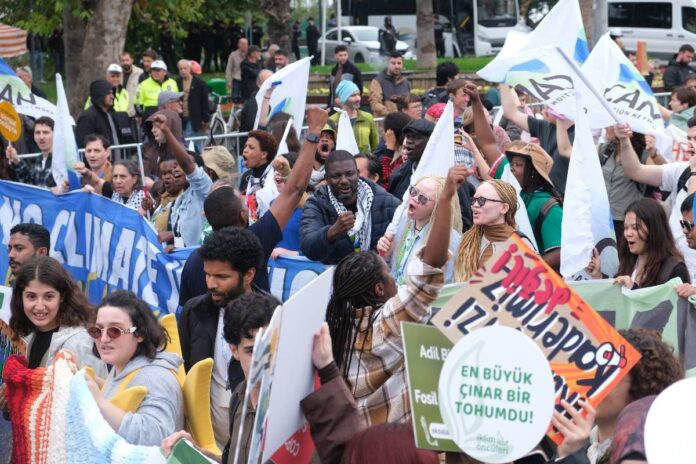
We came together at the Peoples’ Climate Summit in Antalya from across the world. We are workers, peasants, small-scale producers, Indigenous Peoples, women, young people, ecological and climate justice movements, trade unions, peace advocates, scientists, rights organisations and communities defending life.
We came to Antalya to do more than discuss the consequences of climate change. We came to change the social and economic relations that drive the climate crisis, to bring together struggles from across the world and to build together the material conditions for a different way of life.
We live in an age of disaster and necropolitics.
The atmosphere is warming, oceans are acidifying, freshwater is being depleted, forests are disappearing, farmland is being poisoned and biodiversity is suffering losses that will be hard to reverse. Millions of people are struggling to survive amid hunger, poverty, war, forced migration and insecurity.
COP31 was billed as the “implementation COP”. It has already gone down in history as the summit at which governments accepted that the Paris Agreement’s 1.5°C target would be exceeded and sought to postpone meeting it until the end of the century. But overshooting the target does not mean the overshoot must be permanent. Even holding global warming at 1.5°C will have irreversible ecological consequences. It is unacceptable to defer the target to a time when those making the decisions will no longer be alive and to make warming above 1.5°C the new normal for this century.
Warming of 1.5°C is no warning of a distant disaster. It is the disaster we are already living through. The devastation caused by floods and landslides in Nepal, the lives lost and the communities displaced show that the disaster has already begun. Every increment of warming deepens the destruction and increases irreversible losses. Emissions reduction targets must therefore be revised to meet the needs of nature and peoples, rather than corporate interests. We must insist on avoiding an overshoot and on progressively bringing warming below 1.5°C.
Nor does this crisis affect everyone equally. In a world where economic and political power determine who gets to live and who is left to die or face hunger, thirst and displacement, the climate crisis deepens inequalities that determine who lives and who dies. In the Global North as in the Global South, people subjected to discrimination bear a disproportionate share of the costs of ecological destruction.
We reject policies that profit from disasters, turn devastation into new opportunities for capital accumulation and use emergencies to entrench exceptional forms of rule and curtail social rights. We reject authoritarianism, militarised borders and the sacrifice of people’s lives in the name of disaster management.
The climate crisis cannot be understood apart from a capitalist mode of production that treats nature as something to be used without limit and human labour as an input whose cost must continually be driven down. The drive to keep accumulating capital is increasingly at odds with the planet’s ecological limits and with what people need to live in dignity.
At a time when we need to phase out fossil fuels rapidly and protect freshwater ecosystems, the rapid expansion of data centres under capitalism could become one of the defining ecological problems of our time. Their growing demand for electricity puts pressure on governments to delay closing fossil-fuel power plants and, in some cases, to reopen decommissioned plants or build new ones. Cooling systems can draw large volumes of freshwater from bodies of water already under pressure from global warming and industrial use. Even when data centres run on renewable electricity, extracting the minerals and other raw materials needed to build them and the energy infrastructure that powers them can damage ecosystems and the places communities call home in the Global South. We must therefore ask not only how data centres are powered, but also who decides what they are for, at what scale they are built and who bears the ecological cost.
We do not see the climate crisis as a technical problem that can be solved simply by replacing fossil fuels with other energy sources or putting a price on carbon emissions. The crisis raises questions about what production is for, how resources are distributed, who makes decisions and whose needs shape the way society is organised.
In ancient Anatolian thought, air, water, fire and earth were understood as the four elements that make life possible, known as çar anasır. Today air is polluted, water is commodified, land is handed over to corporations, and fire becomes the destructive force of war, wildfires and extreme heat. Yet human beings do not stand outside the nature in which they live. The macrocosm and the microcosm are connected, as are the planet’s life cycles, the human body and the continuity of social life.
The peoples’ climate struggle, from Copenhagen to Glasgow and from Belém to Antalya, is an ongoing one, and we are part of it. We bring together what struggles for food sovereignty, agroecology, feminist transformation, labour rights, peace and ecological justice have learned across the world, and draw on that experience to build a common vision for social transformation.
I. Defend the rights of nature, stop ecocide!
Nature is not a stockpile placed at humanity’s disposal. Forests, rivers, mountains, wetlands, seas, soils and all living beings exist through interconnected ecological relationships. Defending the rights of nature means refusing to define these relationships solely in terms of economic value or to subordinate them to corporate profits. Recognising that humanity is part of nature and cannot survive on Earth unless all living beings are respected, we demand legally binding recognition of the rights of nature.
Mining, industrial agriculture, energy and infrastructure projects, deforestation and urban development driven by land rents fragment ecosystems and cause damage that is difficult to reverse. Ecological destruction also dispossesses and displaces people. Peasants who lose their land, coastal communities whose fishing grounds are polluted and Indigenous Peoples whose forests are destroyed can lose not only their livelihoods, but also their social ties, culture and historical memory.
The loss of a forest, a sacred site, a burial ground or local knowledge passed down through generations cannot be measured in money alone. Ecological restoration must rebuild social and cultural ties as well as repair the physical environment.
We demand that ecocide be recognised as a crime under national and international law, that activities causing severe ecological destruction be stopped and that responsible corporations and public authorities be held to account. Local communities must have guaranteed rights to information, decision-making and effective legal remedies. Indigenous Peoples’ right to free, prior and informed consent must be recognised. The criminalisation and repression of those resisting ecological destruction must end.
Stop plundering nature in the name of a green transition!
We reject a new wave of mining and raw material grabs in the name of phasing out fossil fuels. Growing mineral demand for electric vehicles, batteries and renewable energy technologies is causing fresh ecological damage and deepening unequal trade relations, especially in the Global South. One region’s energy transition cannot come at the cost of another’s destruction.
In Türkiye, struggles from the Kaz Mountains to Akbelen, from İliç to Develi and from Varto to Diyadin make visible the effects of mining and energy policies on forests, pastures, farmland and watersheds. Hosting a climate summit cannot hide the ecological damage within Türkiye or the movements resisting it.
The extraction and trade of critical minerals must respect ecological limits, labour rights and international justice. Intellectual property regimes that perpetuate technological dependence and unequal trade must be transformed, and scientific knowledge and technology must be used for the common good.
II. Phase out fossil fuels, build energy democracy!
Coal, oil and fossil gas production and consumption must be reduced rapidly through planning. New fossil fuel exploration and extraction projects must end, and a binding and equitable timetable for phasing out existing production must be based on what climate science requires. Countries historically responsible for the highest emissions must move faster and provide the necessary finance and technological support.
The success of the energy transition cannot be measured solely by how much renewable capacity is installed. In a system controlled by private energy monopolies, expanding renewables does not in itself end energy poverty, unequal distribution or excessive resource use.
Energy production and distribution must be organised around social needs under democratic public control. Public energy systems, energy cooperatives and community-led models in which workers, users and local communities take part in decisions must be supported.
Renewable energy projects must also respect ecological limits, farmland, biodiversity and community rights. Energy efficiency policies should transform sectors that use excessive amounts of energy, rather than forcing people on low incomes to cut their basic consumption.
The collective power of the working class is decisive in bringing about this transformation. The workers who carry out production also have the power to stop it, change it and reorganise it. A democratically planned fossil fuel phase-out requires recognising workers as decision-makers in the transformation, not simply as people affected by it.
Nuclear power is dangerous at any scale! Stop nuclear expansion from Akkuyu and Sinop to the rest of the world!
Low carbon emissions from electricity generation do not make nuclear power clean. From uranium mining to radioactive waste that must be managed for generations, small modular reactors and large power plants alike come with ecological and social costs. The accidents at Three Mile Island, Chernobyl and Fukushima exposed the risks of reactor accidents. Displacement after Chernobyl and Fukushima meant losing homes and livelihoods, but also damaged social ties built over generations, cultural memory and people’s relationship with the land. Governments and operators must be held accountable and provide long-term compensation and support. Affected communities must make the decisions about reconstruction. We demand a halt to construction at Akkuyu, the cancellation of the planned plant at Sinop and an end to nuclear expansion worldwide.
III. Ecological destruction kills. Health is a right!
COP31 discussed how health systems could withstand the climate crisis, but put forward no binding measures to change the forms of production that make people ill.
Ecological destruction can kill in a single flood or over years of breathing polluted air, drinking poisoned water and living with contaminated and degraded soil. We cannot think about health in isolation from ecocide, peace or the right to life of people living in poverty and those most at risk. Corporations profit from destruction while workers and people living in poverty bear the greatest burden of illness and premature death. The right to health is real only when we can change the conditions that make us ill and protect the health of the ecosystems we live in. It requires a high-quality, equitable public health system that is free and accessible to everyone and provides treatment when we need it. To prevent the deaths caused by ecological destruction and the climate crisis that are so often made invisible, we demand clean air, safe water and food, healthy working conditions and free public healthcare for all.
Fund life, not war
War and militarism are inseparable from the ecological crisis. Arms production and military activity consume vast amounts of energy, raw materials and public funds, while wars destroy cities, farmland, water infrastructure and ecosystems. Chemical pollution, explosive remnants, biodiversity loss and the effects of destroyed infrastructure persist for generations after conflicts end.
There is no climate justice without justice for Palestine!
In Gaza, war and occupation are destroying lives along with the water infrastructure, farmland, health facilities and ecosystems that sustain life. We condemn Israel’s genocide in Gaza, the occupation and forced displacement. We demand an immediate and permanent end to the violence, an end to the occupation, accountability for those responsible for war crimes and crimes against humanity, and recognition of the Palestinian people’s right to self-determination. Palestinian communities must lead ecological restoration and reconstruction without being forced into new forms of dependence.
NATO members’ pledge to allocate 5% of their GDP to defence and security-related spending by 2035 shows where budget priorities lie in a world that still falls short on climate finance. Military spending must be cut and redirected to climate finance, public services, the transformation of food systems and ecological restoration. Military emissions must be included in climate policies, and the rights of workers in the arms industry must be protected.
From Sudan to Congo, from Ukraine to every region affected by conflict, we call for an end to war, occupation and ecological destruction. In Türkiye, we stand for democratic peace and for redress of the social and ecological harms caused by conflict. Peace requires a world without borders, where all peoples live in freedom and equality and freedom of movement does not depend on citizenship.
Peace in the Kurdish question must also mean peace with nature!
The harm caused by conflict over the Kurdish question to the living and non-living constituents of nature must be fully documented and the findings made public. The current disarmament process must not be used to open the way for new, large-scale plunder of nature. Civilian mechanisms for monitoring and implementing peace must be established with the participation of ecological organisations.
The struggle against war, militarism, racism and every form of colonialism is integral to our climate politics. We renew the ecological movements’ call for peace and bring the experience and memory of our struggles into Türkiye’s “Resolution and Social Peace” process. For us, peace begins when the guns fall silent and endures when human and other-than-human life can flourish.
IV. We demand food sovereignty!
Food systems both drive the climate crisis and suffer its effects. Industrial agriculture, deforestation, heavy chemical use, dependence on fossil fuels, long supply chains and industrial animal farming intensify ecological destruction, while droughts, floods and extreme heat make it harder for small-scale producers to make a living.
Food sovereignty is the right of peoples to determine their own food and agricultural systems democratically. It requires collective control over land, water, seeds and the means of production, and protection of the rights of peasants, farmworkers, fishers, pastoralists and local communities.
Agroecology is a path to social transformation that brings together land rights, local and scientific knowledge, feminist struggle, collective organising and solidarity economies. It must be recognised as a central approach to climate adaptation in agriculture and food systems and supported through public funding.
We oppose the destruction caused by industrial animal farming, grazing practices that damage ecosystems and the commodification of animals. We support ecological farming that does not rely on the use of animals and plant-based agroecological production. Public incentives must support this transformation and access to healthy food for all while protecting the rights of producers and workers. We distinguish the traditional livelihoods of pastoral peoples and communities from grazing practices spread by colonialism in many parts of the world, which have fuelled the loss of tropical forests in particular.
Dependence on chemicals that pollute soil and water, harm biodiversity and threaten public health and future generations must end. Highly hazardous pesticides and those that cause cancer, harm reproductive health or disrupt the endocrine system must be banned immediately. Small-scale producers and farmworkers must not bear the cost of this transformation. A just transition to agroecological production must be secured through public support that safeguards farmers’ incomes and well-being, technical training, independent research, cooperatives and public purchase guarantees.
Seeds must be freed from corporate monopolies. Farmers’ rights to save, reproduce and share seeds must be protected, and local networks of producers and consumers strengthened. Everyone must have guaranteed access to healthy, sufficient and culturally appropriate food.
In the Global South, community-led agroecology and seed sovereignty initiatives must have direct access to grant-based climate finance and the power to decide how it is used. This finance must explicitly support community seed banks, integrated farming, the production of traditional Indigenous foods and local food markets.
V. Water is life. It is not for sale!
The climate crisis is also a deepening water crisis. Drought, changing rainfall patterns, groundwater depletion, pollution and ecosystem destruction are changing how people and other living beings can access water.
Water sustains all life and must not be governed by the market. Access to clean, safe and sufficient water must be guaranteed by constitutional and public protections. Drinking water must be freely available in schools, hospitals and public spaces. Water services must be democratically and publicly managed, not privatised.
Water use by mining, industry, large-scale agriculture, tourism, data centres and artificial intelligence infrastructure must be monitored transparently. Fair water budgets must be drawn up for each watershed with local communities, producers and scientists.
Wetland restoration, the protection of rivers’ ecological flows, rainwater harvesting and pollution prevention at source must be priorities. Equitable use, ecological integrity and international cooperation must be strengthened in the management of transboundary waters.
VI. Change production, not the waste it leaves behind!
Waste is a structural consequence of capitalist production and consumption. Deliberately shortening the lifespan of products, constantly creating new consumer needs, using excessive packaging and organising production around capital accumulation rather than social needs generate ever more waste.
The lasting solution is to end planned obsolescence and reorganise production around actual social needs, ecological limits and a long useful life for products.
Products must be designed to last, to be repaired and reused, and to require fewer materials. Unnecessary production must be reduced, and decisions about what to produce must be brought under democratic social control instead of being driven by corporate profit.
The international movement of waste reproduces global inequalities. When countries with high levels of consumption export their waste, they transfer the ecological costs of production and consumption to the places where other peoples live.
Waste exports must end. No country should become another country’s dumping ground. Ending the inequalities created by the waste trade requires changing global relations of production and consumption.
The export of hazardous ships for dismantling must end, as must shipbreaking practices that threaten the environment and workers’ health. Accumulated ecological damage in shipbreaking centres such as Aliağa must be repaired, and workers’ incomes, employment and social rights guaranteed.
VII. Climate finance is an obligation. Let peoples lead the just transition!
We condemn the Global North countries’ shameful evasion at COP31 of their legal obligations to provide new and additional, predictable and adequate public climate finance to support climate action in the Global South.
Climate finance is a matter of historical responsibility and international justice. As the International Court of Justice explained in its 2025 advisory opinion, the Paris Agreement obliges developed country Parties to provide finance to developing country Parties for mitigation and adaptation. This finance must be adequate, predictable and directly accessible, provided primarily from public funds through grants that do not create debt.
Adaptation finance must support public health, access to water, disaster risk reduction, ecological restoration, agroecology, food sovereignty and safe housing. Indigenous Peoples, small-scale producers and local communities must have direct access to finance and the power to decide how it is used.
For societies that have historically borne the impacts of climate change without having caused it, loss and damage finance must not be overshadowed by mitigation and adaptation finance. Sidelined at COP31, it must be recognised as a legal obligation and made a priority, with mechanisms that guarantee payment of compensation. Compensation must not be limited to economic losses. It must also account for the loss of cultural heritage, ecosystems, social ties and knowledge passed down through generations, as well as impacts on health and the growing burden of unpaid care. Affected communities must determine priorities for repair and have direct access to loss and damage finance.
Climate finance must not create new debt and dependency. Unjust debts in the Global South must be cancelled, the international financial architecture democratised and climate technologies shared for the public good. Fossil fuel subsidies must end. Climate funds must not finance the arms industry, destructive mining or ecologically risky technologies.
While rich countries evade their climate finance obligations at COP31, women are once again expected to make up the shortfall with their labour, walk farther for water and rebuild their lives after every disaster. Direct access to climate finance must be a priority, with better access to grants for people and communities most affected by the climate crisis and often excluded from funding. In particular, barriers to grants must be removed for women, girls, people of diverse sexual orientations and gender identities, Indigenous Peoples, children and young people, persons with disabilities, communities of African descent, workers, internally displaced people and people forced to migrate by climate impacts. Climate finance must be gender-responsive and grounded in human rights. In particular, Indigenous Peoples’ right to free, prior and informed consent must be respected and protected.
A just transition must extend beyond energy to mining, industry, transport, waste management and care services. Workers’ rights to organise and bargain collectively, to income security and to decision-making power must be protected.
The just transition mechanism agreed in Belém must be more than a platform for sharing information. At COP31 we demand a democratic body with adequate funding and the capacity to act, in which trade unions, workers, women, peasants, Indigenous Peoples and affected communities have decision-making power.
This mechanism must provide technical support, capacity-building, technology sharing and access to finance, and help expand community-led action. It must also address the structural barriers created by international trade, debt and intellectual property regimes.
A just transition must guarantee labour rights and access to social protection for all workers worldwide, in both the formal and informal sectors, including the rights to organise and bargain collectively. It must aim for full employment and decent work for all by creating new, high-quality, secure and fairly paid jobs. Employment policies must close regional, gender and generational gaps and eliminate the discrimination that persons with disabilities, migrants and LGBTQIA+ people face in accessing employment and at work.
Agriculture and food systems must be an explicit priority of the Just Transition Mechanism. Its responsibilities must include protecting access to land and collective land rights, and guaranteeing the rights of farmers and Indigenous Peoples to save, reproduce, use and share their seeds. Affected communities must have decision-making power in designing, implementing and monitoring transition plans.
VIII. Reject false solutions, defend independent science!
Some policies put forward in response to the climate crisis aim to preserve the existing economic order without changing the relations of production and consumption that caused the crisis. Carbon markets, offsetting, the financialisation of nature, speculative carbon removal and large-scale geoengineering can prolong the fossil fuel economy when used in place of real emissions cuts.
Technological interventions must be assessed for their full ecological and social impacts. A technology designed to solve one problem may deepen another. Large-scale bioenergy and carbon removal projects can increase pressure on farmland and freshwater. Mineral-intensive energy technologies can drive an expansion of mining. Marine geoengineering can alter ocean ecosystems in ways whose long-term consequences are uncertain.
The precautionary principle must be applied to the commercial roll-out of practices such as ocean fertilisation, artificial enhancement of ocean alkalinity and the sinking of marine biomass. Relevant decisions under the Convention on Biological Diversity must be upheld, and ecologically risky marine geoengineering projects must not be included in carbon markets under Article 6 of the Paris Agreement.
The severity of the climate crisis also calls for a critical assessment of existing scientific targets and policy assumptions. Earlier safety frameworks that relied on keeping atmospheric carbon dioxide concentrations at 450 ppm do not offer adequate protection in light of palaeoclimate evidence on long-term feedbacks, ice-sheet responses and irreversible ecological changes.
The independence of scientific assessments must be guaranteed. Fossil fuel companies’ funding of research and their financial ties to scientists and international scientific institutions make transparent oversight of conflicts of interest essential.
The involvement of experts with financial ties to oil, gas and industrial agriculture companies in international climate assessments raises serious questions about how the independence of scientific institutions is safeguarded. Every stage, from setting research agendas to funding studies and writing reports, must be free from corporate influence.
Research funding must be transparent, ties to fossil fuel companies openly disclosed, conflicts of interest independently monitored and public research capacity strengthened. The right to information and freedom of expression must be protected in the face of corporate greenwashing, climate disinformation and the use of scientific knowledge to serve commercial interests.
IX. The Public Pathway. Both clean air and a livelihood!
Structural inequalities determine who bears the burden of the climate crisis and who is protected. We must change the policies that create these barriers and guarantee access to public services and social protection regardless of citizenship, residency or employment status.
Governments must guarantee workers both a livelihood and clean air, rather than forcing them to choose between the two.
We demand a public pathway that guarantees labour rights and access to social protection for all workers worldwide, whether in formal or informal employment. It aims for full employment and decent work for all by creating new, high-quality jobs. It must close regional, gender and generational gaps, tackle ableism in access to decent work and remove the barriers that persons with disabilities, migrants and LGBTQIA+ people face. Workers and trade unions must have a decisive say in shaping this pathway. A public approach means more than state ownership. It means public funding, democratic oversight, decision-making by workers and service users, gender equality and accessibility for all.
The Public Pathway requires guaranteeing healthcare, education, housing, food, water, energy and care together. Cities must be reorganised around these rights. Instead of redevelopment driven by land rents, we need safe and accessible housing, public transport, green spaces and disaster-resilient infrastructure. The phase-out of polluting activities must be planned together with income guarantees, public employment, social protection and the right to retraining for workers. Workers must have the right to stop work without loss of pay in dangerous climate conditions and the right to safe working conditions.
Access to the energy needed for heating, cooling, lighting and everyday life must not be a privilege that depends on what a household can afford. Energy must be recognised as a basic right and energy poverty eliminated.
Workers must not be forced to choose between losing their health by staying in polluting industries and losing their jobs and incomes. They must not have to risk their lives in extreme heat, floods, wildfires or other climate disasters to keep their jobs.
In disasters, protection is a right, not charity
Disaster plans that assume everyone has the same mobility, income and access to information and public services reproduce inequality at every stage, from preparedness and evacuation to temporary accommodation and reconstruction. Early warning systems may be inaccessible to people with visual or hearing disabilities. Evacuation plans may leave out people with limited mobility. Temporary shelters may overlook the safety and privacy needs of women, children and LGBTQI+ people. When property ownership determines eligibility, reconstruction and support programmes can exclude tenants, informal workers, migrants and women who lack economic independence.
Gender equality and universal accessibility must be binding requirements at every stage of disaster management. Risk assessments, early warnings, evacuation plans, health services and reconstruction programmes must be designed with those affected. Mechanisms to prevent gender-based violence and provide survivors with safe ways to seek help, protection and uninterrupted support must be in place from preparedness through reconstruction.
Experience has shown that local women’s organising plays a vital role in preparing for, responding to and recovering from disasters. Local climate policies must support existing women’s organisations and create the conditions for women to organise in new ways.
Governments are responsible for protecting public rights before, during and after disasters. Before a disaster, they must reduce risks, provide safe housing, strengthen public infrastructure and establish accessible early warning systems. During a disaster, people must have access without discrimination to healthcare, shelter, food, water, energy, communications and transport. After a disaster, people must be able to secure safe housing without taking on debt. Income and employment rights must be protected, public services restored and social life rebuilt.
Protection for people affected by disasters cannot depend on donation drives, temporary relief or corporate social responsibility programmes. Disaster protection, social security and recovery are rights, not charity. They must be backed by public budgets, legal guarantees and democratic accountability.
Feminist climate justice. We will not pay for crises we did not cause with our labour, our bodies, our lives, our rights, our dreams or our futures.
Feminist climate justice means transforming the economic, social and political relations that produce inequalities, rather than expecting women and LGBTQI+ people to adapt as those inequalities worsen. As water, food and energy become harder to access, a growing burden of unpaid care takes away women’s time, reduces their income and limits their economic independence. Discrimination based on sexual orientation, gender identity or sex characteristics blocks LGBTQI+ people’s access to safe housing, healthcare and social protection. The knowledge and organised struggles of women and LGBTQI+ people are integral to climate policy. Women’s, feminist and LGBTQI+ organisations must be able to exercise equal and effective decision-making power in safety, from drafting policy and setting budgets to monitoring implementation.
Climate policies and budgets must be subject to binding requirements on gender equality and non-discrimination. Women’s and LGBTQI+ organisations and grassroots initiatives must have direct access to climate finance. Allocations and outcomes must be monitored independently using disaggregated data. A just transition must strengthen women’s equal access to land and the means of production, and protect the rights of women and LGBTQI+ people to secure employment, equal pay and income security.
We are not merely victims of the climate crisis. We are shaping the solutions. We will continue to fight for a public, purple and green transformation.
Socialise care
Socialising care means ending the practice of leaving responsibility for care to households and to women in particular. Free, accessible, high-quality childcare, care services for older persons and persons with disabilities, community-based healthcare and social support must be guaranteed as essential public infrastructure for climate adaptation. Care workers’ rights to secure employment, decent pay and organising must be protected.
X. Fight fascism and authoritarianism
As ecological destruction deepens, war, militarism and fascism gain strength. As movements defending the places where people live grow, so does the repression they face. Peasants resisting mines, workers refusing to work in toxic conditions and Indigenous Peoples defending their waters and lands want a say in the decisions that shape their lives. Corporations and governments too often make decisions behind closed doors, criminalise dissent and target those who defend life.
In Türkiye and around the world, journalists, opposition politicians, trade unionists, human rights defenders and people defending life are arrested, subjected to violence and killed. Repression extends beyond prison. In Türkiye, thousands were dismissed by emergency decrees with the force of law. People who have won court rulings in their favour but have not been reinstated are denied their livelihoods and the right to practise their professions, condemning them to civil death. No one should lose their freedom, livelihood or life for reporting, organising, asserting their rights or challenging those in power.
While wars tighten control over land and water, the far right blames migrants, refugees and oppressed peoples for poverty, insecurity and displacement. We oppose using the climate crisis as a pretext to militarise borders and suspend fundamental rights. The ecological movement demands democracy, equality and justice. Everyone must be free to access information, dissent and organise. Peoples must have real power over the decisions that shape their lives and the future of the places they call home.
From Antalya, we salute the peoples who have risen up in dozens of countries over the past year! We salute the people of the United States who organised mass resistance in the streets to Trump’s authoritarian policies and delivered a strong rebuke in the midterm elections. We salute the young people of Serbia whose sustained resistance defeated Vučić’s party at the polls, and the workers in Spain who went on general strike for the right to housing. These struggles show that organised peoples can force even seemingly unassailable governments to retreat. They give us hope.
Your struggle is our struggle!
XI. Unite our struggles, rebuild the world!
We see the Peoples’ Climate Summit as more than a place to challenge international climate negotiations. Our gathering in Antalya is part of an ongoing effort in which movements across the world produce knowledge together, share their experiences and build lasting forms of solidarity.
A peasant defending their land, a worker demanding safe conditions and income security, a woman fighting for access to public care services and a people demanding freedom from occupation and war act in different historical circumstances. What connects their struggles is the right of people and communities to shape the conditions of their own lives.
We must therefore cross the boundaries that separate our struggles, develop joint campaigns and build lasting networks of international solidarity.
We will continue to monitor climate negotiations, assess governments’ commitments, scrutinise corporate activities and bring peoples’ demands into decision-making.
We draw strength from the working class’s ability to stop and replan production, from peasants and small-scale producers defending land and food, from women’s capacity to sustain life and transform social relations, from the collective experience of Indigenous Peoples and from the organised solidarity of all peoples.
From Antalya to the peoples of the world
We reject a world in which people’s lives are protected differently according to their market value, citizenship, class or the side of a border on which they were born.
We stand for the right of all peoples to live in freedom, equality and peace in a world without borders.
Today’s ecological and social crisis is not inevitable. How production is organised, where energy comes from, how food is produced, what public budgets are spent on and how societies decide their own futures are political choices.
For us, justice means repairing past harm and changing the relations that keep reproducing it. Peace means securing freedom, equality and a life of dignity for all peoples. Well-being is not limitless consumption. It is being able to live in dignity and protecting the conditions that allow life to renew itself.
The Earth was here before us and will be here after us. We defend it not only for the needs of the present, but also for generations yet to be born and for all the beings with whom we share life.
Until the Earth, without beginning or end, becomes the face of love…
Let us unite our struggles. Let us produce knowledge together, strengthen our networks of solidarity and connect the struggles that defend life.
Let us build a world where peoples can solve common problems together instead of being forced to fight one another. Let us recognise that the freedom of each people depends on the freedom of others.
We renew the call we made in Belém. Peoples of the world, unite!
Let us build a world in which those who come after us know only from old stories that we were once forced to choose between clean air and a livelihood.
THE PEOPLES’ COMMON DEMANDS
- Ensure a just, rapid and binding phase-out of fossil fuels.
- Guarantee energy, water, food, housing, healthcare, education and care as fundamental public rights.
- Recognise the rights of nature and stop ecocide and green extractivism.
- Adopt 350 ppm as a safe ecological limit and bring global warming below 1.5°C through sustained cuts in carbon dioxide emissions.
- Provide adequate, public and directly accessible grant-based climate finance in line with historical responsibility. Recognise non-economic loss and damage, and guarantee ecological and social repair.
- Ban the use of toxic chemicals in agriculture and provide public support for agroecological production and food sovereignty.
- Stop nuclear expansion worldwide, including at Akkuyu and Sinop.
- Ensure a just phase-out of fossil fuel-dependent industrial animal farming and redirect incentives towards ecological farming that does not rely on the use of animals, and towards plant-based agroecology.
- End planned obsolescence and plan production democratically around social needs and ecological limits.
- End the export of waste from the countries where it is generated and reduce waste through production planning.
- Give affected communities decision-making power in the just transition. Prioritise agriculture and food systems, and protect land and seed rights. Ensure full employment and decent work for all. Close regional, gender and generational employment gaps and address the inequalities faced by persons with disabilities, migrants and LGBTQIA+ people.
- Protect all public rights before, during and after disasters, and base disaster policies on gender equality and universal accessibility.
- Make gender equality and non-discrimination binding in climate policy. Give women’s and LGBTQI+ organisations decision-making power and direct access to finance.
- Socialise care and protect workers’ livelihoods and their right to work in a healthy environment.
- Do not substitute carbon markets, false solutions or ecologically risky geoengineering for real emissions cuts.
- Keep climate science independent of corporate financial interests, transparent and open to public scrutiny.
- Abolish war budgets and redirect funds to climate justice, peace and public services.
We demand real democracy in which workers and peoples have direct decision-making power over their lives, their labour and the future of the places they call home.
We say:
We want both clean air and a livelihood!
Food is a right! Water is a right! Energy is a right! Housing is a right!
End ecocide, war and exploitation!
Long live the international solidarity of peoples!
We defend life. We are rebuilding the world!
Your fight is our fight!
Ya basta, artık yeter, edi bese, enough is enough!
Peoples’ Climate Summit
Antalya, 18 November 2026