
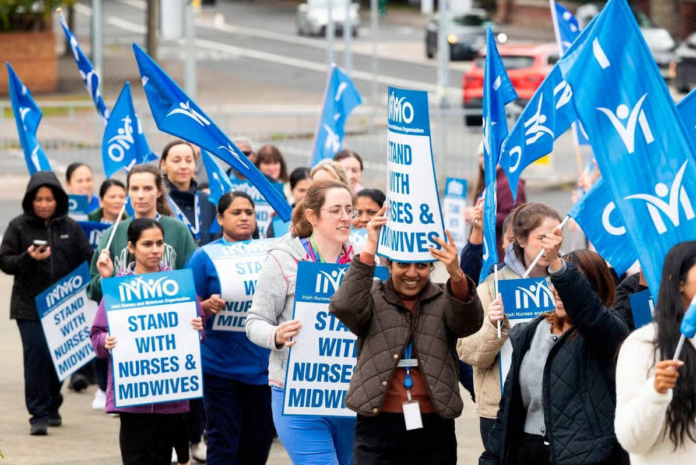
On 14th October, public sector trade unions affiliated to Irish Congress of Trade Unions (ICTU) went on strike for 24 hours. Three hundred thousand workers walked out and mounted picket lines outside schools, hospitals, universities and government buildings in villages, towns and cities across the south of Ireland. This was the largest strike in Ireland in 17 years.
Workers in the public service have negotiated their pay via a Public Service Agreement, signed between ICTU and the Government of Ireland for more than four decades, with the most recent agreement covering the period from 1st January 2024 to 30th June 2026. When this deal ran out the government failed to make a new pay offer. Over the summer the unions balloted for action and the anger of their members was reflected in very high votes for action-most returning a yes vote between 90 and 97%.
Industrial action began on September 30th, 2026, with union members “working-to-rule”. This is when employees do no more than the minimum required by the rules of their contract or job. Teachers, for example, only working during school hours, including refusing to participate in after-school events or parent–teacher meetings.
Two one-day strikes were initially planned for 14th and 21st October. On October 14th the 19 ICTU-affiliated unions-the largest of which are The Irish Nurses and Midwives Organisation (INMO), Fórsa, SIPTU, the Association of Secondary Teachers, Ireland (ASTI), and the Irish National Teachers’ Organisation (INTO))-were supported by a simultaneous strike by the Postgraduate Workers’ Organisation (PWO), a union representing doctoral candidates which is not a recognised trade union, and by university students organised by Aontas na Mac Léinn in Éirinn (AMLÉ).
Negotiations Begin
Following the strike on October 14th, the Public Services Committee (PSC) of ICTU entered into negotiation with the Government, and the planned strike on the 21st October was called off. On November 2nd, following two weeks of negotiations, the PSC announced that unions were planning for a further 24-hour strike on 12th November, as no agreement had been reached. This date was chosen to coincide with a meeting of the European Political Community in Dublin, the largest ever such international meeting to ever take place in Ireland. The unions planned to hold rallies in Dublin, Letterkenny, Cork, Limerick, Sligo, Waterford and Tullamore on the day. If the action had gone ahead widespread disruption would have resulted, including disruption of the European event. The mood was there for further action, and opinion polls showed that there was solid support from the wider working class with 70% in favour of the strikes.
By November 11th, a pay offer had been made to the unions, equating to an overall increase of 10.75% over 2.5 years (to March 2029). The union leaderships agreed to recommend the deal to their members and cancelled the planned strike on 12th November. The agreement still needs to be voted on by members of the trade unions, with results expected by December. The new agreement covers the public sector workers who took action-including the civil service, teachers, doctors, nurses and a wide range of other public sector workers-and also members of the Irish army and An Garda Síochána (the police force).
What is in the Proposed Deal?
The deal is complicated. There are, for example, a series of measures designed to deliver larger pay rises to lower-paid workers. The Government is claiming that over the lifetime of the deal starting pay for a cleaner would rise by 18.3%, for a special needs assistant would rise by 17.2%, for a new garda by 14.6% and for a new primary or secondary teacher it would rise by 13.1% or 12.8% respectively.
Public sector wage agreements include restrictions on industrial action. In other words, by agreeing to the pay deal unions undertake not to hold strikes seeking pay rises. Such a clause is included in this agreement: “All forms of industrial action are precluded in respect of any matters relating to remuneration or to any matter covered by this Agreement.”
The key question for union members is whether the pay rise they receive matches or keeps ahead of the rise in the cost of living. The Central Bank has forecast inflation will be an average of 3.4% this year, 3.1% next year and 2% in 2028. In fact, inflation is currently running at 4.3%. The pay increases in the deal work out at around 3.9% annually. If those forecasts for inflation are accurate, the deal would give workers a pay increase which would be marginally ahead of inflation. The agreement says if basic assumptions regarding inflation or other economic matters change, either the Government or unions can trigger a review clause. A review would “be engaged upon jointly as soon as possible and in any event will be concluded within six weeks.”
The last years-from January 2021 to June 2026-were not good for public sector workers. Over that time period the rise in the cost of living was 27.2% – driven by a burst in inflation of 8.2% in 2022 following the outbreak of the war in Ukraine-whereas wages rose by 23% for civil servants, 28% for Defence Forces, 36% for gardaí, 21% for education workers and 25% for healthcare workers. In other words, over that period, public sector workers suffered real wage cuts with exception of the state forces. Over the period of the most recent pay agreement from January 2024 until June 2026 was 8%. The police and defence forces again gained most-Defence Forces gross earnings rose 14%, and Gardaí 17%. Total gross earnings in the civil service rose by only 9%, education workers gained 12% and health workers 7%. This is the background to the deal: years of real pay cuts for most public sector workers.
AI and Flexible Working
The agreement is vague on changes in workload and conditions at work. A key issue for many workers is the introduction of AI into the public sector. AI has the potential to improve working lives, reducing the amount of time spent on routine and mundane tasks. It also has the capacity to both cost workers their jobs, and to increase pressure and stress at work. The deal states that everything must be done with the agreement of the unions and government in a process which will include “redesign of workflows, work practices and organisational structures”. There are no clear targets for specific productivity gains or deadlines for implementation.
An accidental gain stemming from the measures introduced to cope with the Covid pandemic is the effective right to work remotely when it is appropriate. This right has been steadily eroded in the private sector, but the agreement says existing arrangements will remain in place for the public sector. “Remote and blended working arrangements will remain subject to ongoing review to ensure they align with organisational priorities, service delivery requirements and relevant legislative provisions.”
A significant issue for the union movement is the widespread use of agency workers in the public sector, especially in health care. Agency workers have fewer rights and their presence in the workplace tends to undermine the strength of union members. The agreement says it aims “to reduce reliance on overtime and agency staffing through improved rostering, mobility and the effective use of available technologies.”
A Proud History
The importance of the magnificent display of working-class power on October 14th goes beyond the immediate industrial issues. It represents the re-awakening of a movement with a proud history from a long slumber.
In the early 1960s Ireland had a low number of strikes each year but this changed very rapidly as the decade progressed. By 1964 the number of days lost through strikes had more than sextupled to 545,000. In 1969 Ireland had more strikes per employee than nearly all of the advanced capitalist countries. Many of the strikes were unofficial (wildcat) actions, and shop stewards were confident about disregarding union officials and taking their members out after workplace meetings and a show of hands.
This militancy continued into the 1970s and 1980s but the efforts of government, employers and union bureaucrats ushered in an era of greater centralised bargaining, with less freedom from workplace representatives to take their own initiative, over time. Nevertheless, union membership continued to grow. In 1979 and 1980 Ireland witnessed an enormous movement of the working class for taxation justice. On January 20th, 1980, a general strike of 700,000 workers took place, and the largest march by organised workers in Irish history. At the time the BBC described the enormous demonstration as the ‘largest, peaceful protest in post-war Europe’. The strikes and marches took place to demand a more equitable taxation system for workers. Workers paid, as they continue to do today, income tax through a system whereby employers deduct income tax and other taxes directly from wages. Prosperous farmers and the wealthy avoided paying tax by various means. The working class were fighting to replace an unjust tax system and to ensure that the wealthy paid their ‘fair share’ of tax. The burden of direct and indirect taxation still falls heavily on PAYE workers and their dependents today.
Forty Years of “Social Partnership”
From 1987 onwards a series of trade union-government deals ushered in an era of “social partnership”. The deals were designed to ensure industrial peace and were an important factor in attracting foreign capital to Ireland-alongside ultra-low taxes on profits. The “Celtic Tiger” was born.
Social partnership has delivered real wage increase in some years but has been of much greater benefit to the ruling class. The share of national income going to the working class has fallen, whereas the share going to profits has increased. In 1987, the share of the national economy going to profits, interest and dividends was 31%; the share to wages, pension and social security was 69% (the share for the working class). After ten years of social partnership, the share going to profits, interest and dividends had risen to 41% and the share going to workers had dropped to 59%. The deal on offer now must be assessed in light of last year’s stark reality: in 2025 wages increased by 1.5% whereas profits were up by 18.8%.
The social partnership deals from 1987 onwards have also weakened shop-floor organisation and the confidence of workers. The percentage of union membership fell from 45% in 1985 to 23% in 2025 (OECD (2025), “Membership of unions and employers’ organisations, and bargaining coverage: Standing, but losing ground”, OECD Publishing, Paris, https://doi.org/10.1787/fe47107c-en).
The change in the number of strike days across the last 40 years is telling. In 1985 there were 126 disputes, involving 169,000 workers, and there were 418,000 strike days. In 2025 there were only 3 disputes involving 3151 workers, who took a total of 9302 strike days (https://data.cso.ie/table/IDA01), 0.75 % of the 1985 figure.
There were occasional years which went against the trend downwards: 2009 stands out. In that year there were 168 strikes, involving 279,000 workers, and 330,000 strike days. 2009 of course was the year after the financial crash, when EU-directed austerity was imposed, and for a brief period the trade union bureaucracies had no choice but to allow for strike action as a safety valve. Social partnership became a mirage when it mattered most. The bankers were protected; the working class paid the price.
Rebuilding the Unions
Rebuilding union structures takes time. A new activist layer cannot be willed into existence. A major strike such as October 14th acts as a jolt to consciousness. The power of the working class is demonstrated for all to see. The act of standing in solidarity builds bonds that are not easily undone. Consciousness can be catapulted forward in a short period of time. For many workers it was their first experience of struggle, and they draw positive conclusions about the need to organise, agitate and build for the next time.
The converse is also the case of course-if workers act but the action ends in defeat it can have a negative impact. An honourable defeat, however, if a struggle has been conducted with energy and union structures remain intact, helps to build confidence. But a sell-out will almost always have a demoralising effect, although sometimes the opposite is the case: a sell-out can act as a spur to rank and file members to become involved in their union and replace a worn-out or careerist “leadership”.
The one-day strike has scored a partial victory. How workers interpret the deal and decide on their next steps is key. After years of social peace even marginal gains will be seen as a victory-and a victory which resulted from action. To gain more now would require the workers voting down a deal which has been recommended by the union leaders. Workers will be aware that winning more will not be easy. It will require faith in their own strength-that their strength is greater than the combined force of government and the bureaucracy, aided by the media.
Left activists should argue for a process of consultation, with workplace meetings both in person and online, to explain the deal on offer and the alternative-a renewed round of action against a government which will not easily make further concessions. The left must offer a sober analysis, not a light-minded call to reject the deal and engage in further action without thought. A renewed round of action can win if the public sector workforce together rejects the deal and declare for new strike days.