


By Vicky Doulougeri
The following text is based on the lead-off of Viki Doulougeri, to the discussion titled “Science in the shadow of the swastika”, held during the 33rd camp of Antinazi Zone / YRE (Youth Against Racism in Europe), the antifascist and antiracist campaign built around Xekinima (Greek section of ISp).
This introduction is about the role of doctors and scientists in nazi Germany. There were two more introductions in this discussion, one by Elisa Mellin regarding how the Nazis took over science, and another one by Giorgos Fragos, regarding Social Darwinism, that will be published in the coming days.
_________________
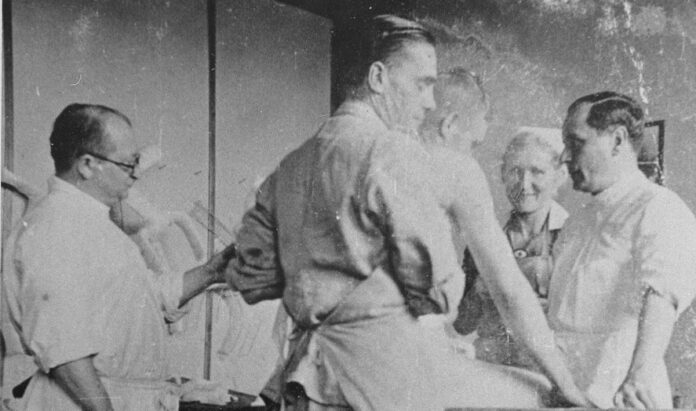
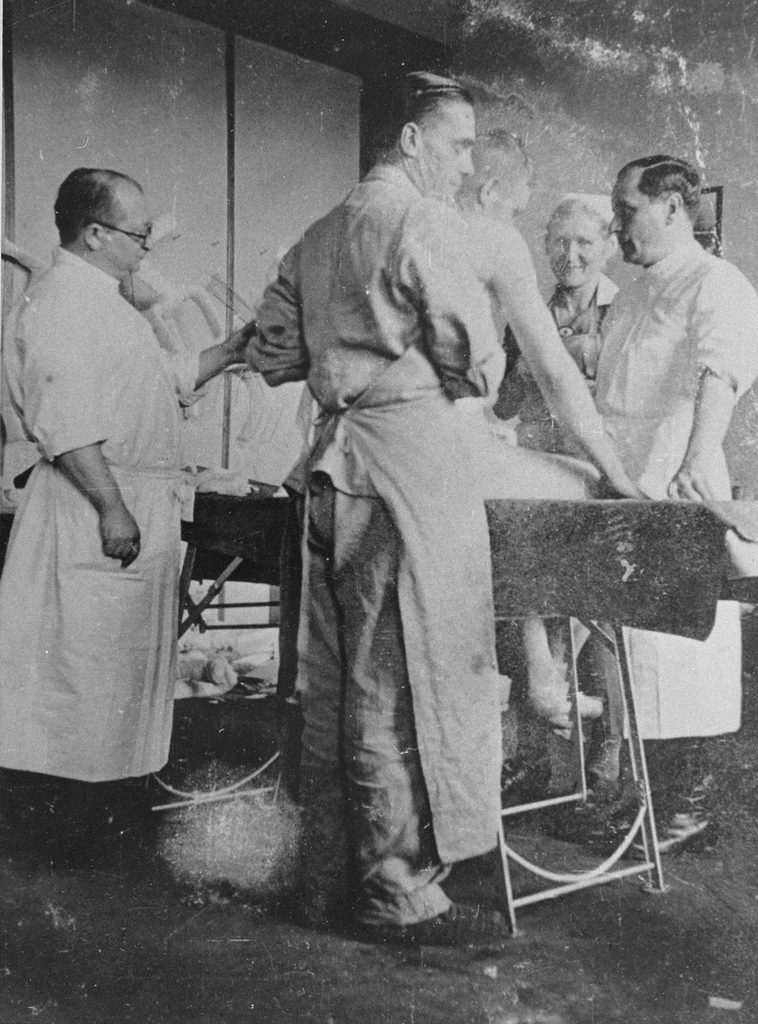
I think there are two basic questions on many people’s minds. Why did the doctors in Nazi Germany do what they did in the service of the Nazis? I should also mention here that it wasn’t only doctors, but also other scientists such as biologists and chemists. How is it that scientists, whom the majority of society trusts, come to act in such a way? And the second question is how this affected German society.
If we first look at the “why,” we will find a series of social, economic, and ideological causes:
- World War I left Germany in a very difficult economic situation. It was on the losing side and was forced to pay very heavy war reparations; an industrial region of the country passed under French control; its economy was already severely damaged and then came the global economic crisis of the 1930s — the stock market crash of ’29, and so on. This created enormous unemployment and enormous inflation (the prices of goods rose every day), which also heavily affected the middle class. A large part of the middle class fell abruptly into poverty — even doctors, many of whom could not even keep their practices running. People had no money for doctors, and health insurance funds had collapsed… There were also many doctors in Germany at that time, most of whom were Jewish. Under the Nazis’ racial policy, Jewish doctors were banned from practicing their profession, and this opened the door for German doctors. In simpler terms, the Jews were accused of “racial impurity,” were dismissed, and were subsequently sent to concentration camps — thereby job positions were freed, many of them university positions, which were then taken over by German doctors. Most of those who distinguished themselves as Nazi doctors were among those who had seized the positions of Jewish doctors.
- Doctors, both because they have devoted years to their scientific training and because they are connected to our deepest desire for health and our fear of death, enjoy the near-unanimous respect of the vast majority of society. Because of this, those in power can use this particular professional group as a useful tool for their own purposes, gaining direct influence over society. In simple terms, if someone is willing to sell their soul to the system in order to benefit from it, the system embraces them, equips them with its rhetoric of the moment, and sends them out to speak openly to the masses in order to persuade them. The same holds true for other scientists and academics as well.
I think we would more easily listen to and accept a strange, new scientific theory from a scientist than from a politician. In this case, of course, we are talking about pseudoscientific theories.
Let’s take another example to better understand how this works. In the 1980s, when the AIDS epidemic broke out, the blame was placed on gay men. This was a group of people against whom prejudice already existed. But it became socially far more convincing that gay men were to blame for AIDS once this was stated by the CDC (the Centers for Disease Control and Prevention in the US).
- The majority of scientists, including doctors, had excessive trust in the existing scientific institutions. They did not easily question what they had learned, for example, at university, and did not approach it with a critical spirit. Before Nazi Germany came into being, the theory of social Darwinism was taught in universities as accepted and normal, and the great majority of scientists had embraced it. Without doubts, without second thoughts, they regarded the racial purity of the Aryan race as the norm. It was therefore not something that lay outside their own thinking — it was not some new idea they adopted only once they decided to join the Nazi party, but something they themselves already carried within them.
- Obviously, it was not only their role as scientists that led them to the Nazi party, nor only what they were taught during their student years. There were also ideological reasons — that is, they genuinely supported Nazi ideology. Others, on the other hand, may have seen their own interest in the Nazi party, and perhaps some others were afraid and thought that, they would either follow the Nazis or die.
But none of this is an excuse for what followed (or for what had already happened even before Hitler’s rise to power) — especially since there were counter-examples. There were scientists who refuted the theory of racial purity and did not accept it; who refused to take part in the mass sterilizations carried out even before Hitler came to power; or in the human experiments conducted during the Holocaust; or, even more simply, who refused to propagate Nazi rhetoric. Of course, for taking this stance, many of them were hunted down, persecuted, and put to death.
The 1930s were a decade of deep economic and political crisis. The traditional parties and institutions collapsed, and society turned, on the one hand, to the Nazi party, which presented itself as anti-systemic, and on the other hand to the working-class parties of the Left (the Social Democrats and the KPD, the German Communist Party). In fact, the majority of society turned to the left. However, the Left did not cooperate between itself. Thus, the Nazis prevailed, to some extent electorally, but to a large extent through the violence and terror they inflicted on society.
As far as the field of science is concerned, despite all the exceptions, the path followed by the overwhelming majority of scientists in Germany at that time proves that the dominant scientific narrative, within the framework of the capitalist system, is not entirely, to say the least, objective and independent. As long as scientists and their work are part of the system, they obviously cannot remain unaffected and neutral. They have learned specific things, they have learned a specific way of thinking, and this is what they reproduce. Sometimes this is correct. Sometimes it is wrong, and sometimes it leads to tragedies. We must also take into account which scientists and which research projects are funded and promoted… All funding and all programs pass through the hands of power, through one center of power or another.
I think one very fundamental conclusion that we, as young scientists, must draw is the need for a critical spirit toward dominant theories and dominant narratives. There are things that are correct and that we must support, and there are also theories and narratives that we must have the courage to question, because the only thing they serve is the system itself. They do not serve the good and the progress of society, as science is supposed to.
The second thing we need to examine on this topic is how the scientists’ and academics’ stance affected German society.
As mentioned earlier, society (both then and now) often places great trust in science. And, broadly speaking, that is a good thing. We do not want an irrational society that believes vaccines alter our DNA, or that the earth is flat, and so on. So, when in Nazi Germany “eminent” university professors propagated the view that something was correct and necessary, a great many people were convinced without doubts or second thoughts. And when 53% of doctors and biologists were registered members of the Nazi party, we can understand exactly what that “correct and necessary” thing being propagated actually was.
In this particular case, an important role was also played by the humiliating (for Germany) Treaty of Versailles, and by the international economic crisis that drove the German economy into collapse and pushed not only the working class but also the middle class into mass poverty. People in despair, struggling for survival, are ready to believe many things and are ready to accept extreme solutions. The propagandists of racial purity and social Darwinism, therefore, did not speak only in theoretical terms — they seized this opportunity and framed the issue in economic terms. Thus, the cost of caring for the “weak” [people with disabilities, people with mental illnesses, etc.] was calculated, and the exact amount by which these people supposedly “burdened” the state budget was propagated. The streets were filled with posters that put a price, in money or in food, on the cost of caring for, educating, and feeding children with neurological or learning difficulties, and —combined with the prevailing view at the time that everything was hereditary— this was used to justify to society the need for the compulsory sterilization of children and parents.
Later, after 1933, with the racial laws, citizens were divided into Aryans and non-Aryans. And because non-Aryans were considered, in a sense, “ill” —as though they contaminated the “nation’s blood”— they gradually began to be persecuted (after first having various freedoms stripped from them) and eventually ended up in concentration camps. It did not take long (by ’39) for compulsory sterilization to turn into compulsory euthanasia, wherever it was deemed necessary — of course, only if the person in question was considered of no use anywhere, such as in manual labor, etc.
What we must certainly bear in mind is that the seed for everything that was allowed to happen during World War II in Germany, and in all the countries it occupied, already existed within society beforehand. It was something that Nazi politicians and scientists built together, shaking hands on it. Scientists, with the prestige they held, lent respectability to social Darwinism and gave the Nazis an alibi to carry out their plans. Eugenicists, of course, did not confine themselves to university lectures, but went out into society, through newspaper articles and public discussions, and managed to convince people that the authoritarianism of the state was grounded in science. And this propaganda, under conditions of economic crisis, found fertile ground.
The result was that an overwhelming proportion of society fell silent and accepted the crimes committed by the Nazis — some because they agreed, others because they were afraid.
The gas chambers were built and tested by doctors and engineers. The original idea did not even come from the Nazis themselves, but from scientists and doctors. The gases they used were supplied by the chemical industry. The lethal injections were supplied by the pharmaceutical industry.
We can therefore understand that the majority of the sciences, and of industries in general, supported the Nazi regime.
Nevertheless, there were counter-examples of scientists and academics who resisted the Nazi party, obviously out of fear of their own extermination. For example, the director of the Berlin Psychiatric Outpatient Clinic, Rittmeister, helped many of his patients avoid compulsory euthanasia, and hid and saved Jews as well as members of the resistance. In ’41 he began making contact with the communist organization known as the Red Orchestra, whose members also included other doctors, and he took part in acts of sabotage and in editing a magazine that documented Nazi crimes. Also of medical origin was the White Rose organization, founded by medical students. One of their characteristic activities was printing and distributing resistance leaflets — something that today might sound minor to us, but for society at the time was extremely important in awakening people’s conscience.
Another example is the couple Oskar and Cécile Vogt. The Germans, notably, did not hunt them down, presumably because of their reputation (they had described a rare childhood neurological syndrome). They openly condemned the regime, refused to dismiss Jews or dissidents, and hid members of the resistance.
It is estimated that from Hitler’s rise to power in ’33 until ’45, around 800,000 Germans were imprisoned as members of the resistance. And here I am not talking about Jews or Roma, but about German citizens who were considered Aryan.
The resistance struggle and the left of that era showed the way forward, and in the end Nazism was defeated. We —as young scientists, as politically active people— owe it to ourselves to follow in the footsteps of those who questioned and fought against the Nazi regime.