

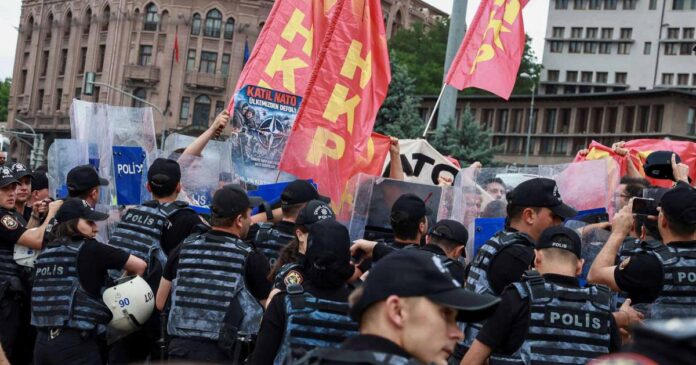
The NATO Summit held in Ankara between 28 June and 10 July is the new political showcase of the war economy. NATO adopted a 5%defence and security spending target, adopted in the 2025 Hague Declaration. The 2026 Ankara Summit agenda was structured around “increased investment, industrial production and support for Ukraine”; this framework identifies security not with social welfare, but with military capacity, war preparedness and industrial-scale arms production. The fact that the summit in Turkey took place amid protest bans, mass detentions, barricades, closed public spaces and intense security measures clearly revealed the social face of this new security architecture.
The NATO Summit, militarization and the changing security strategy
NATO’s current strategy has moved beyond the limits of the classical narrative of collective defence. In the Hague Declaration of 25 June 2025, member states agreed to allocate 5 percent of GDP to defence and security-related spending by 2035. Of this target, 3.5% is allocated to core defence spending, while 1.5% is allocated to critical infrastructure, civil preparedness, network security, innovation and strengthening the defence industrial base. This formula does not confine war preparedness to military budgets alone; it also pulls roads, ports, energy lines, data centres, supply chains, industrial policy and disaster preparedness into military strategy. So-called security has nothing to do with a principle that protects the life of societies but is all about expanding war capacity.
The Ankara Summit made this very clear. According to NATO’s own statements, the summit agenda included defence investment, the defence industry, support for Ukraine, critical infrastructure, new technologies and increasing production capacity (NATO official, July 2026). The NATO Summit Defence Industry Forum, held in Ankara on 7 July, was organized for transatlantic defence production, investment and innovation; NATO described this forum as an integral part of the summit. At the forum, a 40 billion dollar investment in counter-drone capacity and drone training, new intelligence and surveillance systems, airborne early warning systems and industrial cooperation strategies came to the fore. This picture shows that war is organized not only at the front, but also in factories, budgets, universities, technology companies and logistics networks.
The global rise in defence spending forms the financial backbone of this militarist orientation. According to SIPRI (Stockholm International Peace Research Institute), world military expenditure increased by 2.9% in real terms in 2025, reaching 2.887 trillion dollars; this marked the eleventh consecutive annual increase. According to the same report, military spending in Europe rose by 14%, while spending in Asia and Oceania by 8.1%. These resources are being taken from the lives of workers, women, young people, migrants and the poor, and transferred to the coffers of the arms industry. Money that cannot be found for education, health, care, housing and ecological repair rapidly emerges from the reinforced-concrete wallets of states when war preparedness is at stake.
The climate dimension of militarization can no longer be treated as a secondary issue. According to TNI’s (The Transnational Institute) 2024 study, NATO’s 1.34 trillion dollars in military spending in 2023 caused an estimated 233 million tonnes of CO2 equivalent emissions; this is higher than the annual greenhouse gas emissions of many countries (TNI, 2024). Studies by CEOBS (Conflict and Environment Observatory) and Scientists for Global Responsibility show that the total carbon footprint of the world’s militaries may correspond to around 5.5% of global emissions. Military emissions reporting is not mandatory or transparent within the UNFCCC system. Fossil-fuelled armies, warplanes, ships, tanks, ammunition factories, bases, fuel lines and post-war reconstruction processes are the hidden furnaces of the climate crisis. The war machine burns oil while protecting oil; it turns the atmosphere into a battlefield while securitizing gas pipelines.
The Turkish context: the summit, the security state and renewed bargaining with the United States
Turkey used the Ankara Summit to consolidate its regional military weight, to further integrate its defence industry into the NATO market and to renegotiate its strained relations with the United States. According to Reuters, Erdoğan called on NATO allies at the summit to lift defence industry restrictions among members. He advocated Turkey’s inclusion in European security initiatives and announced an additional 24 billion dollar budget for the “Steel Dome” air defence system. Trump, meanwhile, said that he could lift sanctions on Turkey and would make a decision on the sale of F-35s; Turkey had been removed from the F-35 programme after purchasing the Russian S-400 air defence system in 2019. Thus, the S-400, CAATSA sanctions and the F-35 file returned to the negotiating table in Ankara as matters of war industry diplomacy.
The summit’s domestic political counterpart points to a darker picture. According to Bianet, detention orders were issued for 241 people between 23 and 25 June, and 225 of them were detained. As of 2 July, at least 170 people had been arrested, while 36 were released under judicial control measures, including house arrest. The Ankara Governor’s Office banned all demonstrations for 13 days. It was also reported that some journalists’ summit accreditation was rejected and that access to more than 20 X accounts were blocked.
On 7 July, police intervened in the “No to NATO” action planned in Kurtuluş Park and around 75 people, including members of parliament were detained. The NATO Summit in Turkey turned from a foreign policy agenda into a domestic regime crackdown. The security-oriented line on the Kurdish question, hostility towards migrants, attacks on women and LGBTI+ people, street bans, police violence and the judicial liquidation of the opposition are becoming parts of the same authoritarian architecture. AP reported that Erdoğan’s main political rival, Ekrem İmamoğlu, was presenting his defence in court during the summit, and that the case was being followed in connection with debates over pressure on the opposition in Turkey. There is no transparent and publicly auditable official data on the total amount of public resources spent on summit security. This uncertainty is the fog over the budget of militarization: while spending in the name of war and security grows, society’s right to scrutinize that spending is narrowed.
Iran was not on the margins of the Ankara Summit, it was at its centre. AP reported that Trump threatened further attacks on Iran at the close of the NATO Summit, said that the ceasefire was over but also stated that he did not seek a “long-term” war. Trump criticized NATO allies for not giving enough support to the United States in the Iran war and expressed his disappointment with the alliance. The Strait of Hormuz, as the heart of oil and gas flows, is one of the knots where fossil fuel dependence and war strategy are bound together.
Anti-NATO demonstrations
The anti-NATO demonstrations in Turkey carried a strong class-based and peace-oriented objection to the summit’s official security narrative. On 5 July, more than 100 people who took part in an anti-NATO march in Ankara were detained. Thousands of people in Istanbul, Ankara and Izmir protested NATO’s pressure to increase military spending. Banners at the demonstrations read “NATO wants war, workers want peace”, “Budget for the people, not NATO”, and “No to NATO, no to war”. On 7 July, students, socialist groups and members of parliament held an action in Ankara against NATO’s expanding defence budgets.
The political significance of these demonstrations lies in the fact that they move opposition to NATO beyond a narrow foreign policy position. The language of the actions establishes a common political ground against war budgets, fossil capitalism, the authoritarian security regime, border violence, patriarchy and racism. When the actions in Turkey are considered together with the anti-war and anti-NATO campaigns organized around the 2025 Hague Summit, they make visible the need for a fragmented but growing international anti-militarist coordination. The subject of this coordination cannot be peace movements alone; trade unions, climate justice organizations, feminist movements, youth organizations, migrant solidarity networks and socialist formations are constitutive parts of the same line of struggle.
The importance of anti-militarist campaigns
Anti-militarism is not an abstract wish for peace. It is a struggle over budgets, labour, care, climate, democracy and freedom. As the war economy grows, the resources needed for education, health, care, housing, ecological repair and a just transition flow into the profit wells of the arms industry. The Fossil Fuel Treaty Initiative’s 2026 report “The Double Dividend” argues that a redistribution mechanism transferring resources from military expenditure to climate action could finance a just phase-out of fossil fuels. This proposal is not merely a technical budget calculation; it is the idea of redirecting social resources from war to life. The money allocated to war logistics must be directed towards the care economy, public health, energy democracy, disaster preparedness and ecological restoration.
Militarization cannot be separated from patriarchy, racism and border violence. Militarist society defines masculinity through obedience, discipline and the capacity for violence. It reduces the democratic demands of the Kurdish people to a security problem. It legitimizes the occupation of Palestine through the language of “counter-terrorism”. It normalizes the war on Iran through energy routes and regional hegemony. It divides the Eastern Mediterranean among gas fields, maritime jurisdiction zones, military bases and energy companies.
What is needed today is an international, continuous and class-rooted campaign against NATO expansion, war budgets, the spread of military bases, fossil fuel wars and authoritarian security regimes. This campaign must be built across a map stretching from protest bans in Turkey to the counter-summit experience in The Hague, from solidarity with Palestine to a democratic solution to the Kurdish question to energy wars in the Eastern Mediterranean. The compass is clear: the security of peoples does not lie in NATO’s arms depots, but in peace, public services, ecological repair, equality and freedom.
A line of political struggle
For this reason, opposing the increase in military spending, NATO’s 5% war budget target and the defence industry’s swallowing of public resources is one of the most important political tasks of the present. Public resources must be used not for the profits of arms companies, the expansion of military bases and war logistics, but for education, health, care, housing, disaster preparedness, ecological repair and a just transition. A phase-out of fossil fuel dependence cannot be separated from the struggle against the war economy, because the military strategies that protect oil and gas pipelines are also the armour of the global order that deepens the climate crisis. International campaigns must be built against NATO bases, military transit routes, war logistics and preparations for regional war; in the contexts of Iran, Palestine, Ukraine, Kurdistan and the Eastern Mediterranean, the right of peoples to self-determination, peace and democratic resolution must be defended. In Turkey, protest bans, detentions, barricades and the militarization of public space must end immediately. Anti-militarism must be organized as the common political ground of anticapitalist, feminist, anti-racist, labour and climate justice struggles. To build the International of life rather than the war industry, the common action of trade unions, climate movements, women’s and LGBTI+ organizations, youth, socialists and peace forces must be expanded.