

The following text is a written contribution by the Iranian Revolutionary Marxists’ Tendency (the ISp affiliate in Iran) to the 4th Internationalist Meeting, which took place in Paris, May 15-17. Read more material on Iran here and other contributions to the Paris Internationalist Meeting here
In less than a year, the Iranian masses have endured two imperialist wars and a much more deadly war with ‘their own’ capitalist oligarchy. Only the proletarian vanguard, organised in a Leninist party, can stop this cycle of butchery by two capitalist blocs.
The Imperialist War
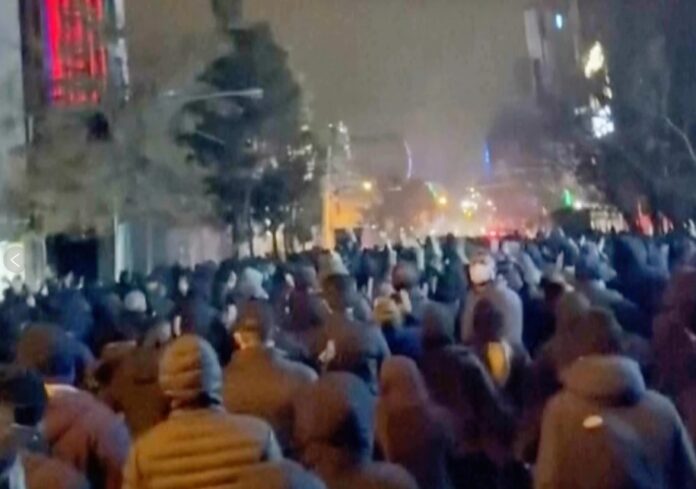
The current imperialist war is the second conflict that the US and Israel have unleased on Iran’s masses while in the middle of negotiations with the Iranian regime. In their attempt to gain more concessions, they have so far killed 3,375 people, including 376 children, and injured 26,500 (1,621 children). They have destroyed hundreds of schools, medical facilities, homes, factories and workshops, power stations and other infrastructure. But the regime, established through drowning the 1979 revolution in blood, does not care about the suffering of the masses. In January, it massacred around 40,000 of its ‘own citizens’ to survive– in just three days!
This war has produced two new types of opportunism that we did not see during the Iran-Iraq War. First, in the 1980s, no Marxist or ‘left’ groups took the Iraqi side. Second, the Stalinists and Maoists took a social-chauvinist position before the regime started its major repression of the left and the mass movements of workers, women and the national minorities (June 1981). Based on their stageist concept of revolution, they regarded Khomeini’s regime (i.e., the counter-revolution!) as somehow continuing the revolution.
Today, the fronts supporting the two blood-soaked reactionary capitalist blocs are much bigger.
The pro-imperialist front
The pro-imperialist and pro-Zionist front began its work before the12-day war in June 2025. In October 2024, when the Iranian regime and Israel had a brief conflict during the Gaza War, Hamid Taqvaee, leader of the Worker-Communist Party of Iran, claimed that: “… any blow to the Islamic Republic will facilitate the people’s struggle to overthrow the government … Many revolutions … occurred in conditions of war and have been victorious, and this can happen in Iran as well.” He is now calling many reports of deaths and destruction as “fake”!
In May 2025, Abdullah Mohtadi, leader of Komala Party of the Iranian Kurdistan, urged Trump that “… it is in the best national interests of the United States to have a direct dialogue with the different components of the Iranian opposition,” […] “because … the regime might collapse under pressure from domestic crises.” This is what Komala, which was one of the two groups that founded the so-called Communist Party of Iran in 1983, has become!
A week before the war, five Iranian Kurdish groups announced a coalition aimed at overthrowing the IRI and establishing regional autonomy. It included the KDPI, Komala Organisation of the Toilers of Kurdistan and PJAK (with Komala PIK joining later). Then, a week after the war started, there were conflicting reports that the CIA or Mossad were arming some Iranian Kurdish groups.
The pro-regime front
In the 1980s, the pro-regime front had illusions about Khomeini’s movement and the IRI. They supported the building of the Pasdaran (IRGC). Some, like the Tudeh Party, even betrayed leftwing activists and were involved in their interrogations. But they mostly stopped collaborating once the regime began to arrest and torture their members.
Today’s social-chauvinists regard themselves as the ‘Axis of Resistance Left’. They are mostly from the post-revolution generation: neither with a Marxist background nor any activity among workers. And, crucially, they don’t see the proletarian revolution as a real possibility.
For 10-12 years, the ‘left’ tendency of the ‘Axis of Resistance’ has been growing among Iran’s university students and has been boosted since the Gaza War. It sees the main contradiction in geopolitics as between Hamas-Hezbollah-IRI and Zionism-US imperialism. (Bizarrely, it includes exiled activists who had to flee the regime’s repression!)
Within this ideological construct, although the Iranian regime is reactionary, resistance to it is a secondary matter. The main contradiction is between ‘the nation’ and imperialism. And the proletariat’s class struggle is a secondary contradiction that can be postponed until the distant post-war future. The ‘Axis of Resistance Left’ includes many erudite ‘philosophers’ – who even admit the regime is repressive! – but put all their skills at the service of Iran’s capitalist oligarchy.
The Class War
Class war is a fixed and constant fact of capitalist society: before the imperialist war, during, and after it. But this war is mostly one-sided! The bourgeoisie constantly attacks working-class families’ standard of living and denies the basic rights of women, national minorities and the masses. Despite suffering the daily consequences of this war, the proletariat faces an organisational, ideological and political crisis that prevents it from overthrowing the capitalist system.
Smashing the January uprising made the Iranian regime stronger. Now it is using the war to rally its own base, recruiting more teenagers into the Basij mobilisation force. It is using the ceasefire to step up executions of protesters arrested in January, detaining many other activists (especially teachers) and abusing political prisoners even more.
Although the regime claims that because of the war unemployment has gone up by two million, with 80-90% of building workers now jobless, Pezeshkian has said that subsidies for millions will have to be cut! The war is also being used to justify mass layoffs and cuts in pay and conditions. Already inflation is at 60-70%, with rice and cooking oil at 200-300%, and buying food takes up around 85% of workers’ pay.
Whatever kind of deal is made with US imperialism, one thing is certain: it will lead to more intensive exploitation of Iran’s workers.
The Actuality of Proletarian Revolution
The imperialist stage of capitalism is the phase when the whole system, on a world scale, is ripe for being overthrown by the proletariat. In 1938, the Fourth International already recognised the objective conditions for the proletarian revolution as “rotten”. However, a critical element for a successful workers’ revolution was and still is missing: the subjective factor, the revolutionary vanguard party of the proletariat.
The proletarian revolution is still an actuality. It’s neither historical dogma nor a daydream about a better world. Based on its experiences of the past 50 years, Iran’s proletarian vanguard is ready to build a revolutionary party that can seize power. Already in 1979, it organised a general strike that toppled the CIA-backed Shah, factory committees and workers’ control over production (and, sometimes, distribution).
But tragically, there were big disparities between the radicalism in the factories and confusion about proletarian strategy. There was no Leninist organisation to plan a workers’ revolution (and to preserve the vanguard’s revolutionary consciousness through the many ebbs and flows of the movement).
Transitional demands
Workers’ control and factory committees were transitional demands that were posed more recently. In 2018, Esmail Bakhshi, a sugar cane workers’ rep, said they had two options: “One is that Haft Tappeh is run entirely by the workers. We will form a committee and run Haft Tappeh consultatively. Don’t worry. We have all the specialisms. Who else has managed Haft Tappeh so far? Have confidence. Have faith in yourself.” The second option was that the state takes over: “… but the state must do [all] … things under the supervision of the workers’ council and under the general supervision of the workers.”
The method of transitional demands connects the current level of consciousness to the next level. Starting from immediate problems, they aim to resolve all the social inequalities that the exploited and oppressed masses have endured for decades. They are links between the reformist minimum programme and the maximum programme: the strategy of the proletariat’s seizure of power. We therefore must decide today’s tactics on the basis of slogans and struggles that are links in a chain leading to the strategy of the revolutionary dictatorship of the proletariat. They therefore cannot be slogans that pass over the heads of the masses.
Crucially, they are also demands that cannot be realised within the capitalist system. Mainly they are posed when the question of revolution does not even occur to most workers. For the workers’vanguard, however, the preparation for a revolutionary situation is an urgent matter. Combining these demands forms a revolutionary programme for resolving the crises of capitalist society and humanity.
The Third Front
It is the task of revolutionary Marxists to prepare the workers’ vanguard to take advantage of every situation – war with imperialism, cold war or peace – to overthrow the regime and the capitalist system. (In September 1980, our comrades called on the workers of Khuzestan to demand arms to defend their factories and neighbourhoods.)
Two years before October 1917, during the imperialist slaughter, Trotsky recognised the need for “a third force, revolution”. Today the only revolutionary alternative to the two reactionary fronts is to call on workers and all exploited and oppressed layers to build a third front. A third front is a vital transitional demand during war and is an essential part of preparations for building a revolutionary party. It is a matter of principle: a tactic that will strengthen the anti-capitalist front on the path to building a revolutionary vanguard party based on clandestine cells of the most militant and conscious workers. Calling for it emphasises the need for ideological and political independence of workers and the masses from all bourgeois forces. We must always call for a third front during a reactionary war.
Iranian Revolutionary Marxists’ Tendency
29 April 2026