


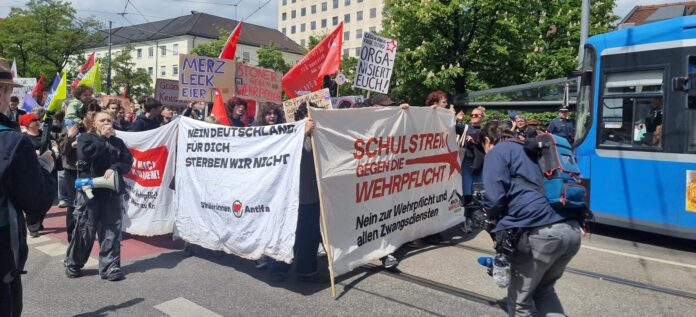
At the Friday, May 8, 2026, strike against the reintroduction of military conscription, students were detained and charged over placards targeting Merz. In Munich, the final rally was interrupted: two people were injured, including a 20-year-old student. In Berlin, three underage students were arrested on their way home from the demonstration. This article initially appeared in Italian in the Punto Critico newsletter.
According to the organizers, 45,000 students in more than 150 German cities took part on Friday in the third school strike against the reintroduction of military conscription by the government of Friedrich Merz.
For Hannes Kramer, spokesperson for Schulstreik gegen Wehrpflicht (“School Strike Against Conscription”):
“Today, across Germany, students made it clear once again that while the rich want war, young people want a future. This is what we learned from the Second World War. That is why, for us today, ‘Never again war!’ also means ‘Never again compulsory military service!’ Back then, companies like IG Farben, Deutsche Bank and Krupp profited from war. Today, the profits of companies such as Rheinmetall are at stake. But if they want to send us to the slaughter in the trenches, we will continue to strike.”
In the states of Hesse, Bavaria and Saxony, many teachers belonging to the GEW teachers’ union — affiliated to the German Trade Union Confederation (DGB) — also supported the strikes. Student representative organizations in states such as Rhineland-Palatinate and North Rhine-Westphalia likewise called for participation.
In recent months, repression against the students has intensified. This may indicate that, even if the movement is not spreading explosively, it is nevertheless creating difficulties for the government. Following an incident in March, when a student was arrested for displaying a placard reading “Merz, fuck off,” many students came to Friday’s demonstrations carrying signs bearing the same slogan.
In Münster, police identified several students displaying that slogan and other anti-chancellor slogans on their placards or chanting them during the protest. There were also cases of schools being physically locked to prevent students from leaving to attend demonstrations, while some schools demanded medical certificates to justify absences.
In Berlin, a 12-year-old, a 14-year-old and a 17-year-old student were arrested while returning home after the demonstration.
In Bavaria, several students displaying similar placards were detained and taken back to school.
The most serious incident occurred in Munich. Shortly after Bernhard Baudler — the GEW Bavaria official responsible for school policy — began speaking at the final rally in Rosa-Luxemburg-Platz before around 1,500 people, riot police entered the square and arrested a 20-year-old student. Officers reportedly tore a placard from her hands, twisted her arm and, during the scuffle, also assaulted another demonstrator, causing minor injuries.
“I was forcibly removed by several officers while I was sitting away from the demonstrators because of the placard I was carrying. It was a situation in which I felt powerless,”
said the student, who asked to remain anonymous for fear of reprisals. She was later released after being identified and charged.
From the platform, Baudler called on the police to remain calm, but he was only able to resume his speech twenty minutes later.
According to Stefanie Sewald, secretary of the youth section of the Ver.di services union in Munich:
“The fact that students are being stopped by the police and charged over a placard represents an act of intimidation against freedom of expression. Those protesting against compulsory military service and militarization should not be criminalized. It is alarming that peaceful protest in schools is being treated as if it were a crime. Democracy also means that young people must be able to openly express their political opinions. Instead, while they demonstrate against war and compulsory military service, the state responds with repression instead of dialogue. This only further confirms how necessary this protest is.”
Although turnout at this demonstration was lower than in December and March — with end-of-year exams and important assessments approaching in Germany as well — the police intervention and the intensification of disciplinary measures in schools could prove to be a boomerang effect, contributing to a higher level of politicization and growing anger among students, with possible consequences for future initiatives (the first are planned for June) and for the next school year.