

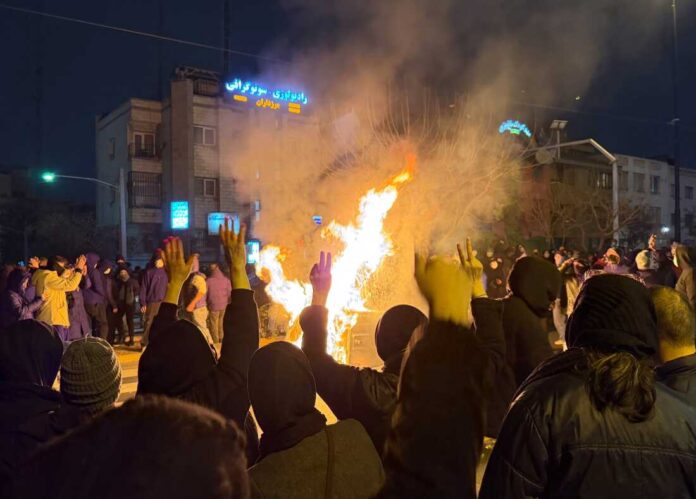
The rapid pace of political developments reflects the turbulent times we are living in. After the recent kidnapping of Venezuelan President Nicholas Maduro, the uprising in Iran and the threat of U.S. intervention now dominate international headlines.
At the time of writing, the uprising that began on 28 December — with merchants in Tehran’s central bazaar at its core — has spread throughout the country, with large and dynamic demonstrations occurring nationwide. The Iranian authorities have responded with brutal repression and internet shutdown. Because of the communications blackout and deliberate suppression of information, the precise number of deaths and arrests is impossible to verify, but all credible reports indicate that they are very high. Videos and images from hospitals and morgues showing dead demonstrators illustrate the scale and ferocity of the state’s response.
U.S. President Trump has publicly threatened strong measures — including possible military intervention — which could escalate violence and further destabilize the region.
Economic situation
Iran is a country of approximately 90 million people, with a long history and strategic geographic importance. The 1978–79 Iranian Revolution began as a popular uprising against the U.S.-backed dictatorship of Shah Mohammad Reza Pahlavi. However, the failed strategy of the Left at that time allowed the revolution to be taken over by religious hardliners, who established an Islamic Republic. Since then, the country has been locked in ongoing confrontation with the United States, Israel, and much of the Western bloc.
Over the past decades, Iran has been the most sanctioned country in the world, a form of economic warfare that has severely weakened its economy and caused immense hardship for the people. The Trump administration has intensified this pressure, combining sanctions with mounting military threats. In 2025, tensions escalated sharply with the “12‑day war” involving bombardments on Iranian territory.
The most immediate trigger of the current unrest has been the country’s deepening economic crisis. Some of the most striking figures that set the stage for the uprising were: the value of the rial, Iran’s national currency, fell by 84% in a single year; overall inflation exceeds 40%, while food prices have surged by more than 70%; and the budget proposal submitted by the prime minister included significant tax increases, while wage raises accounted for only half of the inflation rate.
Political Context
Although the protests initially began mainly related to economic demands, they quickly assumed a political character. For decades, Iranian society has lived under a repressive regime, seeking avenues to express its discontent. Over the last ten years, mass movements have erupted roughly every two to three years, triggered either by deteriorating living standards or demands for democratic rights — most notably the 2022 protests following the death of Mahsa Amini.
The causes of these recurring social explosions are clear: widespread poverty coupled with severe restrictions on democratic rights. For example:
- The regime forbids the formation of independent trade unions, permitting only state-controlled “Islamic” unions, and responds to strikes with repression and imprisonment of strikers.
- Ethnic minorities — including Kurds, Arabs, Baluchis, Turkmen, and others — face systematic discrimination despite constitutional recognition. Meanwhile, the state fosters a climate that encourages racist campaigns against migrants, as seen recently with Afghan refugees.
- Elections are tightly controlled: all candidates must be approved by the regime, with most independents rejected outright. Political parties can theoretically be formed, but only if they accept the principles of the Islamic Republic, effectively theocratic rule under the current system.
- Women in Iran do not enjoy the same legal rights as men. Until recently, they were compelled to wear the hijab under the strict enforcement of the so-called “morality police.” Following the 2022 uprising, the regime was forced to ease enforcement of this rule. Homosexuality remains a criminal offense and is met with severe punishment.
It is clear that the Iranian regime contains no progressive elements.
What Are the Alternatives?
The current uprising appears to be one of the largest in recent years, sparking debate over whether it could lead to the fall of the regime. Reliable information from inside the country is extremely limited, making it difficult to assess how likely such an outcome might be.
It must be emphasized that the regime has built a powerful repressive apparatus. The Islamic Revolutionary Guards (IRGC) and the Basij paramilitaries — the regime’s most loyal armed supporters, numbering nearly one million according to some estimates — are trained to suppress popular uprisings with brutal force. They strike indiscriminately, making it extremely difficult for largely unarmed protest crowds to sustain resistance.
Traditionally, the Iranian regime has been divided into “principlists” (hardliners) and “reformists.” For U.S. intelligence services, an internal shift resulting in a more pro-American government would likely be the most favorable outcome. However, the current crisis seems to have united the two factions, both of which support the harsh suppression of protests given their radical nature.
Other scenarios are also being discussed internationally. Reza Pahlavi, the son of the last Shah (king), has resurfaced claiming a commitment to “bringing democracy to Iran”. Backed by Israel, he is seeking Trump’s endorsement. Similarly, Western interests are promoting the People’s Mujahideen Organisation of Iran, a group that allied with the U.S. during the Iraq War against Iran.
None of these tired, externally backed options have anything to offer to the Iranian people — and they don’t seem to gather significant support to mobilize large sections of the population. While Iranian workers may deeply resent the regime, this does not mean they will easily become pawns of foreign powers.
Will Bombs Bring Peace?
Trump is attempting to portray himself as outraged by the violent suppression of pro-democracy protests in Iran, claiming that this justifies military intervention as well as new tariffs and sanctions.
The hypocrisy is glaring. He has supported the genocide of Palestinians, backed the theocratic and anti-democratic Saudi regime, and stripped away numerous democratic rights in the United States. On the international stage, he shows no interest in the “rules based order” supposedly upheld by Western powers.
A potential U.S. military intervention will not bring democracy to Iran. Trump has no real interest in the welfare of the Iranian people. In fact, it serves U.S. strategic interests to maintain a harsh, oppressive regime that keeps the population under control. His true objective is to curb Iran’s regional influence, limit its challenges to Israel, and maintain the dominance of the U.S. and its allies. If he succeeds, any talk of promoting democratic rights in Iran will be quickly forgotten.
Geopolitical aspect
Some left-wing groups have come out supporting the Iranian regime on the basis that it opposes the U.S., “the greatest enemy.” We reject this approach. First of all, the Left cannot align itself with a regime that wages such a brutal assault on the working class and oppressed people within its own country. Second, Iran’s so‑called “anti‑imperialism” has no progressive content; its aim is to impose a similarly oppressive, Islamic fundamentalist model on neighboring countries and across the wider region. Moreover, this approach has no real prospect of producing any practical results. It is inconceivable that Marxists operating in imperialist countries would tell Iranian activists, “you must endure the yoke of an oppressive regime in order to strike a blow against imperialism internationally (which we ourselves have not managed to overthrow).”
The experience of the Bolsheviks in 1917 is instructive. They did not support the Tsar simply because he was at war with German imperialism, which was larger and more aggressive. Instead, they adopted a class-based position against both the Tsar and German imperialism, ultimately overthrowing the Tsarist regime.
Concerns are often raised that the Iranian uprising is being manipulated by the secret services of Israel or the United States. While it is true that imperialist agencies will certainly attempt to influence the course of events to serve their own interests, it is mistaken to think that they could “create” such a mass movement out of nothing. Popular uprisings emerge from the real, pressing problems faced by ordinary people.
The critical question for the Left is the stance it should adopt. By supporting the Iranian regime, the Left pushes the population into the arms of imperialist powers, who will appear as the only ones to “care” about the issues that have driven people onto the streets. A principled position must prioritize the demands and struggles of the working class and oppressed of Iran, independent of both the regime and imperialist powers.
Class Position
The Iranian people paid a heavy price for the stance taken by the bulk of the Iranian Left during the 1979 revolution. The Tudeh Party of Iran, which held significant influence at the time, supported the mullahs under the banner of “anti-imperialism.” Once the Islamic regime consolidated power, it turned decisively against the Left and the labour movement, resulting in tens of thousands of deaths, hundreds of thousands of imprisonments, and millions of exiles. Learning from these historical mistakes is crucial to ensure they are not repeated.
In Conclusion, we support:
- Victory for the uprising in Iran! End the repression! Down with the bloodstained mullah regime!
- No U.S. or Israeli imperialist intervention in any form! The liberation of the Iranian people can only come from the Iranian people themselves.
- Opposition to the economic sanctions imposed by the West, which harm ordinary Iranians while leaving the regime’s elite untouched.
- Support for the radical voices within the movement who are fighting to build democratic structures and empower the working class through strikes and organized self-defence.
- The development of an anti-war and internationalist movement in NATO countries to resist militarization, the new arms race, and imperialist interventions.
- Efforts to create left-wing political forces with a socialist programme, a united front approach, and a class-based perspective, capable of offering a real alternative to the decay of capitalism.