


Turkey has entered a new and dangerous phase of authoritarian consolidation. The recent “absolute nullity” decision annulling the latest Congress of the main opposition party, the Republican People’s Party, CHP, is not an isolated legal dispute. It is part of a broader operation by the governing AKP party, to weaken, divide and politically incapacitate the country’s main opposition party before the next presidential election.
_____________
CHP is neither a marginal nor a left or radical party. It is Turkey’s oldest bourgeois political party and main opposition party in the Parliament. Historically, it has been associated with republicanism, secularism and democratic rights. Today, the CHP is a broad centre-left party governing Turkey’s largest cities and serving as the main institutional opposition force against President Recep Tayyip Erdoğan’s ruling Justice and Development Party, AKP.
This makes the current developments critically important. Erdoğan faces a constitutional problem. Under Turkey’s current constitutional framework, under normal conditions, he cannot simply run for president once again. In practice, there are two political routes before him: changing the constitution, or calling an early election under conditions that would allow him to stand as a candidate again.
The problem for Erdoğan is that the electoral terrain has changed. In the 2024 local elections, CHP became the leading party nationwide and won Turkey’s largest metropolitan municipalities, including Istanbul and Ankara. This was a historic defeat for the AKP and showed that Erdoğan’s political machine was no longer unbeatable.
One of the main reasons behind this shift is the long-running economic crisis. Since 2018 in particular, Turkey has faced high inflation, currency instability, declining purchasing power and growing social discontent.
Opinion polls have also shown that the AKP has been losing strength, while CHP’s support is growing. Erdoğan therefore faces not only a legal obstacle to another candidacy, but also a political one: a revitalised opposition with electoral momentum.
The government’s response has been to try to eliminate its rival before the race even begins. First, Ekrem İmamoğlu, the CHP mayor of Istanbul and Erdoğan’s most serious potential presidential challenger, was imprisoned together with members of his team. Then a trustee was appointed to the CHP’s Istanbul provincial organisation.
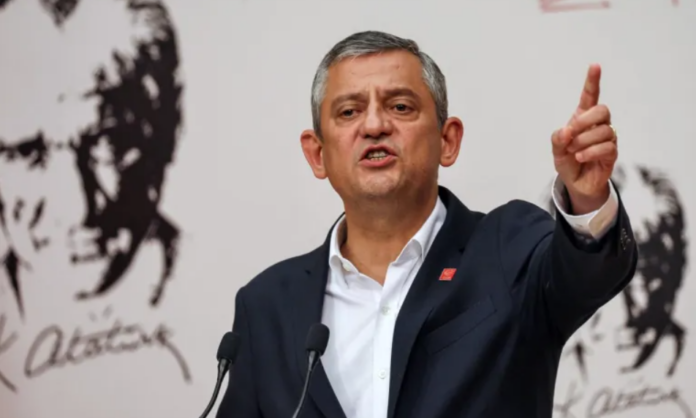
Now, the party’s latest congress has been declared invalid by court order, targeting Özgür Özel’s leadership and reopening the question of the party’s internal leadership. This is not merely a technical intervention into party law. By restoring Kemal Kılıçdaroğlu, the former leader defeated at the 2023 congress, the courts have effectively rehabilitated a political past that the party membership had already tried to move beyond. The judiciary is not returning the CHP to neutrality; it is selecting one factional memory over another, turning an internal democratic rupture into a state-managed crisis.
This matters because Kılıçdaroğlu is not simply an “old leader.” He represents the unresolved trauma of the 2023 presidential defeat, the limits of the previous opposition strategy, and a leadership model that many CHP members believed had exhausted itself. His court-enabled return would therefore not restore order. On the contrary, it would reopen precisely the wounds that Özel’s leadership had attempted to contain: the conflict between the party’s old guard and its new leadership, between the memory of defeat and the momentum created after the 2024 local election victories, between institutional continuity and the demand for renewal.
For Erdoğan’s regime, this is politically useful. A divided CHP is easier to defeat than a reenergized CHP. A party forced to debate who its legitimate chair is cannot fully organize against authoritarian consolidation. In this sense, the court ruling does not only remove a leader; it manufactures dual legitimacy inside the opposition: one leadership deriving its authority from party members and recent electoral momentum, another deriving its authority from a court order. That is why the decision is so dangerous. It transforms an external authoritarian attack into an internal party clash, making the opposition spend its energy on itself rather than on the regime.
This is not merely pressure on one party. It shows that authoritarianism in Turkey has reached a new level. Elections had already been held for a long time under deeply unequal conditions: government control over the media, judicial pressure, the criminalisation of opposition, and the mobilisation of state resources in favour of the ruling bloc had made elections profoundly unfair. Yet elections still mattered. They were not entirely symbolic. They remained one of the last political arenas in which society could interrupt the script written by the regime.
That is precisely why the opposition is now being dismantled piece by piece. The aim is not only to defeat the CHP at the ballot box, but to prevent it from entering the election as a coherent, legitimate and mobilised political force. If this process continues, elections may still be held in Turkey, but they will increasingly resemble a race against a shattered mirror: the opposition will formally exist, but in a fragmented, exhausted and institutionally sabotaged form.
For this reason, the current crisis must be understood as far more than an internal congress dispute within the CHP. It is an open intervention showing that even the most minimal limits of bourgeois democracy are no longer recognised by the government. The right of political parties to elect their own leadership, the right of citizens to choose between different political alternatives, despite the severe “limitations”, to say the least, of bourgeois parliamentary democracy, and the basic principle that governments should not use the judiciary to eliminate their opponents have all become unnecessary burdens for the regime.
The issue is not to create any illusion about the class character of the CHP. The CHP is an establishment, centre-left party operating within the bourgeois political field. But today the attack is not directed only at the CHP. It targets the entire political ground on which elections, parties, trade unions, democratic mass organisations and social opposition can still move.
The regime is not merely weakening one rival. It is narrowing the public space in which the working class, socialists, the women’s movement, youth, the Kurdish people, Alevis, trade unions and all oppressed groups can struggle.
Therefore, the task is to raise an independent, united and grassroots democratic struggle against the regime’s attempt to dismantle the opposition piece by piece.
What the Left and all forces of social opposition must defend today is not the CHP itself, but the people’s right to organise, to object, and to express their will both in the streets and at the ballot box.
When the ruling classes begin to suspend even the rules of parliamentarian competition among themselves, this is not only a crisis of bourgeois politics. It also means that the door is being opened to a more naked, more coercive and more arbitrary regime for the working class and the oppressed. That is why the response to this attack cannot be confined to narrow party calculations, electoral engineering or a wait-and-see approach.
What is needed today is for socialists, trade unions, democratic mass organisations, women, youth, the Kurdish people, Alevis, labour and freedom forces to stand side by side while preserving their own independent voice and organised power. United struggle, without being trapped within the limits of establishment opposition, is the necessary path for defending the democratic rights of the working class and the oppressed against the regime’s authoritarian offensive.