


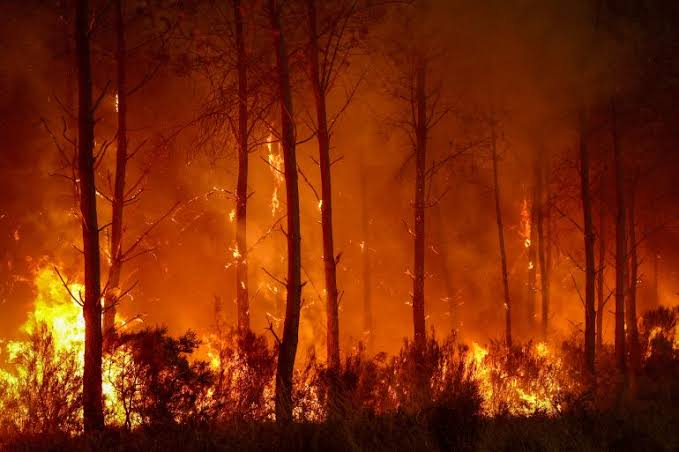
“What we are living through is not a series of isolated incidents. It is … the most painful manifestation of a climate emergency that is making … wildfires more voracious and heatwaves more frequent, and, as a result, our land more vulnerable. It is no longer an exception. It is the rule.”
Pedro Sanchez, Spanish Prime minister
At the end of July and first days of August, Spain and France were dealing with the worst wildfires in their recent history, with more than 650,000 acres of forest and grassland destroyed, and more than 370,000 people having evacuated their homes. At least 170,000 acres were burnt in Greece, where three firefighters and two pilots were killed while battling the blazes.
Just like the Spanish prime minister, government representatives across Europe when dealing with huge forest fires, blame it on the climate crisis implying that this is a new situation that we have to get used to.
However, climate change is nothing new. We know about it and about its consequences for a long period of time. Scientists have been warning for decades that if measures are not taken urgently, heatwaves will become more frequent and more intense and forests will become more vulnerable to fires and diseases. During those decades, what have the European states done to prevent this destruction and protect the highly sensitive forest ecosystems of the continent?
Disastrous cuts
According to a recent podcast of “The Guardian” in France, only seven out or 12 fire fighting planes were available to be used against the blaze in Bordeaux, since the country’s fleet is very old and the rest were being repaired. Michaël Pacanowski, president of a firefighters union in France says: “We know civil security lacks resources, that the system is at breaking point and needs reform, but it takes forest fires like the ones we have today to put these issues back on the table”.
In Spain, firefighters have been warning for years that cuts in Fire Service can have serious consequences. In Madrid, 64 out of the 124 positions of the local Forest Fire Prevention and Extinction Service are today vacant, while firefighters are forced to work with old, inadequate means and Personal Protective Equipment.
Vacant positions in the Greek Fire Service are calculated between 3,500 – 4,000. Every summer, thousands of temporary fire fighters are hired to cover those needs and fired again in winter. When demanding permanent jobs, they are being dealt with tear gas, arrests and beating by the riot police.
Several vehicles and dozens of fire fighters were deployed to France and Spain from countries like Italy, Portugal, Turkey, etc. International solidarity and assistance between different countries during difficult times is of course necessary. But what would happen if there were huge wildfires in two more countries at the same time? The total resources of the European Mechanism of Civil Protection are not enough to deal with a number of forest fires that break out simultaneously in the continent. European Commission admits that “these fires are out of capacity”.
A number of European countries have drastically reduced their firefighting staff during the last years. Between 2021-2022 France “lost” 5,446 firefighters, Romania 2,450, Portugal 2,907, etc. Having more firefighters, better equipment, enough and functional vehicles, does not mean that a country can deal with a forest fire that has gone out of control. It means that many more (if not all) the forest fires detected, will be dealt with at their early stages, before having the time to turn into “mega-fires” (a term commonly used by governments and local authorities to imply that nothing can be done).
Forest Fires and Climate Change
With the exception of politicians like Trump, Bolsonaro, Milei and other far-right figures who generally deny its existence, most governments in recent years have used climate change as an excuse for their inability to act in a timely manner to limit and minimize the impact of wildfires. Climate change is usually described as an invincible, almost supernatural force. What they usually say (not exactly in these words) is that we must accept that every year we’ll be losing larger and larger areas of forests and grassland, and there’s nothing we can do about it.
The fact that climate change makes forests more vulnerable to wildfires and increases their frequency and intensity is undeniable. According to data collected by NASA in the duration of 21 years (2003 – 2023), wildfires are becoming increasingly frequent and intense as summers grow hotter and drier, with the coniferous forests of the Northern Hemisphere being the most affected by this trend. It is also well known that once a wildfire has grown significantly in both size and intensity, it is much more difficult to contain it, than it would be in its early stages. At the same time, the burning process releases large amounts of carbon dioxide into the atmosphere (that was until then stored in vegetation – primarily in large trees), increasing greenhouse gas emissions. And the vicious cycle continues.
The link between climate change and wildfires should have led, years or even decades ago, to a substantial increase in public spending on firefighting staff and equipment, as well as planning and building infrastructure like water reservoirs, forest roads, firebreaks, etc. Measures should also have been taken to drastically reduce the use of fossil fuels and promote the use of renewable energy sources. However, governments that hypocritically invoke the threat of climate change are doing none of the above.
And while “climate change is the main reason for the loss of our forests,” as most European governments try to convince us, mining industries expand and the use of fossil fuels continues as if nothing were happening. The UN annual climate summits (COP) not only fail to adopt binding commitments to reduce greenhouse gas emissions, but rather serve as meeting points where big energy companies and government representatives make deals for the extraction and trade of fossil fuels.
In order to protect what is left from the European forest ecosystems, immediate action is necessary. We need to fight for:
- Large-scale staff recruitment in Fire and Forest Services.
- Mass funding to cover all the needs of both agencies, so that they can effectively carry out prevention efforts and forest firefighting operations.
- Training for the local communities living near forests, as well as substantive training and adequate equipment for volunteer forest protection groups.
- Absolute protection of burned areas; Ban every change of land use.
- Flood control and soil conservation projects.
- Scientifically supervised reforestation where deemed necessary. Protection of natural forest regeneration in burned areas.
- All forest areas must belong to the State, and their protection must be its responsibility