

Two summits, two different visions of the future
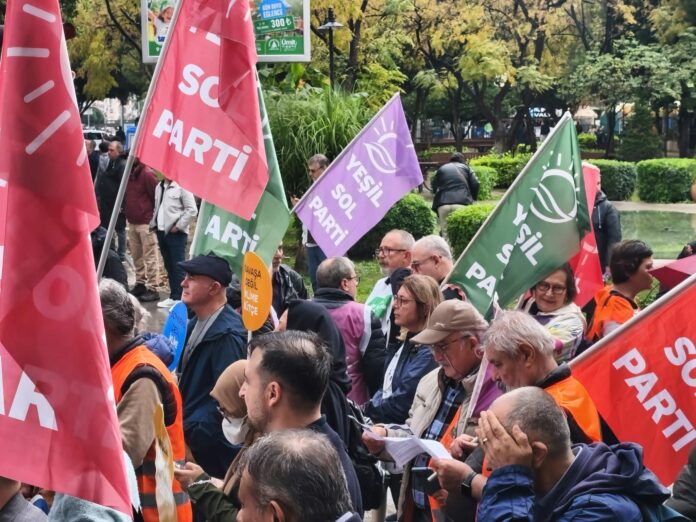
While governments, corporations and international institutions gathered in Antalya, Turkey, for COP31, activists, workers, peasants, trade unionists, feminists, ecological defenders and representatives of social movements from across the world came together for the Peoples’ Climate Summit (PCS). The contrast between the two gatherings could hardly have been sharper.
COP31 once again exposed the structural limitations of international climate negotiations. Despite increasingly alarming scientific evidence, governments remain unwilling to confront the economic system responsible for ecological destruction. Fossil fuel corporations continue to exercise enormous influence over political decisions, while climate finance remains inadequate, difficult to access and increasingly dependent on market mechanisms and private investment
The negotiations themselves illustrated this deadlock. The first draft of the COP31 political declaration, published on 16 November, contained references to transitioning away from fossil fuels. However, these references had disappeared from the revised draft published on 19 November. As negotiations extended beyond their scheduled conclusion, fundamental issues remained unresolved.
Yet the problem goes much deeper than the wording of any particular agreement. Even when governments acknowledge the need to reduce emissions, they rarely question who controls energy production, who bears the costs of transition, or why economic growth and corporate profitability remain the organising principles of climate policy.
The Peoples’ Climate Summit attempted to reverse this logic. Rather than treating climate change as a technical problem to be managed by governments and corporations, it placed democratic control, social justice and the transformation of production at the centre of its discussions.
An unprecedented collective achievement in Türkiye
Organising an international summit of this scale in Türkiye was itself a significant political achievement.
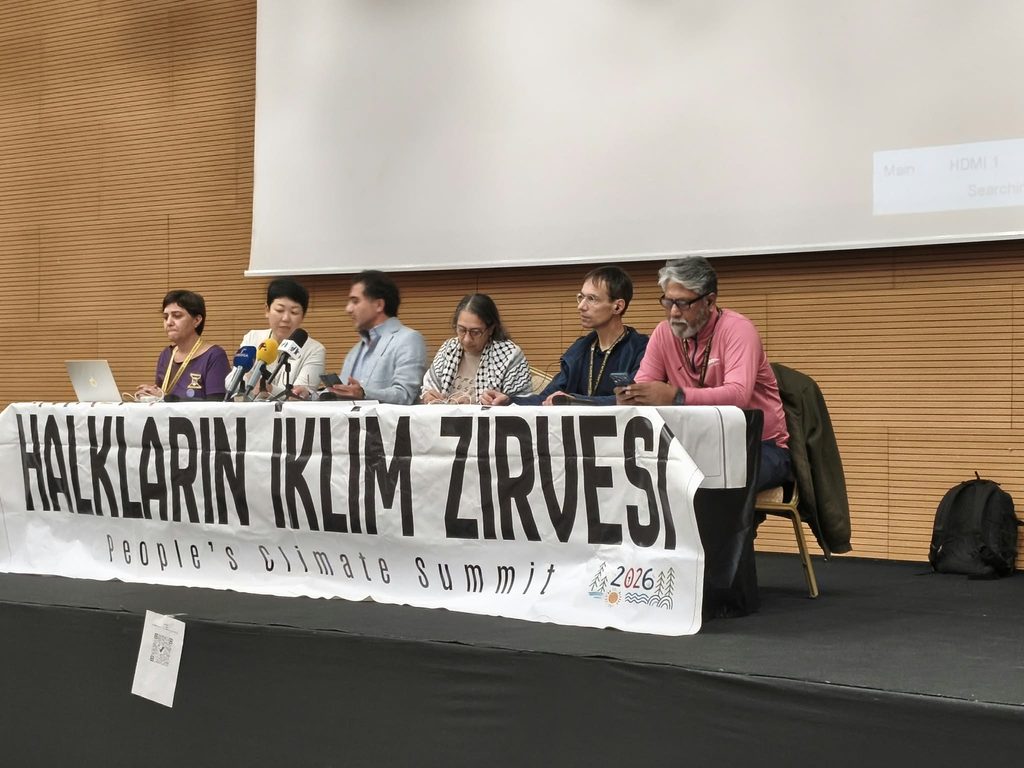
Over five days, nearly 500 volunteers helped organise approximately 2000 activities, bringing together participants from 45 countries. Panels, workshops, forums, cultural events, political discussions and solidarity meetings transformed the summit into a space for collective learning, political debate and international coordination.
These figures, however, tell only part of the story.
In a country where authoritarianism has increasingly restricted democratic participation, freedom of expression and collective organisation, creating an independent space where different movements could meet, discuss and make decisions together was a political act in its own right.
At a time when opposition politicians, journalists, trade unionists and social movements face repression, the summit demonstrated that collective democratic mechanisms can still be built through solidarity, voluntary work, and political determination.
The organising process was also an experiment in putting the principles defended by the PCS into practice. Relying heavily on voluntary contributions and solidarity funding, the organisers attempted to minimise monetary transactions and the use of disposable plastics, while making participation possible regardless of people’s financial means.
Language justice was another important achievement. Through simultaneous interpretation, volunteer translators and multilingual communication, the organisers attempted to overcome the linguistic inequalities that are frequently reproduced within international movements. Participation in political discussions should not be a privilege reserved for those who speak English or can afford professional interpretation services.
Naturally, these efforts were not without difficulties or contradictions. Organising such a large international gathering with limited financial means required enormous work, creativity and, at times, unavoidable compromises. Nevertheless, the experience demonstrated the potential of collective organisation outside corporate sponsorship and conventional conference structures.
Perhaps most importantly, the summit made something increasingly rare under authoritarian conditions possible: it created a space where people could breathe politically, develop mutual trust, openly debate their differences and experience collective democratic practice. Creating and defending such spaces is itself part of the struggle for social transformation.
From general criticism to concrete demands
One of the summit’s most important achievements was its attempt to develop concrete political alternatives.
The international climate justice movement has long argued that the ecological crisis cannot be resolved within the existing economic system. In Antalya, this general position was connected more systematically to proposals concerning energy, food, employment, public services, finance and democratic planning.
Energy democracy was one of the central themes. Discussions went beyond demands for increased investment in renewable energy to question who owns energy infrastructure, who determines investment priorities and whose needs energy production is organised to meet.
The international capitalist economic order presents the expansion of renewable energy as though a major transition away from fossil fuels were already underway. In reality, however, what we are witnessing is not so much the replacement of fossil fuels as the addition of renewable energy to the existing energy system.
In 2010, global consumption of coal, oil and natural gas amounted to approximately 438.3 exajoules. By 2025, it had reached 517.7 exajoules, representing an increase of around 18% over fifteen years. The fact that fossil fuel consumption continues to rise in absolute terms, despite the rapid expansion of solar and wind power, clearly demonstrates the limitations of energy transition within the logic of capitalist growth.
Moreover, renewable energy technologies are not free from ecological and social costs. The extraction of lithium, copper, nickel, cobalt and rare earth elements required for solar panels, wind turbines, batteries and electricity transmission infrastructure is driving a new wave of mining across many parts of the world. The impacts of these activities on water, soil, biodiversity and human health have not been adequately investigated, particularly with regard to their long-term and cumulative consequences.
Renewable energy investments themselves can also impose severe costs on local ecosystems and communities. Projects implemented without democratic participation and comprehensive ecological and social impact assessments can lead to the loss of agricultural and grazing land, the destruction of livelihoods, the displacement of local populations and even the abandonment of entire communities.
Consequently, renewable energy, in itself, does not constitute an ecological transformation policy. Which technologies are used, where they are located, at what scale they operate, whose needs they serve and who controls them are fundamentally political questions.
Simply increasing generation capacity while treating ever-expanding energy demand as inevitable, reproduces the fossil fuel-based growth model through different technologies. What we need instead is a transformation in which social needs are prioritized and democratically determined, unnecessary and destructive production is reduced, the limits of energy consumption are openly debated, and production is publicly planned within ecological boundaries.
This is precisely what energy democracy requires: collective decisions not only about how energy is produced, but also about how much is produced, what it is used for, who makes these decisions and who bears the consequences.
The public pathway: A democratic foundation for ecological and social transformation
The concept of a public pathway for ecological and social transformation also emerged as an important focus of discussion at the summit.
Immediately before the Peoples’ Climate Summit, Trade Unions for Energy Democracy (TUED) organised a two-day international meeting connected to the summit.
This gathering made an important contribution to developing the public pathway approach. Bringing together trade unionists and representatives of labour movements from different countries, it helped strengthen the understanding that ecological transformation cannot be left to market mechanisms and private investment, but must be organised through public ownership, democratic planning and workers’ control.
This discussion extended far beyond the energy sector. The feminist climate justice movement’s concept of a green-purple public transformation points towards a similar perspective of comprehensive social reorganisation.
It encompasses a broad programme ranging from the socialisation of care work to the public ownership of energy, and from reorganising healthcare, education, housing, transport and food systems as fundamental rights to removing these essential services from the logic of commodification.
Here, public ownership does not simply mean state ownership. The objective is to organise production and services under the direct control and democratic management of the workers who provide them and the people who depend on them.
The public pathway, therefore, is not merely about assigning greater responsibilities to existing state institutions. It requires the democratisation of economic decision-making, placing social needs before profit, and planning production and social reproduction together.
It was particularly significant that trade unions, feminist movements, ecological organisations and social movements from different countries began to converge around this perspective, despite approaching these questions from different experiences and traditions.
The public pathway is increasingly taking shape as a perspective of democratic social transformation in which workers, producers and the people using public services exercise direct rights of participation, decision-making, control and management.
The institutional forms, democratic mechanisms and political strategies through which this approach can be realised remain subjects of debate. However, the Antalya experience demonstrated that discussions around the public pathway are among the most important political debates that the international climate justice movement must follow, deepen and develop into common programmes of struggle in the coming period.
Food sovereignty and agroecology were also prominent themes. Participants challenged industrial agriculture, corporate control over seeds, pesticide dependency and the concentration of land ownership. They defended public support for small-scale producers, the protection of land and seed rights, and food systems organised around social needs rather than agribusiness profits.
These demands were particularly important because agriculture and food systems are frequently treated as secondary issues in international climate negotiations, despite their central role in ecological destruction, inequality and the conditions of everyday survival.
Artificial Intelligence
Another important development was that artificial intelligence and its ecological consequences entered the summit’s agenda as a distinct political issue for the first time.
The enormous energy and water consumption of data centres, the extraction of minerals for digital infrastructure, electronic waste, and the connections between artificial intelligence, military technologies and corporate power were discussed as interconnected dimensions of the ecological crisis.
These debates challenged the widespread assumption that digitalisation is inherently environmentally beneficial. They also raised fundamental questions about the ownership and control of technological development, and whether technological innovation serves social needs or accelerates capital accumulation.
Taken together, these discussions marked an important development. The summit did not simply repeat the familiar slogan of changing the system, not the climate. It began to examine more concretely what such a transformation would mean in terms of ownership, production, distribution, rights and democratic institutions.
Climate finance and the struggle over a just transition
Climate finance remained one of the central dividing lines between the official COP31 negotiations and the demands articulated at the Peoples’ Climate Summit.
The PCS insisted that climate finance must reflect historical responsibility. Wealthy industrialised countries, which have contributed disproportionately to cumulative greenhouse gas emissions, must provide adequate, predictable and predominantly grant-based public finance to countries and communities facing the consequences of the climate crisis.
Climate finance cannot simply become another instrument for expanding debt, creating new markets or transferring public money to private investors.
Discussions also addressed the Belém–Antalya Mechanism (BAM), proposed as an institutional mechanism to support the implementation of just transition commitments under the UN climate negotiations.
The debate surrounding BAM raised important questions: Can an international mechanism genuinely support workers and affected communities? Will it include sufficient public financing, meaningful democratic participation and enforceable social protections? Or will it become another institution producing recommendations while leaving existing economic relations untouched?
For the movements gathered in Antalya, a just transition must mean much more than retraining workers for employment in new industries. It must guarantee employment security, income protection, collective bargaining rights, social protection and democratic participation. Its costs must not be imposed on workers, the poor or communities already suffering from ecological destruction.
This discussion also highlighted the relationship between climate finance and global inequality. A transformation that reproduces the dependence of the Global South on Northern capital, technology and financial institutions cannot be considered just.
The summit contributed to bringing these debates out of the technical language of international negotiations and connecting them to the political struggles of workers, peasants, local communities and social movements.
War, militarism and ecological destruction
Another distinctive contribution of the Peoples’ Climate Summit was its insistence that war and militarism cannot be separated from the ecological crisis.
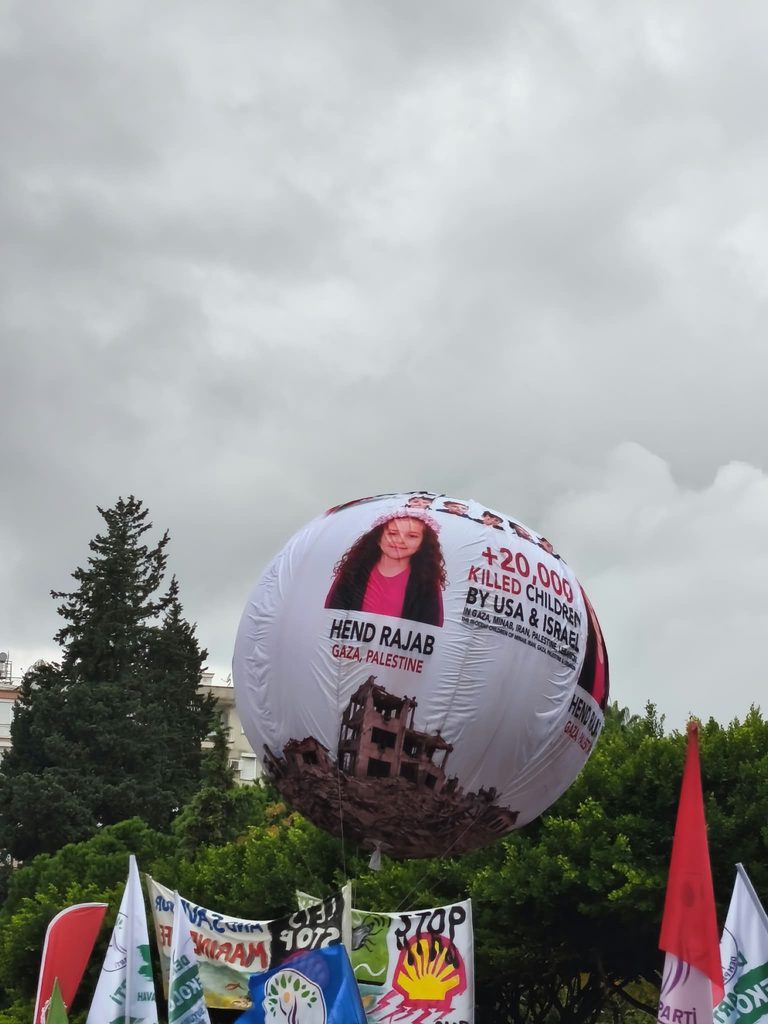
While official climate negotiations largely exclude military emissions, arms production, occupation and the ecological consequences of warfare from their agenda, the summit devoted considerable attention to these issues.
Military expenditure consumes enormous public budgets that could otherwise be used for healthcare, housing, ecological restoration and climate adaptation. Wars destroy agricultural land, water systems, infrastructure and entire ecosystems. Militarisation also strengthens authoritarianism and repression against communities defending their living environments.
Discussions on Palestine, the Kurdish question, militarisation and international conflicts brought together peace movements and ecological organisations that do not always operate within the same political networks.
An important message emerged from these discussions: peace cannot simply mean the end of armed conflict. It must also involve repairing ecological destruction, restoring the conditions for collective life and guaranteeing the rights of displaced communities.
In the context of Türkiye, this meant emphasising that any peace process addressing the Kurdish question must also confront the ecological destruction affecting Kurdish regions. Peace cannot become an opportunity for a new wave of mining, energy projects, land grabbing and corporate expansion.
The summit’s perspective of “Peace with Nature” thus connected anti-war politics to a broader struggle against exploitation, colonialism and ecological destruction.
This approach was particularly significant at a time of increasing military expenditure, intensifying geopolitical rivalries and the growing integration of fossil fuel interests with military and security policies.
Internationalist Standpoint: Building bridges across divided societies
Internationalist Standpoint (ISP) maintained a strong political presence throughout the summit, organising two panels and contributing speakers to numerous other discussions and activities. ISP’s participation helped bring the relationships between capitalism, ecological destruction, militarism and socialist transformation to the centre of the debates.
ISp had sizeable delegations from Greece, Cyprus, north and south, Romania and individual comrdes from other countries. It had its own stall, with a leaflet in Turkinsh and English, a special brochure produced particulalry for the event, T-shirts and other fighting fund material.
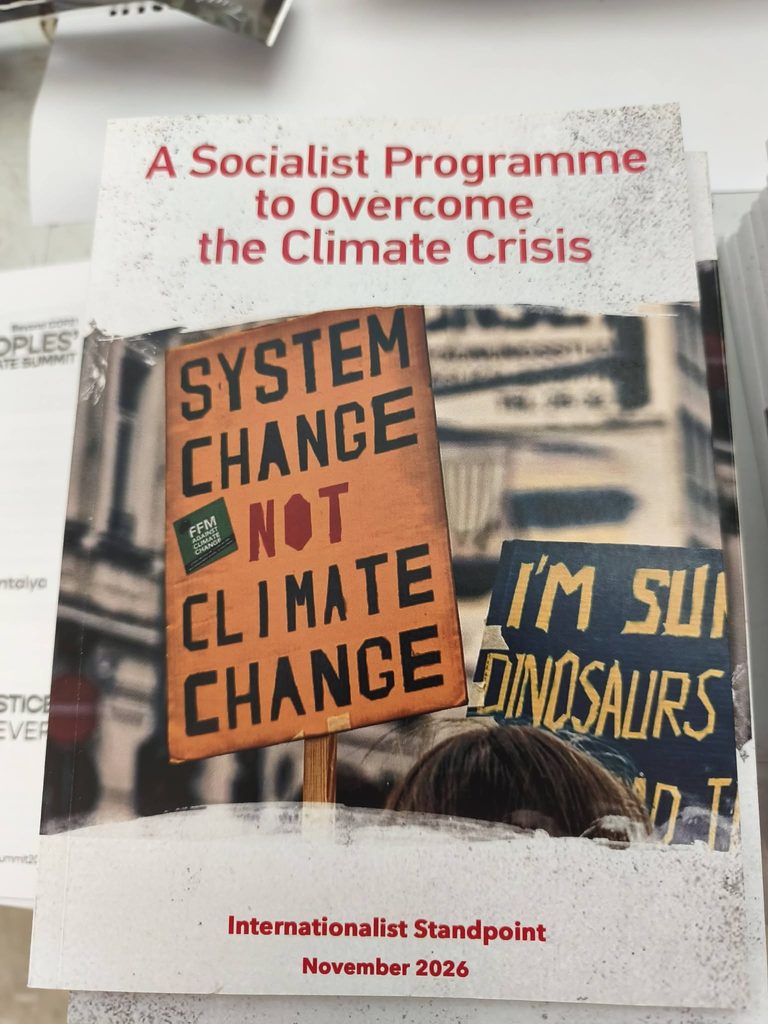
In particular, ISP emphasised that the ecological crisis cannot be resolved simply through greener technologies, changes in individual consumption or better international agreements. The decisive questions concern ownership, production, democratic planning and the power of the working class and social movements to transform society.
An especially important aspect of this participation was the presence of delegations from Greece and Cyprus. The participation of NEDA (New Internationalist Left), an organisation active in both northern and southern Cyprus, gave particular significance to discussions on internationalism, peace and united struggle.
Together, these delegations brought the Cyprus question into the summit’s political discussions. We emphasised the importance of the common struggle of Greek Cypriot and Turkish Cypriot workers, and the need to work towards a united, independent and socialist Cyprus.
The discussions also provided an opportunity to address the forthcoming 6 December elections in northern Cyprus, including the cooperation between NEDA and Bağımsızlık Yolu (Independence Path). This cooperation offered a concrete example of how organisations with different political and organisational traditions can translate common struggles around workers’ rights, democracy, peace and socialism into practical political initiatives.
The Cyprus question also has direct implications for Türkiye and the wider Eastern Mediterranean. The discovery and exploitation of offshore natural gas reserves have intensified competition over exclusive economic zones (EEZs) and maritime jurisdiction. Large multinational oil and gas corporations have gained enormous influence over the region’s future, while governments increasingly approach the Mediterranean as a territory to be divided into competing zones of extraction.
Türkiye’s determination to pursue offshore gas exploration, competing claims over maritime boundaries, and the presence of Greek and Turkish naval forces in the region have repeatedly created dangerous tensions. Although relations between the two countries have experienced periods of relative calm, the underlying disputes remain unresolved. The possibility of renewed military confrontation cannot be separated from the broader competition over energy, sovereign claims and geopolitical influence.
From an internationalist socialist perspective, this raises a fundamental question: Why should Greek, Turkish, Greek Cypriot and Turkish Cypriot workers be drawn into confrontation over natural gas reserves whose exploitation only benefits corporations and competing ruling classes?
The ecological dimension of this conflict is also very important. At a time when the world urgently needs to move away from fossil fuels, governments in the Eastern Mediterranean are mobilising political, economic and military resources to secure access to new gas fields. The same fossil fuel expansion that accelerates ecological destruction also becomes a potential source of international conflict.
This is why building bridges between movements in Greece, northern Cyprus, southern Cyprus and Türkiye is much more than a symbolic gesture of solidarity. It creates opportunities for common political action against nationalism, militarisation, fossil fuel expansion and the division of working people along ethnic and national lines.
The presence of ISP, the Cypriot and Greek comrades, demonstrated that such cooperation is not merely an aspiration for the future. It is already being developed in practice through shared campaigns, political discussions, solidarity networks and efforts to formulate common socialist perspectives.
This experience also enriched the broader discussions at the Peoples’ Climate Summit about unity and united struggle. Cooperation between organisations from different countries and political backgrounds demonstrated that unity does not require the suppression of political differences. It can be built through concrete struggles, shared objectives, democratic discussion and collective action.
For the socialist left, which has long struggled to overcome organisational fragmentation, this was an important message. United struggle cannot be established simply by declaring the need for unity. It develops when organisations assume practical responsibilities in common campaigns, openly discuss their political differences and demonstrate through experience that cooperation can strengthen rather than weaken their respective struggles.
By bringing together comrades from Türkiye, Greece and both sides of Cyprus, ISP helped make this perspective visible within an international climate justice gathering. The presence of a strong delegation from the Romanian section of ISp, GAS, also, gave a Balkan dimension and perspective to our future tasks.
Our message was clear: the peoples of the Eastern Mediterranean have far more to gain from peace, ecological justice and socialist cooperation than from competing national claims over fossil fuel reserves.
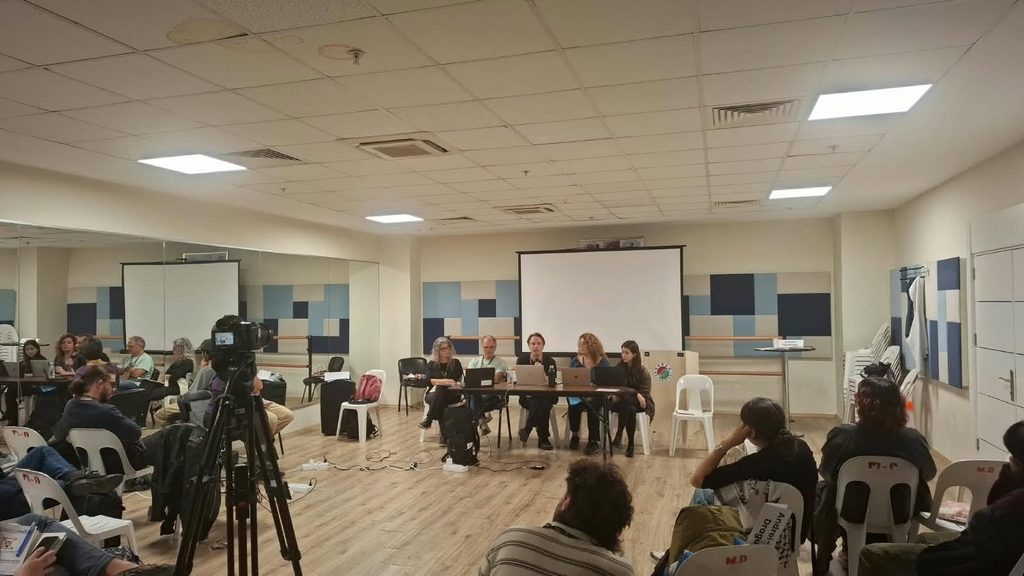
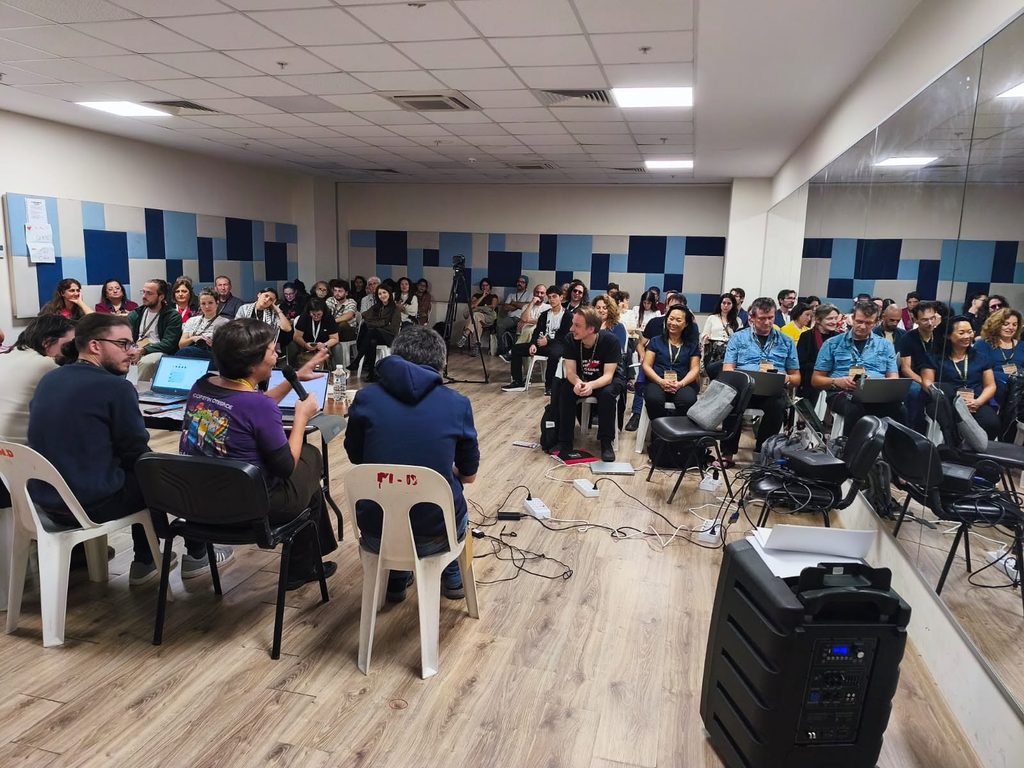
In this sense, our intervention went beyond the immediate discussions of the summit. It connected the struggle for a united and socialist Cyprus with the wider fight against militarism, fossil fuel capitalism and authoritarianism, demonstrating how ecological struggles can provide a foundation for a new internationalist politics.
At a time when governments are increasingly militarising borders, seas and energy routes, building lasting political bridges between working people across these divisions is an essential part of constructing a common alternative.
The final declaration and the challenges ahead
The summit concluded with a common declaration bringing together demands emerging from different thematic discussions.
The declaration called for a rapid and binding phase-out of fossil fuels, energy democracy, publicly financed ecological transformation, food sovereignty, agroecology, the recognition of the rights of nature, universal public services, labour rights and democratic control over production.
It rejected the expansion of nuclear power, carbon markets and other false solutions, while insisting that ecological transformation must also confront patriarchy, racism, authoritarianism, colonialism and militarism.
Importantly, the declaration did not present these demands as separate reforms to be implemented independently of one another. It situated them within a broader struggle to transform the social relations that produce ecological and economic crises.
Nevertheless, declaration is only a starting point.
The real political significance of the Peoples’ Climate Summit will depend on what happens after Antalya. Can the networks established during the summit develop into lasting forms of cooperation? Can common demands be translated into coordinated campaigns? Can the connections between workers, peasants, feminist movements, ecological organisations and anti-war movements be strengthened beyond international conferences?
These are not questions that can be resolved simply by organising another summit. They require political organisation, sustained mobilisation and a willingness to confront the power of capital at local, national and international levels.
Beyond Antalya: Building the forces for transformation
The Peoples’ Climate Summit should not be romanticised. Differences between participating organisations remain significant, and many discussions are still at an early stage. The distance between common declarations and coordinated international action remains considerable.
Nevertheless, the gathering represented an important step forward.
It brought together struggles that are too often separated, strengthened the political content of climate justice demands, and demonstrated that democratic, internationalist and collectively organised alternatives remain possible even under difficult political conditions.
Perhaps its most important contribution was its attempt to move beyond the familiar opposition between official climate negotiations and protest movements. It sought to create a space in which movements themselves could formulate policies, produce knowledge, develop common demands and experiment with alternative forms of collective organisation.
This experience is particularly significant at a time when the far right is gaining ground internationally, authoritarian governments are intensifying repression, and militarisation is becoming a central feature of global politics.
The ecological movement cannot respond to these developments by limiting itself to environmental demands. It must become part of the wider struggle for democracy, peace, equality and socialism.
The Antalya experience suggests that this process is already underway. Its strength lies not in the absence of disagreements, but in the capacity to develop collective action across them.
COP31 once again demonstrated the inability of governments operating within the existing capitalist order to confront the causes of ecological destruction. The Peoples’ Climate Summit demonstrated something different: that workers, local communities and social movements can begin to develop their own collective answers.
The challenge now is to transform this experience into lasting organisations, common campaigns and a stronger international movement capable not only of resisting ecological destruction, but of fundamentally changing the system that produces it.
The struggle does not end in Antalya. The task is to carry the summit’s demands, connections, and collective experience into workplaces, neighborhoods, fields, universities, and streets across the world.
Our struggles are connected. Our future must be built together.