


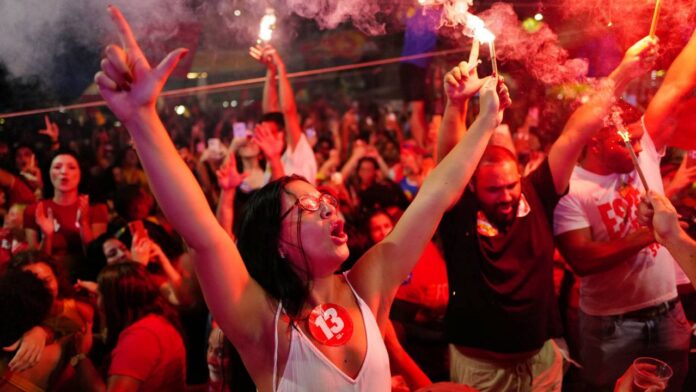
The announcement of the results of the second round of the presidential election in Brazil -with Lula’s unprecedented comeback and victory- sparked mass celebrations and relief not only in Brazil and Latin America, but around the world.
The fact that a far-right candidate – especially in Latin America’s largest country – was defeated, despite the widespread rise of the far right internationally, filled millions of people with joy and confidence. The defeat of Flávio Bolsonaro (son of the convicted felon former president Jair Bolsonaro) dealt a resounding blow to those nostalgic for the military junta, racists, and fascists, and put the brakes on the Trump-backed “shift to the right” on the continent. The fact that Bolsonaro Jr. fled the country illegally as soon as he lost the election is a telling summary of these developments.
The political upheaval was built in the streets
The decisive factor in this political upheaval was the mobilization of millions of people following the results of the first round (on October 4). Bolsonaro’s lead and the possibility of his election brought a large segment of society out onto the streets, especially in the major cities (Rio de Janeiro, São Paulo, etc.).
The threat of a far-right president with clear ties to organized crime and fascist gangs, sparked a mass movement with anti-fascist, anti-racist, feminist, and pro-worker sentiments.
This movement fought against Bolsonaro. And it pushed Lula to steer his campaign to the left in order to get elected. It is no coincidence that between the first and second rounds, significant pro-people reform measures were announced or passed, such as the abolition of the six-day, 44-hour workweek, the elimination of public transit fares on weekends and holidays, an increase in the amount provided by the Bolsa Família (a benefit for the lowest-income households), and measures to assist heavily-indebted households.
It was this momentum that brought three million more voters to the polls, the overwhelming majority of whom voted for Lula. Lula received ten million more votes than in the first round, while Bolsonaro received four million more (even though the vast majority of the other candidates in the first round were right-wing – and thus aligned with him).
The Far Right Remains Strong
Despite the significant defeat, and the impression of disarray created by Bolsonaro’s departure, the far right in the country remains very strong. Lula’s victory does not negate the fact that Bolsonaro received 48% (nearly 60 million votes – more than his father’s results in 2018 and 2022). This was achieved while his father is in prison, convicted of attempting a coup, while Flavio Bolsonaro himself is implicated in various corruption scandals.
So what is it that gave Bolsonaro such momentum after four years of Lula’s government?
In postwar Brazil, there was a strong far-right, fascist tradition (linked both to the country’s colonial history and to the fact that many Nazis fled there after their defeat). According to exit polls, Bolsonaro had a slight lead among white voters, men, those with higher education, and those with higher incomes. However, the far-right vote, unlike in elections prior to 2018, remains stubbornly high. It is important to examine why.
Lula’s Workers’ Party (PT) won the 2002 election. It was the first time a left-wing party had won an election since the restoration of democracy (the country had been under a military dictatorship from 1964 to 1985). Lula initially implemented a series of pro-working people measures that earned him significant support from the working class, relying primarily on the high prices of the raw materials the country exported. At the same time, however, he did not want under any circumstances to encroach on capital’s profits. He often boasted publicly that local and foreign businesspeople “made money like never before” during his time in office.
When the crisis hit Brazil in 2008, Lula implemented austerity measures. In 2013, people took to the streets en masse in a historic grassroots movement against the PT government’s austerity policies. In 2014, the judicial investigation known as “Car Wash” began (a corruption case involving high-ranking government officials and including Lula himself). It is impossible to know how many and which of these charges were genuine and which were fabricated, but in the public consciousness, widespread corruption was associated with the PT government.
The far right exploited this economic situation and political turmoil to gain ground. Thus, almost “out of nowhere”, Bolsonaro appeared, positioning himself as an “anti-establishment” figure. In addition to rallying the country’s existing far-right base, the Bolsonaristas are winning the votes of a segment of the working class that wants to punish Lula as the country’s “establishment” and who want to send a message against the policies that keep them “at the bottom”.
It is interesting to note that in a 2025 poll, 48% of Bolsonaro’s voters favored “radical upheavals”, while the corresponding percentage among Lula’s voters stood at 16%.
Where the Battle Will Be Decided
Given these facts, those who claim that “the far right and fascism in Brazil are over” are making a serious mistake. This is because the factors that fueled its rise of the far-right continue to exist.
Lula was forced to shift his campaign to the left, but he is already under intense pressure. The day after his victory, the country’s currency lost 8% of its value, and the stock markets fell by 14%. The day after that, there was a “correction,” but the message from big capital was clear: rein it in. Finance Minister Durigan rushed to reassure the markets, saying that the government remains committed to “fiscal stability.”
On the international stage, Lula is trying to play the game of a “multi-level foreign policy” – that is, to remain open to cooperation with many imperialist powers, not just one. This is the basis for Brazil’s participation in the BRICS (the alliance centered on China) on the one hand, and its effort to strike a balance with Trump on the other.
Lula’s presidency, therefore, will soon find itself caught in the crossfire. On the one hand, there is Brazilian big business, which wants to increase its profits; Trump and Xi, who want Brazil within their own sphere of influence; and the Chamber of Deputies and the Senate, where the Right and the Far Right hold a large majority.[1] On the other hand, there is popular anger and indignation over the cost of living, and a movement that, while largely unorganized and encompassing a wide range of views within it, has grown in confidence since the elections and expects Lula to fulfill his pro-people promises.
Despite the relief over Bolsonaro’s defeat, we cannot expect Lula to truly make a turn in defense of the interests of working people. That would require a confrontation with capital – both domestic and international.
Under the pressure and in the heat of the moment, Lula may take some additional progressive measures. But, as corresponding “progressive” or “center-left” governments around the world continually demonstrate, any political movement that does not want to clash with big interests and the system that serves them, ultimately ends up compromising with them.
It is this compromise that gives the far right a boost. This is how Bolsonaro “came to be”, and if the same pattern repeats itself, he will return in one form or another.
The Brazilian Left (more specifically the anti-capitalist Left operating within the framework of the P-SOL[2], an alliance of organizations to the left of the Workers’ Party that supported Lula in the presidential election) has the task of building an alternative to Lula and against big business interests, in order to pull the working majority out of this vicious cycle of crisis and the threat of the far right.