

Alan Jones
The economic austerity measures imposed by the International Monetary Fund and implemented by neoliberal lackey President Rodrigo Paz, are taking a massive toll on the livelihoods of working families in Bolivia. The price of diesel has increased by more than 350% compared to 2025. The price now depends on the fluctuations of the international market and has accelerated the crisis in the economy with a dramatic spike in the prices of basic household goods, public transportation, imports, and production in general, further undermining the living conditions of the working class. It should be remembered that when Paz took office in 2025, poverty affected 40% of the population of Bolivia, with 20% inflation while wages increased barely 5%. In a country so rich in energy, exports gas and lithium (a mineral critical for batteries internationally) the Bolivian oligarchy condemns millions of people to poverty and shortages.
The government’s agreements with the IMF aim to shift the burden of the crisis onto the working class by increasing the country’s foreign debt along with the devaluation of the currency against the dollar amid unstable exchange rates, fuel shortages, and the distribution of contaminated gasoline. Meanwhile more corruption and drug trafficking scandals linked to the government and the Paz family are coming to the surface.
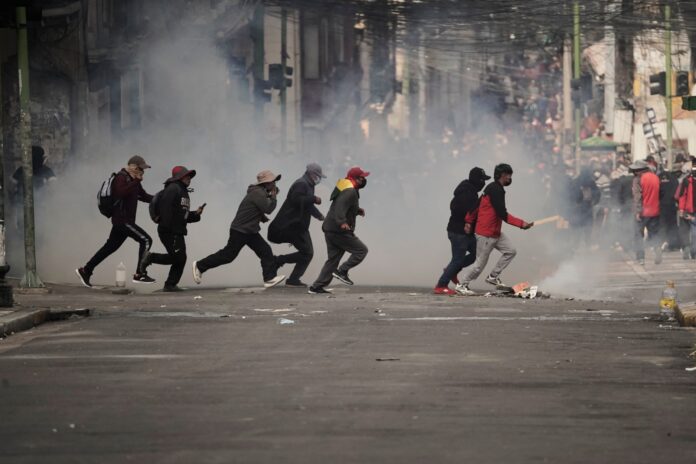
To implement this policy against the exploited and oppressed, the government, the IMF, and Donald Trump’s “Shield of the Americas”-to which Paz belongs- have all needed a to rely on a force other than their own: the power of labor bureaucracy that controls the Bolivian major union federation, COB. The COB leaders as well as other popular and peasant organizations such as FEJUVE agreed to a negotiated truce with the Paz government after more than a month of uninterrupted explosive mobilizations that had shut down the country in May-June this year. This has allowed this corrupt government to continue the attacks on living standards.
This truce was disguised as “a state of emergency”, but the military lacked the power to stop the massive protests that immediately arose in response to the Paz austerity measures—ranging from protests by transportation workers following the agreement to protests by families over excessive charges by real estate moguls. In the east, massive , peasant protests over fuel are continuing as well as now teachers again joining the struggle in the cities.
The pact between the COB bureaucracy and the government was the main factor that paralyzed the May – June protests. But the truce lasted only three months and has now ended. The government mistakenly believes that it was the state of emergency that allowed it to govern and it has decreed an extension of the state of emergency through December.
A rank-and-file upsurge is pressing the COB union federation to call for mass assemblies and move to act. The same is happening in peasant and popular organizations. The leaders can no longer contain the pressure from below and Bolivia seems to be heading toward the third phase of an explosive revolt.
The way forward is for mass assemblies and mass protests to demand COB and popular organizations call a general strike against austerity and the price increases to bring down the neoliberal government of Rodrigo Paz and the corrupt, right-wing Parliament. The government is weak and everyone is beginning to prepare for Paz’s downfall and possible early elections in order to buy more time for the current regime.
The Bolivian working class, peasants, women, and indigenous people are once again in the forefront of social struggles in Latin America against oppression, poverty, and racism. The experience of the last two decades in Bolivia as well as Latin America show the urgent need to bring the mining and hydrocarbon resources, the agro-industrial corporations, banks and imperialist cartels under the democratic control and management of working people.