

Ciaran Mulholland-based on the writings of Irish Marxist Peter Hadden (1950-2010)
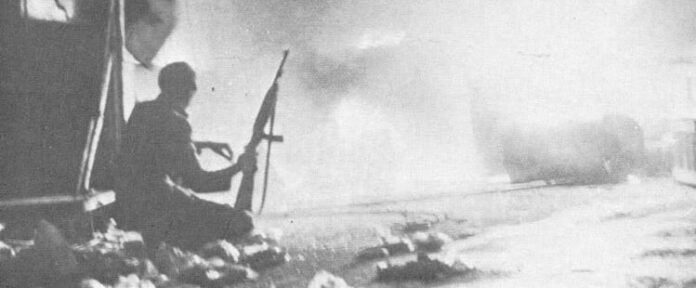
At 4.00am on the morning of Monday 9th August 1971, British soldiers raided Catholic homes across Northern Ireland. Men and boys were dragged from their beds. As it became clear what was happening fierce rioting spread through Catholic working-class areas of Belfast, Derry and other towns and gun battles broke out between the Provisional and Official wings of the IRA and the British Army.
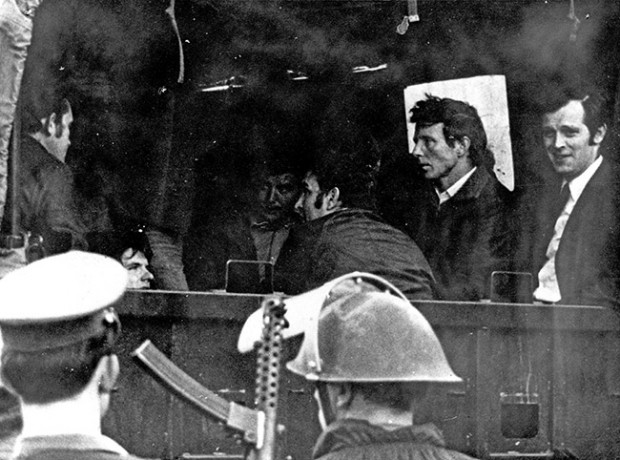
342 men were taken to makeshift internment camps. The arrests were based on poor intelligence and most active IRA volunteers escaped. The majority held were older activists, veterans of previous struggles, or political activists including a number who had been prominent during the period of the civil rights struggle. Many were active trade unionists, some who had played a prominent role in local areas during a recent postal strike.
Those seized were brutally treated-often forced to run a gauntlet of soldiers and police and beaten and then incarcerated without charge or trial. Fourteen of the internees were subjected to what the state referred to as “‘in-depth interrogation”. Torture techniques, previously used by the British Army in Kenya, Oman, Aden and Cyprus, were employed. The men were hooded, made to stand for long periods leaning on their fingertips against a wall, subjected to high pitched noise, deprived of sleep and regularly beaten. Some were blindfolded and thrown out of helicopters unaware that they were only feet off the ground.
The British government calculated that internment would unleash a wave of violence, but that they could control this, and the IRA’s capacity to organise would be hit hard. Internment had been used in every decade since the 1920s and was, from the standpoint of the state, successful. This time it was a serious miscalculation. The state overestimated the effectiveness of internment and grossly underestimated the scale, the intensity and the duration of the opposition.
The army operations sparked an immediate upsurge of violence, the worst since the August 1969 riots. Roads and streets were blocked with burning barricades to stop the British Army entering local areas. In Derry, barricades were erected around Free Derry and for the next year these areas effectively seceded from state control. Soldiers came under sustained attack from the IRA and rioters and reacted with extreme violence. Between 9th and 11th August, 24 people were killed: 20 civilians (14 Catholics, 6 Protestants), two members of the Provisional IRA (shot dead by the British Army), and two members of the British Army (shot dead by the Provisional IRA). In West Belfast’s Ballymurphy housing estate, 11 Catholic civilians were killed by the Parachute Regiment over two days in what became known as the Ballymurphy Massacre. In Ardoyne, in north Belfast, soldiers shot dead three people on 9th August.
There was also sectarian violence between Protestants and Catholics. 7,000 Catholics and 2,000 Protestants fled their Belfast homes, forced out by the violence, by threats or simply out of fear. This was until then the biggest forced movement of a civilian population in Europe since World War II. 200 Protestant families fled Ardoyne and burnt their own homes as they left to ensure they would be uninhabitable. Areas once mixed and peaceful were segregated into either hard-line Protestant or Catholic districts. What had occurred in a limited number of areas in August 1969 now took place over much of working-class Belfast.
Mass Opposition
A mass movement of opposition was at once ignited within Catholic areas. In Derry, 8,000 workers came out on strike. A “rent and rate strike” was started and was quickly effective-by December a quarter of all Catholic homes were withholding rent and rates. The Payment of Debt Act allowed rent arrears and other debts to be deducted from wages and benefits, but it failed to break the rent strike.
A ban on marches until the end of the year simply could not be enforced as no-go areas were sealed off by barricades. An anti-internment rally on Sunday 10th September attracted 20,000 people to Casement Park in West Belfast and there newly recruited IRA members paraded openly.
There was no doubting the mood of mass opposition which existed, but it was a one-sided as it was based only among Catholics, with Protestants either neutral or else supporting the government. So long as it could rely on the indifference or support of two thirds of the population the government could sustain its policy, albeit at the cost of unprecedented upheaval and complete political breakdown.
The responsibility to broaden the opposition to internment rested with the workers’ movement. Internment was not a sectarian issue but was a class issue. Catholics were the immediate target, but if it succeeded against them, it could be used against Protestants and, against the workers’ movement if and when it came to represent a threat to the ruling class. It is true that there was a risk that if the trade unions took up the issue in a clumsy or one-sided way that sectarian division might be opened up within the unions and the labour movement generally. To avoid a sectarian reaction the entire workers’ movement in Britain and Ireland would have had to take up and actively oppose internment, and as they did so, spell out the class reasons for this opposition directly to their members in the workplaces. Opposition to internment would have needed to be linked to an overall struggle against all forms of sectarian violence and repression, posing the need for workers to organise their own defence against the attack.
This would not have been easy but the alternative – inaction – definitely made things worse. A policy of ignoring difficulties does not mean that they go away. More often it means that these difficulties will sharpen until they cannot be ignored. Then they will have to be faced, but on less favourable grounds than when they first arose. The union leadership chose the path of inaction and thus cut itself off from the mass movement of opposition spreading through Catholic areas.
The youth wing of the Northern Ireland Labour Party, the Young Socialists, refused to be silenced. Belfast YS issued a special leaflet which they distributed at the huge Casement Park anti-internment rally in September, and which argued a class position: “Today the ruling class intern the Catholics who threaten them. Tomorrow they will turn against all who fight against their economic slavery, Protestant and Catholic alike. That is why this is a clear question. That is why the entire working class must be mobilised against internment and against the system which makes such measures necessary … If the entire trade union movement had been mobilised against internment and against the government which introduced it, Protestants and Catholics would have been brought into the struggle together”.
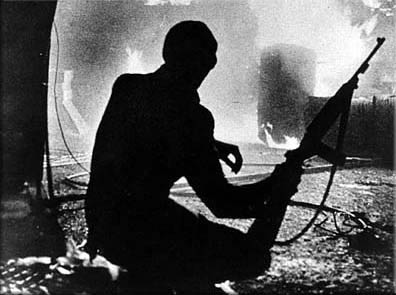
As a single statement representing the opinions of a minority within the labour movements this could have little impact. While YS members were giving out gave out the leaflets at the Casement Park rally, the IRA presence was much more visibly and forcefully felt. Young members, many newly recruited, paraded openly in black berets. All this was an open indication of the dramatic change which had taken place.
Military activity, especially from the Provisionals, escalated dramatically. Between April and August, the total number of deaths among the security forces had been four soldiers whereas between August and November 30 soldiers and 11 members of the police and locally recruited Ulster Defence Regiment were killed. In terms of civilian casualties, 17 civilians had been killed in 1971 before internment, as against 95 between August and the end of the year.
An operation designed to quash the IRA had in fact established them like never before in their history as a force in the urban areas among working class Catholics. Unemployment and poverty, the apparent absence of any other means to fight back and above all the repression tightening on the Catholic areas, were the factors which created enormous illusions in the IRA. Above all their military campaign seemed to offer an easy way to hit back.
Individual Terrorism
The hard truth was that no matter how popular it might have been in Catholic areas, the Provisional IRA’s campaign was a blind alley. It was the responsibility of socialists to tell the working class this truth, even though in doing so they risked isolation.
In the first place, the entire campaign was based on a mistaken analysis of the strategy of the British ruling class. IRA propaganda stated that they were fighting to force the British government to a conference table where they would be compelled to negotiate a withdrawal. Yet the British capitalists, in pursuit of their own class interests, were prepared to withdraw but were prevented from even taking one step in that direction due to their fear of civil war. The IRA campaign increased Protestant anger and Protestant opposition to reunification and made civil war even more certain should Britain pull out. Thus, its net political effect was to make it even less possible for Britain to go.
Secondly, no matter how fiercely fought or how broad the initial base of support, individual terrorism invariably leads to the same results. Its ultimate effect was to strengthen the state, providing an excuse for greater repression. In upholding sporadic attacks by marginal groups as an alternative to mass mobilisation, individual terrorism reduces the masses to passivity, allowing them only to spectate and applaud.
In any case the IRA campaign had as its base only one third of the population at most (the Catholics) and had the effect of driving the remaining two thirds into a position of support for whatever measures of repression were taken against it.
Nevertheless, when society reaches a point of social, political and economic impasse with no force able to show a way out, terrorism can become sustained. This explains the capacity of the Provisionals, although waging an unwinnable campaign, to sustain themselves for a quarter of a century and recover from military blows directed against them.
Today, as in 1971 there is no solution on a capitalist basis. None of the choices available on the basis of capitalism – that is, maintenance of the status quo, capitalist independence, capitalist unification or capitalist integration with Britain, nor any variant of these – will allow for reconciliation.
In 1968 and 1969 the labour movement had had the opportunity to find a way out: by building on the unity of the working class, struggling against all oppressors, Orange and Green, and bringing about a socialist solution. That opportunity was squandered. A defeat was suffered and like every defeat it had its price. By 1972 the organisations of the labour movement were numbed and semi-paralysed by the scale and ferocity of the sectarian reaction. Those who in this climate advocated the ideas of class unity and socialism were isolated. Such ideas seemed ridiculous to the majority of people at the time, contradicted as they were on a daily basis by events.
Virtually every tendency in society succumbed to this situation, either capitulating to the sectarian pressures or else becoming enshrouded in gloom and pessimism. Yet it was at the beginning of 1972, just as Stormont was disintegrating, that a small group of labour movement activists, North and South, launched the monthly newspaper Militant Irish Monthly, a paper whose objective was to achieve class unity and socialism.
Militant carried the simple message that: the only force in society capable of solving the problem was the working class, not a section of the working class, but the working class, Catholic and Protestant, united in struggle. This unity could only be achieved based on a struggle around socialist policies and for a socialist solution to the national question.
Marxists base themselves not simply on things as they are but on how they will change and what they will become. Surrounded by pessimists and cynics, Militant was alone at the time in being able to put forward a generally optimistic perspective. A defeat had been suffered but not a final defeat. The movement had suffered other defeats in the course of its history – at the time of partition, in the 1930s, in 1949 – yet each time it had been able to recover, to move once again onto the road of struggle. While the blow suffered this time may have been greater than at any past time, even the time of partition, there were compensating factors.: the working class was stronger, its organisations more powerful and the world situation much more favourable than in the past. While it would now take time, the working class would again be able to recover. New opportunities would arise. The task in 1971-1972 was to learn the lessons of those mistakes which had given rise to this situation and to organise to ensure that they would not be repeated and that future opportunities would not be let slip by.