

Internationalist Standpoint spoke to Sebastian Rave, member of the Spokesperson Council of the Anticapitalist Left (AKL) within Die Linke, and an activist in the antimilitarization and antifascist movement in Germany, about recent developments in Germany, especially centering on the left party “Die Linke”. The interview was taken by comrade Andros Payiatsos.
- Hi Seba. A few years back, Die Linke seemed to be in a mortal crisis. But recently it seems to have recovered electorally. What is the actual picture?
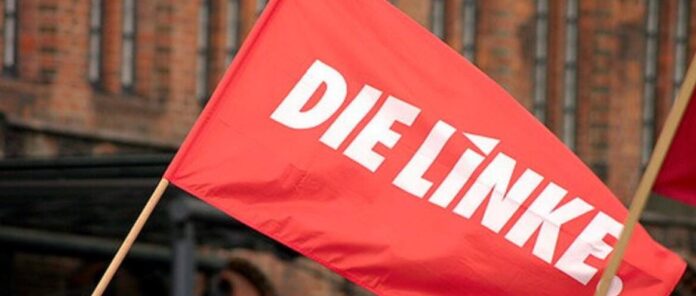
Hi Andros, yes, Die Linke (“The Left”) seemed to be on its deathbed already, but only if you took a superficial look. After years of internal conflicts, in 2023 there was a rightward split around Sarah Wagenknecht, former parliamentary leader of Die Linke, who had taken over a nationalistic, sometimes borderline racist position. Before that, many young people who sympathized with Die Linke didn’t join the party because its positions didn’t seem clear. I mean, there were clear positions adopted at every congress, but Wagenknecht kept publicly blaming the party’s focus on “open borders” and “bizarre minorities” (as she actually wrote in her book) for the rise of the far right and the electoral demise of Die Linke.
After she left, there was a spirit of new beginnings. In a first wave, a few hundred radical leftists joined the party, because they saw an opening to push it to the left. Then, after a historic mass movement against the far right in 2024, the CDU (the right-wing Christian Democrats) pushed through a motion against migration in the Bundestag (German Parliament), with the votes of the far right AfD (Alternative for Germany). A new mass movement emerged, and this time it was clear that neither the SPD nor the Greens could be the parliamentary voice of the movement, but that only Die Linke could credibly represent the anti-racist movement. Heidi Reichinnek, the new parliamentary leader, and young, dynamic public face of Die Linke, called on the people to go “on the barricades” against the far right, and tens of thousands joined Die Linke.
During the election campaign in the middle of a cold winter, venues were often too small, and Die Linke speakers had to go outside to address the hundreds waiting outside. The election result was a huge surprise – only months before, it seemed that Die Linke would not re-enter the Bundestag but suddenly it got 8.7% of the vote, rising like a phoenix from the ashes.
- What is the picture internally? Is there an influx of membership? Is there a turn of youth to Die Linke?
Absolutely, since the election success even more people have joined Die Linke. It was the perfect storm: Greater political clarity, compared to before, a mass movement against the far right, a new strategy with a focus on young people and social media, and a success story – and suddenly Die Linke had 120,000 members, almost doubling its membership. You could really say this is a re-founded party.
You could see that at the last congress, where 60% of the delegates were attending their first congress! This new layer of members is much younger, more radical, wants to make politics in the first person.
They have been politicised by a mass movement against the collaboration between conservative bourgeois politicians with the far right, while at the same time a war is being fought in and over Ukraine, and a live-streamed genocide has taken place in Gaza. Only a few years before, as kids they spent their youth fighting climate change. It’s not hard to connect the dots: The problem is capitalism. You need to organise against it. And a large, left party is a good place to do that.
- Let’s talk a bit about the general picture of the German economy and society as the background to developments in Die Linke.
The German economy is struggling to adapt to a changed world situation. In the previous period, the German capitalists used cheap labour from the EU and cheap energy from Russia, and exported cars, machines and chemical products to the other European countries, the US and China. Now, faced with US tariffs and with the rise of Chinese capitalism, exports are stalling, while production costs, mainly for energy, are exploding. There’s still a trade surplus, but competition is getting stronger, especially from the Chinese auto industry. As a result, we’re witnessing the beginning of massive job losses. There are reports that VW is planning to cut 120.000 jobs. Estimations say that 225.000 jobs could disappear over the next ten years in the auto industry alone.
At the same time, the Merz government is taking a chainsaw to the welfare state. There are attacks on the unemployed, on workers on sick leave, on parents, on people with disabilities, on workers with fixed-term employment contracts, and even on the 40-hour working week.
As a result, Merz is now the least popular chancellor in the history of the Federal Republic of Germany, with a disapproval rate of 84%.
- The issue of militarization is becoming a major issue, internationally and in Europe. What is the situation in Germany, what is the mood in the youth?
The first steps towards reintroducing the draft are being taken, against which massive school strikes broke out.
In one of those protests, a student carried a placard saying “Merz, lick balls”, and got sued by the state. The result was that the slogan became extremely popular. Speakers would only need to say “Merz”, and the whole crowd would shout “lick balls”!
At the Pride parade in Cologne, which attracted 1.5 million people, a CDU float was booed and heckled at with that slogan throughout the parade.
So, the protests against the draft are turning into protests against the government, with young people rightly asking “Why should I risk my life for this state when it has nothing to offer me in return?”.
But there is another issue, and that connects to the previous question about the economy. An important exception was made to the neoliberal rule against public borrowing for military spending. In 2022, an exception to the so-called debt brake was made for a massive €100 billion military spending programme. Since then, there have been a lot of programmes that have a military-Keynesian character or use something like “military-civil partnership”.
It’s incredible to see how much money can be mobilised all of a sudden, while we’re being told that there’s no money for social welfare at the same time.
Recently, a study showed that every third person relying on food banks is a child. At the same time, the new national budget allocates every third euro to the military. A comment on social media captured it perfectly: “Let them eat tanks”.
- And how is this reflected in Die Linke, how does it respond?
Questions around war and peace are among the most controversial within the party. In the abstract, Die Linke has no issue rejecting militarism and war. But in concrete terms, it becomes more “complicated”: What should be done about Ukraine being attacked by Russia, send weapons or not? That was an issue for a long time, ultimately decided in favor of “diplomacy” and against sending weapons, but not all public figures follow that decision. It’s a debate across the whole left, with all positions represented, but you can see that where Die Linke is part of (local) state governments, its position is closer to the dominant ideas, the ideas of the ruling class, which in this case means unconditional support for Ukraine, including sending weapons.
Another, more recent and very pressing issue is the connection between social cuts and expanding military spending. At the recent congress, a motion was passed unanimously to prepare for demonstrations against social cuts, explicitly linking them to military spending. That is a very important development, and with its unique position Die Linke could make an impact.
- The rise of AfD is clearly one of the most important characteristics of Germany today. What are the dynamics here?
The AfD has become the strongest party in national polls, having overtaken the CDU months ago. That’s a very scary perspective for minorities, but also for unions and the left in general. Even though the AfD is not a fascist party as a whole, it is extremely reactionary, nationalist, racist, mysoginist, and neoliberal.
The “strategy” of just calling them “fascists” and mobilising everyone and their dog against them without saying any critical word against the other ruling parties, has failed.
You can’t defeat the AfD while also defending the status quo.
The AfD is a party of anger, of frustration, and is seen as the only party that is radically different to the others. At the same time, its programme is totally within the current “Zeitgeist”: The German nation needs to be stronger, more independent, and have fewer foreigners – that’s basically what the CDU is saying as well. You could say that the AfD is the right-wing uncle of the CDU. And you need to fight the whole family and the system that produced it.
- Apart from AfD do you have other groups of a clearer nazi character growing, or are most of the nazi forces inside AfD, partially hiding?
The AfD has become a bit of a far-right-wing umbrella. That has always made the party pretty unstable, but also dynamic.
In the past, AfD congresses were highly entertaining shouting matches between the national-conservative right wing and the far right-proto-fascist wing. Now, the party has changed. It’s slicker, more professional, more bureaucratic. The last congress, accompanied by a protest of 50,000 people against the far-right, was actually quite “boring”. Not because there aren’t any ideological or political clashes with enough reasons to fight for, such as, should Germany align more with Trumpism or re-open itself to Russia? That’s a huge controversy within the AfD.
But nothing of that is being openly debated at the moment. I think there are two main reasons for that: First, the members are smart enough to discipline themselves while they are so strong in the polls. But the other reason is simply that the “further right” has won against the national-conservative right within the party.
For example, the slogan of “remigration” was very controversial in 2024. Now everyone in the AfD agrees with it, even if they might define it differently, with some meaning “deport only criminal foreigners”, and others meaning “deport everyone who is not of German descent”. The second definition would affect around 20 million people, which would mean the complete collapse of the German economy. But that definition is actually the origin of the term “remigration”, it comes from the far right “Identitarian Movement”. We can see in real time how fascist ideology is poisoning the public discourse via the AfD. This in turn will strengthen those Nazi forces who are still outside the AfD.
- So, how is Die Linke responding to the rise of the far right?
How to stop the far right is another key debate within Die Linke, and there’s a wide range of positions.
In September, the AfD could win the elections in the eastern German state of Saxony-Anhalt. There’s a debate about whether Die Linke should participate in a government against the AfD – with the CDU. In my opinion that would be a grave mistake. Not only would there be no political basis for a Conservative-Left government, but the AfD would profit even more from being the only party that is different to the “cartel parties” as they call all the others. But the pressure is really high, because people are afraid of the AfD in power, and want to see anything being done against that. At the last congress, it was decided to leave the decision whether to join such anti-AfD-governments to the (local) state parties.
But the AfD is an expression of the crisis of German capitalism. If you give up all opposition to this rotten system in order to save capitalism from the AfD, you give up yourself.
There’s a new initiative within Die Linke that is getting some traction called “morgen:rot” (red:dawn). They want to build a “united front of a new type”, but being a bit ambivalent to what that means. “Blocking the AfD in parliament”, which is one part of their strategy, sounds a lot like joining forces with the other bourgeois parties if necessary. They identify the SPD and the Greens as “partially opponents, partially allies”, which is a drastic mischaracterisation given the role of these parties in the neoliberal attacks of the past years that have made the AfD as big as they are now.
In the end the question is what kind of alliance we need: A cross-class popular front with all the parties of the status quo, basically staying silent on economic issues in order not to break the front, or a class-based alliance across the whole left and the workers’ movement. There’s still a lot of debates to be had about this issue.
- What do you think are the main weak points of Die Linke? What are the lessons of entering governments on a local basis?
The question of entering governments is almost as old a debate as the German left. Rosa Luxemburg said that socialists have two choices: either remain in opposition to the current state and therefore not enter any bourgeois government, or join the government and the state machine, and thereby stop being socialists.
It’s sometimes fascinating to see how Die Linke bases itself on the tradition of Rosa Luxemburg, while at the same time sometimes completely ignoring her political positions.
This is not just a historical question. Where the party is in opposition, it is focused on organising people and struggles, and it plays a good role against militarisation, social cuts etc.
But where the party is in state governments, it does become part of the machine. It has to administer the state, manage the lack of funding, and can sometimes only decide which project to cut. And to justify that, representatives do all sorts of political gymnastics: conflating the interest of the working class with the interest of the (federal) state, and therefore agreeing to war loans because some money would reach the state level. Or claiming that participation in government is the only way to change anything. They’re basically falling for what was said about the SPD in the 1920s: “They thought they were in power, but they were only in government”.
- Lastly, there is an anticapitalist coalition inside Die Linke. How is it doing? What perspectives do you see?
You’re talking about the Anticapitalist Left (AKL) I suppose. At the last congress, we managed to push the programme to the left on two important points: (1) that Die Linke should be in favour of a sliding wage scale and (2) that key industries should be nationalised.
But there’s still a lot of work ahead: many of the new, young members are still unorganised within the party’s different currents. There are some signs of frustration after a compromise on Gaza was reached at the congress, which finally said that there was a genocide, but still defends Israel as a state and its right to exist, instead of talking about the right to self-determination for all.
The new, mostly young members are impatient, and have a right to be so. But moving a whole party to the left is a huge task. It’s the task of the organised left wing within Die Linke to politically harden and organise these new layers, and to prepare them for the long and hard battles ahead.
- Great! Thanks a lot for all this valuable insight into what is happening in Germany and Die Linke in particular, Seba.