

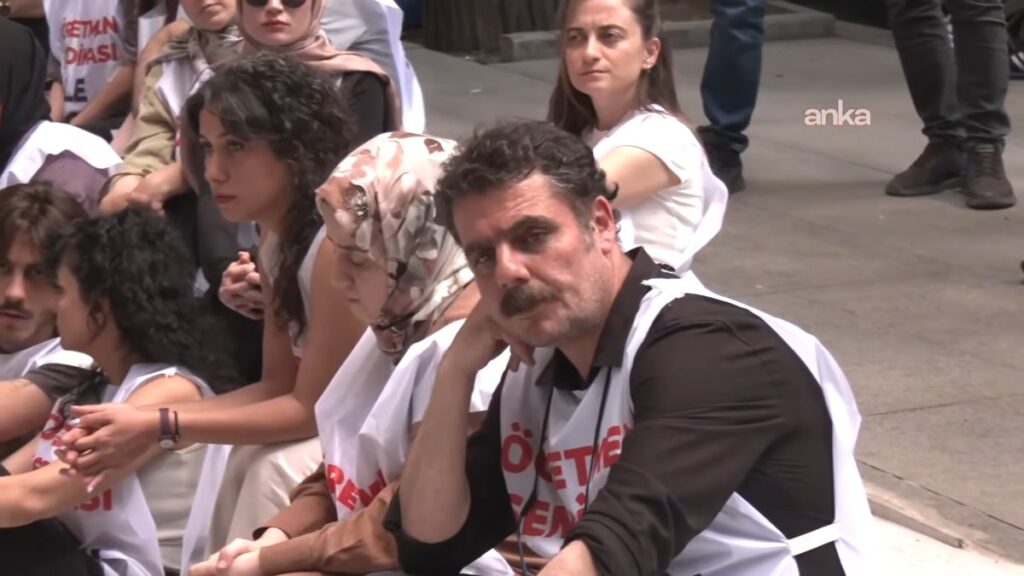
On the tenth day of a hunger strike in Ankara, 25 members of the Private Sector Teachers’ Union were still refusing food. Their demands were twofold: justice for 1,611 teacher candidates excluded from public appointments through arbitrary oral interview scores, and a legally guaranteed base salary for teachers working in private schools and tutoring centres.
The union says private-sector teachers in Turkey face poverty wages, insecure contracts, long working hours and employer pressure, while promises made by the Ministry of National Education have repeatedly gone unanswered.
This interview was conducted in Ankara on 24 June, the tenth day of the strike. On the thirteenth day, 154 intellectuals and artists publicly appealed to the strikers to end the action because of health concerns. The union then announced that it was suspending the hunger strike until the end of the NATO Summit, calling on the government to use this period as “time to think” and respond to the teachers’ demands.
Hunger strikes as a method of resistance have a long history in Turkey, especially in prison resistance movements and within the socialist left. Yet, as far as we know, this is the first time such a method has been used by a trade union in Turkey.
Timur, a hunger striker, and a representative of the Ankara branch of the Private Sector Teachers’ Union, explains how broken promises, blocked negotiations and police violence pushed the union toward what it describes as a last resort.
_____________________
- Could you explain your demands? Why did you begin a hunger strike?
Our first demand concerns the 1,611 victims of the oral interview system. These are teacher candidates who, in 2023, had enough points in the written exam to be appointed to public teaching posts, but were pushed out of the quota through arbitrary oral interview scores.
There is already a draft law prepared by the Nationalist Movement Party, or MHP, the ultra-nationalist partner of the ruling coalition. This problem could be solved through that regulation. But the Ministry of National Education is resisting it because it fears that all oral interviews would then be opened to questioning.
Our second demand is a base (minimum) salary for private-sector teachers. This was on the agenda in 2024 and was postponed to 2025. The ministry said, “We will solve it” but nothing concrete happened.
At one point, the Ministry of Labour officially invited the Ministry of National Education, our union and employer associations to sit at the same table. Later, the same ministry said it could not bring employer associations to the meeting because they were associations, not unions.
Our demand is clear: a commission should be established, legal regulation should be prepared on these two issues, and negotiations should restart.
- Did the hunger strike begin around these two demands?
Yes. If a concrete step is taken, we will reassess our action. But the hunger strike was not something we planned for days. It became unavoidable after the police attacks.
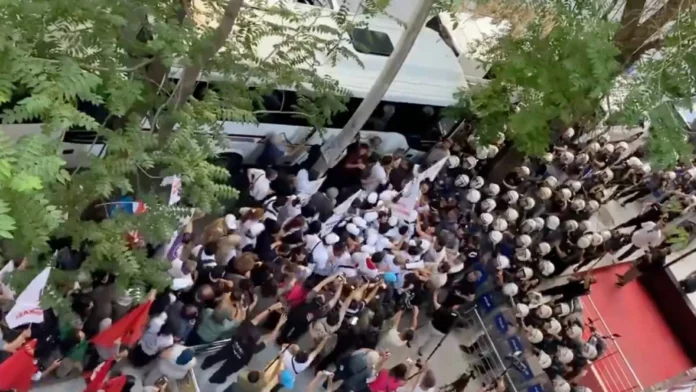
For 15 days, we had publicly announced that we would gather in front of the Ministry of National Education and march to Parliament. We were attacked before we had even opened a banner. The next day, after people were released from detention, we called for a gathering at Kurtuluş Park in Ankara. Around 30 people trying to go there were surrounded at their hotel. It was almost like an exit ban. The decision to begin the hunger strike was taken that day.
- The police response has been very harsh. Do you think this is connected to the broader political context?
I think the connection with the NATO Summit is clear. They do not want any movement in Turkey to carry the hope of protest during the summit process. There is great anger in the labour field, and they do not want a channel through which that anger can flow.
They also want to control the city. And they want to divide our union from the teachers harmed by the oral interview system. When we come together, a powerful image emerges. It represents different parts of society in Turkey. They cannot tolerate that.
They tried to criminalise us in the eyes of the interview victims. They put pressure on mothers, on women wearing headscarves, and said things like, “Separate yourselves from them, do you know who they are?” When that did not work, they turned to force.
Most of our actions were carried out through negotiation with the security forces until now. We repeatedly said we would walk on the pavement, avoid blocking traffic and accept any route given to us. Even then, riot police attacked.
- Your union has become known for militant forms of action. Is the harsh response related to this history?
Yes. Some friends have been singled out and turned into targets. We have been making things difficult for the authorities for several years.
The police often use negotiation as a tactic to waste time and weaken resistance. We announce a march; they keep saying “We will see” until the day is gone.
Now there is beating and punching during detentions. We are getting medical reports documenting assault. The detention of our union’s president was especially violent. As he was taken away, they formed a corridor and each officer hit him once. This was not something they used to do so openly.
- Could you tell us about the union? How many members do you have now?
The union was founded in 2021. In Turkey, the legal path for private-sector teachers to unionise had opened in 2008, and there were earlier initiatives. But because of the wider crisis of the trade union movement, those efforts did not develop into a lasting struggle.
When we started, we saw a deep gap between union structures and the real conditions of workers. Many unions had become bureaucratic and inward-looking.
Our union created space for a militant form of unionism. By that, I mean organising from the grass roots, identifying the employer as the opponent and directly targeting the source of the problem.
For us, having a realistic and convincing demand was very important. The union achieved this with the base salary demand. Today, even teachers who are not members of our union can say, “The base salary is our right”.
The union made its biggest leap during the Parliament vigil in 2024. When we crossed the police barricade in front of the Ministry of National Education and reached Parliament, our membership grew sharply.
We have more than 11,000 members, close to 12,000. The sector includes around 276,000 teachers. So this is a significant number.
Legally, private-sector teachers are placed in “Branch No. 10,” a broad labour category in Turkey covering commerce, office work, education and fine arts. They are not organised under a separate education sector category, which affects union organising and collective bargaining rights.
For a while, we grew almost exponentially. That momentum later declined because the demand was worn down by the lack of response. But we preserved our numbers, and that is also important.
- Do you find the level of solidarity sufficient?
What we need now are steps that put political pressure on the government. A rally by Social Democrats or Socialists would be meaningful for us, but the government may not be deeply affected by that alone.
What would be more effective is pressure from voters of the ruling parties. The ruling Justice and Development Party, or AKP, and its coalition partner, the Nationalist Movement Party, or MHP, are the only two parties that have not visited us. That says a lot.
Families should go to AKP and MHP offices in the provinces and say, “Solve this issue, our children are there”. Among us, there are teachers whose families voted for the AKP. When AKP voters demand accountability, that is one of the things the government fears.
- Why a hunger strike, rather than a strike or work stoppage? How long will you continue?
We are the only union in Turkey with this many members but without collective bargaining authority and therefore without the right to strike. Our tools are very limited.
Over the last four years, we contacted every possible institution: the Ministry of National Education, the Ministry of Labour, the Ministry of Finance, Parliament and channels to the Presidency.
We no longer have anything left to say. Every day, people were being detained and kept in custody until evening. We refused to be a union that simply eats and drinks while this continues. When we say “we choose hunger” this is what we mean.
Turkey has very painful experiences with hunger strikes. If the state remains indifferent, it can let such actions continue for 150 or 190 days. The health dimension is serious.
Politically, our answer is clear: there must be an official and public commitment to solve these two demands. A private promise is not enough. They must speak in front of the press or give a clear commitment.
In Turkey, unions are often dealt with behind closed doors. Later, promises can be denied. We do not accept that. We inform the public every day about our meetings and what was said.
At this point, resistance from the government side to these two demands is political. There is no other rational explanation left other than the government entering into a political standoff with us.
- What kind of development would open the hunger strike to discussion?
If the base salary law comes to the commission, the hunger strike becomes open to discussion. If there is a concrete step for the 1,611 teacher candidates, that also opens the discussion.
But no one can simply say “it is over” alone. The action was decided collectively. Concrete developments can only open a collective discussion.
If the government thinks, “Ankara will be closed during the NATO Summit, we can manage them,” it is wrong. What can they do at most? Enter the union building and drag us out. That would also work in our favour.
They detain us, but they cannot find an offence to charge us with. We are not harming anyone. Our actions are organised and disciplined. We are doing this for a question that concerns 276,000 teachers in Turkey. This is what we call militant unionism.
- What has been the most important contribution of this struggle?
For years, we could not convince public opinion in Turkey that the owners of private schools and private tutoring centres are bosses. We could not even convince many teachers.
Many private school owners come from an educational background. Some were once teachers themselves. But once someone becomes an employer, they are an employer. The relation of exploitation begins there.
We also could not explain that the Ministry of National Education is not a neutral arbiter in this conflict. This struggle exposed that.
Everyone in Turkey needs to understand this: this is class struggle at its roots. You are a worker, and the other side is the boss. Whatever you win, you win through struggle.
- What would you like to say finally?
Our message is clear: there is no fear and no going home.
This struggle may not end in victory. But I think the slogan “Teachers are giving a lesson in struggle” has now found its place. This time, we have lived up to the slogan.
I do not want to think too much beyond winning.