


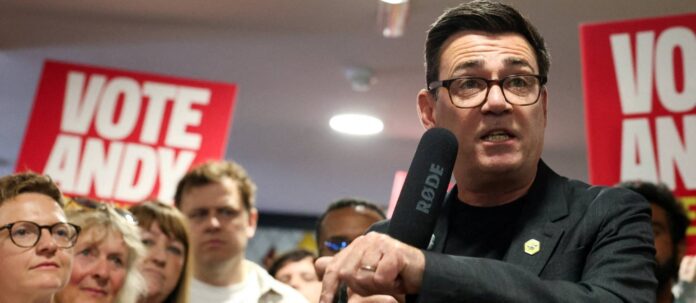
Andy Burnham, Labour Mayor of Greater Manchester, has won the Makerfield by election. He will now stand-down as Mayor of Greater Manchester. His margin of victory was greater than anticipated, with Burnham securing 55% of the vote. But at the same time the far-right party Reform UK won 35% with the new, far-right party (Restore) backed by Elon Musk, securing 7% of the vote. None of the 13 other parties running for election secured more than 2.19%.
It is clear that the vote for Burnham was a vote of two constituencies. One was the anti-racist, anti- Reform and Restore vote and the other, perhaps more conspicuously the anti-Keir Starmer vote. There is a clear drive both in the country at large as well as within the Labour Party for Starmer to go and a leadership challenge seems likely. This would appear to be the only significant driver for Burnham to stand in Makerfield, giving up his Mayoral role in Greater Manchester. Starmer has argued against a leadership challenge, saying that it would not be in the countries’ interest and has already suggested that he would offer Burnham a cabinet post if elected.
Burnham will now stand-down as Mayor of Greater Manchester. In his victory speech he talked in very general terms about “bringing people together” and the need for change but buried within that speech was the phrase “this result will bring about a country that works for everywhere”. It is certain that his ambitions are greater than to work as a back bench MP or even as a member of the Cabinet. It will soon be clear whether Burnham does intend to run for Party leader as he has done twice before, losing out to Ed Miliband in 2010 and finishing second to Jeremy Corbyn in 2015.
It is clear that, although Burnham talks about change and addressing austerity, he is unlikely to be prepared to take on the City of London. It has already been reported that he has recently discussed the economy with Bank of England chief Andy Haldane as well as Richard Hughes – ex chair of the Office for Budget Responsibility, an economic body set up under the Conservative government which ensures that any government does not break financial “rules”, and Jim O’Neil an ex-Tory minister and former Chairman of Goldman Sachs Asset Management. These discussions suggest that Burnham will not challenge the existing fiscal orthodoxy in any significant way.
Burnham is also weak on immigration and militarization, accepting the broad thrust of Labour’s current position on immigration as well as Labour’s plans to increase military spending. His wriggle room to end austerity would be limited by increases in military spending as well as accepting neo-liberal fiscal rules. At best Burnham will only be able to tinker around the edges of neo-liberalism and the enthusiasm for his leadership will soon pall if he is discovered to be a continuity candidate for the neo-liberals.
It is sobering to consider that the far-right (Reform and Restore) combined took 42% of the vote in Makerfield. The result highlighted the continued level of support for Reform, with 35% of the vote. This shows that Reform is still strong, especially in the larger English towns and no other Labour candidate apart from Burnham would have been able to win the Makerfield seat for Labour. Keir Starmer’s claim that “Reform is now on the run,” shows a pathetic attempt to place himself as part of the current decline in support for Reform whilst failing to acknowledge the emergence of Restore who appear to be taking votes away from Reform.
This result is certainly not an endorsement of Labour. What it does suggest though, is where voters see the threat of Reform, they can choose to vote tactically to keep them out. This idea is supported by the fact that the Green Party and Liberal Democrat votes fell by 4% and 6%, when they might have been expected to increase and in the case of the Green’s increase significantly. There are moves being discussed in my constituency for example (Calderdale) for the Greens, Lib Dems and Labour to consider tactical voting against Reform in future elections. This popular front approach could however backfire, especially on the Greens, if they continue to support pro-capitalist and anti-workimg class policies when in power on local councils.
In his victory speech Burnham thanked the opposition for a “civil debate between us”. In fact he and Labour are pandering to the fears right-wing parties promote around immigration as well as the need to increase military spending. Burnham was at one time was Chief Secretary to the Treasury and held several ministerial roles in New Labour governments. Although hehas described himself as a socialist, he continues to show his ability to manoeuvre into positions of power and accept the orthodoxies of the capitalist class.
However, if Burnham replaces Starmer as Prime Minister most workers and young people would see this a small step in the right direction. Starmer has taken reactionary positions on trade union rights and human rights as well as an aggressively anti-Palestinian position in the Middle East. Since becoming Prime Minister, Starmer has moved further and further to the right – far to the right in many respects of the Greens and even Liberal Democrats. Under Burnham, it is possible that Starmer’s positions on the Middle East could be moderated.
The need for a new worker’s party remains as pressing as ever.. The Trades Unionist and Socialist Coalition (TUSC), has launched a “trades unionists for a new political party” initiative. This has been a process that has been taking place for some time, but the stagnation of the Your Party project makes it even more pressing. There are attempts to bring left forces together both within and beyond the trade unions. The idea of breaking the link with Labour has arisen in some unions, most significantly UNITE (Britian’s largest union) which is considering its relationship with the Labour Party.
If Burnham were to become Prime Minister and make concessions to the unions, it could be that there is a pause in the progress of these developments. This would not mean however that the need for a new mass worker’s party would be any less urgent. Under Burnham, the Labour Party would not develop into such a party and the left forces coming together need to draw closer together, share ideas and platforms and build a socialist movement that could grow out of the current impasse. It is encouraging the TUSC is inviting speakers from across the left, including from groups they have previously had difference with to their meetings. It is to be hoped that socialists can sit in rooms together, bury their differences and work towards a bigger objective.