

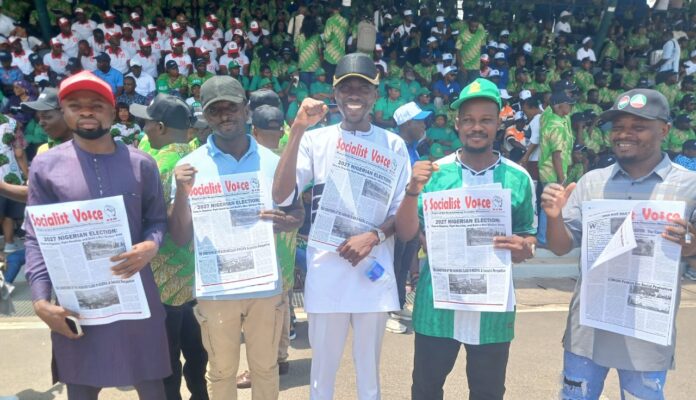
Article from the recent issue of Socialist Voice, newspaper of the ISp affiliate in Nigeria, Revolutionary Socialist Movement
Nigeria today is caught in a deepening crisis where the rising cost of petrol has become a daily burden on ordinary people, especially workers struggling to survive on extremely low wages. The removal of fuel subsidies since 2023, when Tinubu came to power and the recent US/Israel War on Iran, combined with broader economic pressures, have pushed petrol prices to levels that were once unimaginable, triggering a chain reaction across every sector of the economy.
In Nigeria, petrol is not just another commodity it is the backbone of transportation, electricity generation, and small-scale business operations. With an unstable power supply, millions depend on petrol to run generators in homes, shops, and offices. So when petrol prices rise, everything else follows: transport fares increase, food prices skyrocket, and the cost of basic services becomes unbearable.
The Minimum Wage as Class Policy
Capitalist governments present the minimum wage as a technical balance between “business viability” and “worker welfare.” This is false neutrality. Every minimum wage is a class decision. When the government negotiates for months to move from ₦30,000 to ₦70,000 while governors claim states “cannot pay,” what is really being said is that the profits of contractors, the allowances of legislators, and the subsidies to elite industries are non-negotiable, but the workers’ wages are? The Nigerian legislator’s monthly package can exceed ₦13 million, yet labour is told the treasury is empty. This is not scarcity. It is a priority.
From a socialist view, the minimum wage should not be pegged to what capital says it can afford. It must be pegged to what labor needs to live: food, housing, healthcare, transport, education, and cultural life. Anything less is legalized poverty.
For Nigerian workers, the situation is particularly harsh. The national minimum wage remains painfully low and far from sufficient to meet even the most basic needs. A worker earning the minimum wage now finds that a significant portion of their income goes into transportation alone. Feeding a family, paying rent, healthcare, and education have become near impossible tasks. What used to be a struggle has now turned into outright suffering.
This crisis is not accidental. It reflects deeper structural problems in the economy and policy choices that prioritize market forces over human welfare. While government officials argue that subsidy removal is necessary for long-term economic stability, the immediate reality is that workers are paying the price for reforms they did not design and do not benefit from.
Under the administration of Bola Ahmed Tinubu, promises of relief measures and wage adjustments have yet to translate into meaningful improvements in the lives of workers. Inflation continues to erode incomes, and any proposed wage increases often lag far behind the rising cost of living. Often time minimum wage only get increased after strikes and protests, the Tinubu government also faced mass strikes and protests before the last minimum wage was approved.
For the Nigerian worker, the minimum wage is not just a number. It is a verdict on whether the wealth of the nation belongs to those who create it or to those who appropriate it. From a socialist standpoint, the struggle over the minimum wage exposes the fundamental contradiction of Nigerian capitalism: an economy built by labor, yet governed by capital and looted with greed.
This growing gap between wages and living costs raises an urgent question: how long can workers endure?
Historically, meaningful change has not come without struggle. Across the world, workers have had to organize, protest, and assert their collective power to win better wages, improved working conditions, and social protections. In Nigeria, there is a growing realization that economic demands alone may not be enough. The struggle increasingly points toward the need for political power. Workers must have a direct say in governance and policy decisions that shape their lives.
Inflation, Devaluation, and the Wage Illusion
Since 2023, currency devaluation and fuel subsidy removal have tripled transport and energy costs. Landlords in Abuja, Lagos and major cities adjusted rents immediately. Market women adjusted prices the same day. But the minimum wage remains a political negotiation that takes years.
This lag is not accidental. Inflation without wage indexation functions as a hidden tax on labor. It allows employers to cut real wages without passing a single law. RSM demands automatic adjustment: wages tied to cost-of-living indices, audited by worker councils, not left to the goodwill of the National Salaries, Incomes and Wages Commission.
According to a report the new minimum wage is eroded with inflation despite the fact that many states have not implement the new minimum wage and recently there is a report that inflation has increased to 15.38% in March 2026, marking the first increase in 12 months, up from 15.06% in February 2026. This reversal from a period of easing indicates renewed pressure on household spending driven by higher food, transport and accommodation cost. This is primarily attributed to the high cost of fuel and has led to high cost of food and high transportation.
Towards a Living Wage
A socialist program does not stop at raising the minimum wage. It asks: why should survival be the horizon? The goal is a living wage – one that covers actual family needs in 2026 Nigeria plus having social benefits: free healthcare, public housing, subsidized transport, and education funded by taxes on oil rents, luxury imports, and corporate profits.
Nigeria’s GDP is over $400 billion. Its pension assets exceed ₦20 trillion. It’s not the case that there are no money for the workers. It is how are they distributed. When Dangote’s refinery can post billions in projected revenue, but cleaners at federal secretariats earn less down ₦70,000, the minimum wage is functioning as designed: to maintain a vast pool of cheap labour. Even with the vast human and natural resources that Nigeria has, many workers and ordinary masses live in penury. Socialism begins with a simple truth: value comes from labour. When the Nigerian state and private employers fix wages below the cost of dignified survival, they are not “managing the economy.” They are enforcing a transfer of wealth from the worker to the employer, from the public to the private.
2027 Elections
The Oil rigs in the Delta do not drill themselves. Ports in Lagos do not load themselves. Classrooms, hospitals, and construction sites across Abuja and other cities in Nigeria do not run without the technicians and engineers, skilled and unskilled labourers and masons. Yet in 2024, the approved minimum wage stood at ₦70,000 per month, roughly $45 at the parallel market rate. In a country where food inflation has repeatedly crossed 30% and a bag of rice consumes more than half of that wage, the figure is not a floor. It is a trapdoor.
Trade unions and workers’ organizations must move beyond periodic negotiations and symbolic protests. There is a need for sustained mobilization, cross-sector unity, and a clear political agenda that prioritizes the needs of the working class. Without this, policies will continue to be made in favor of elites, while the majority struggle to survive.
In the last few days, the Trade Union Congress of Nigeria has called on the Federal Government to deploy excess crude oil revenue to subsidy local refineries as a way of cushioning the impact of rising fuel prices on Nigerians. President of the Congress, Festus Osifo, made the call during a press briefing in Abuja. He warned that the price of Premium Motor Spirit, popularly called Petrol, could climb to as high as N2,000 per litre if urgent measures were not taken.
On the other side, the NLC is urging both reflection on the state of workers’ rights and a celebration of collective efforts in continuously building the wealth of nations. The union, in a statement signed by its General Secretary, Emmanuel Ugboaja, condemned several state governments for continuing to violate the 2024 National Minimum Wage Act, refusing to implement key provisions, including consequential adjustments for senior workers, regular and timely payment of the new wage, and the extension of coverage to local government staff, primary school teachers, and health workers.
The union said such violations constitute not only a breach of the law but an assault on the dignity of Nigerian workers. He then called on workers to use May Day rallies to protest the implementation of a 70,000 minimum wage in some states that have refused to pay.
The rising cost of petrol is more than an economic issue it is a symbol of a broader system that places heavy burdens on workers while offering little in return. Addressing this crisis requires not just policy adjustments, but a fundamental shift in who holds power and whose interests are represented.
For Nigerian workers, the path forward may be difficult, but it is clear: collective struggle, organization, and active participation in political processes are essential. Only then can they hope to secure a future where the wealth of the nation works for all, not just a privileged few.
No ruling class in history has volunteered a decent wage. The ₦70,000 increase only came after NLC and TUC shut down the country with mass protests and general strikes. That is the lesson. The minimum wage is not given. It is taken through organized power strikes, mass protests, and political representation of labour against capital.
A socialist state of the nation would therefore judge the minimum wage by three tests:
1. Can a worker on this wage live in Abuja without debt?
2. Is the wage set by workers themselves, not by governors pleading poverty?
3. Does it rise automatically with the price of garri, rice, fuel, and rent?
Until the answer to all three is yes, the minimum wage remains what it has always been under capitalism: a ceiling painted to look like a floor.
The wealth exists. The labor exists. What is missing is control of production by those who produce this wealth. Workers must set the aim of fighting for political power instead of continuing to support capitalist politicians who will continue with greed and looting public resources.