

- Free Nnamdi Kanu Now!
- Self-Determination is an Undeniable Right
- Socialist Solution the Only Way Forward
By RSM Secretariat
Historical Roots of the National Question
Nigeria’s National Question has remained unresolved since independence in 1960, shaping the country’s political instability, recurring ethnic tensions, and periodic calls for restructuring or outright self-determination. At its core lies a fundamental issue: how can a state composed of diverse nations, each with its own history, culture, and aspirations, have a single political framework that is just, equitable, and democratic? This situation is rooted in the role of British colonialism, which undemocratically yoked Nigeria together largely in pursuit of its own economic and strategic interests.
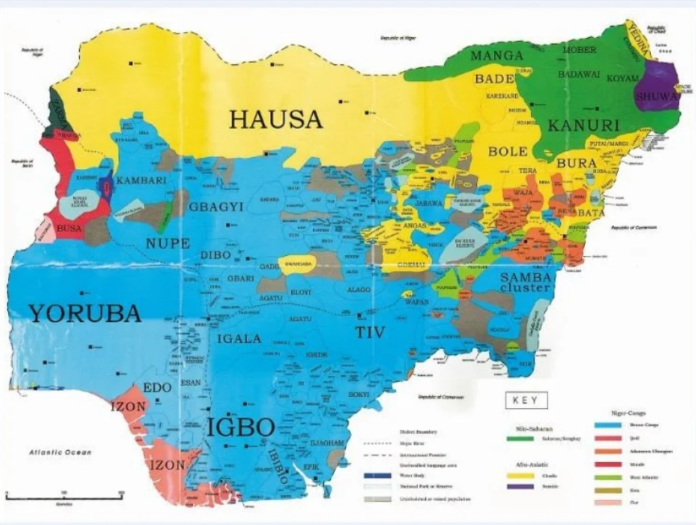
The roots of this crisis lie in colonial amalgamation. In 1914, the British imperialists merged distinct regions into what became modern Nigeria without the consent of the peoples involved. This artificial union ignored deep differences among ethnic nationalities such as the Igbo, Yoruba, Hausa-Fulani, Ijaw, and many others. After independence, instead of renegotiating this arrangement, successive governments—civilian and military—centralized power, often favoring certain ethnic groups over others.
Over 60 years of Nigeria’s existence, different ethnic groups have expressed grievances over marginalization in the distribution of economic and political power, resource control, and demands for autonomy or separation. Repeated crises have meant that Nigeria has often remained united largely through the increasing use of state force to suppress dissent.
The capitalist system, based on private ownership of the means of production, provides the combustible material for ethnic crises by ensuring that Nigeria’s vast wealth in human and natural resources does not translate into even and harmonious development, or into the satisfaction of the basic needs of working people regardless of their ethnicity.
The aftermath of the Nigerian Civil War in 1970 further entrenched mistrust. The defeat of Biafra did not resolve underlying grievances; rather, it suppressed them under a fragile unity maintained by force. Despite the return to civil rule over two decades ago, separatist sentiments have continued to grow, particularly in the South East and, to a lesser extent, in the South West. This has contributed to rising insecurity and the proliferation of armed groups.
But one thing is clear: the working class faces the same problems across the country. In this sense, the labour movement can be the only real force capable of uniting working and poor people in a common struggle against oppression and for improved living conditions. Without the struggles waged by the labour movement since 1999—against fuel price hikes, anti-poor policies, and on issues such as the minimum wage—the conditions of the working masses would be even worse.
More than ever, the labour movement now has a responsibility to act to prevent further ethnic and sectarian division. This means taking up the challenge of building a united struggle of workers and youth across the country around issues such as poverty, unemployment, poor living conditions, and wages, as well as the broader fight to end capitalism.
The states in the South East and South West are governed by corrupt capitalist politicians who are also responsible for the socio-economic crises in these regions. This means that responsibility lies not only with the federal government, but also with these state administrations.
If these governors had judiciously utilized federal allocations and internally generated revenue over the last 25+ years since the return to civilian rule, many of the socio-economic crises ravaging these areas could have been significantly addressed. Despite the enormous potential for development, the vast majority of Igbo people continue to face harsh living conditions.
The Case of Nnamdi Kanu
In recent decades, unresolved tensions have re-emerged through various movements demanding restructuring or secession. One of the most prominent figures in this resurgence is Nnamdi Kanu, leader of the Indigenous People of Biafra (IPOB).
On November 20, 2025, the long-running trial of Nnamdi Kanu came to an end with a sentence of life imprisonment. His continued detention represents the Nigerian state’s clampdown on dissenting voices. Simon Ekpa, a Finland-based activist of IPOB, was also sentenced in 2025 to six years’ imprisonment for inciting violence and promoting Biafran independence.
While fighting for the unity of working people, socialists recognize and uphold the right to self-determination. We demand that the Igbo people be allowed to freely and democratically determine whether they want to secede or remain within the boundaries of Nigeria. We also condemn the repeated killing of unarmed agitators from IPOB, the Movement for the Actualisation of the Sovereign State of Biafra (MASSOB), and the Biafra Independence Movement (BIM) by soldiers and police on the orders of the Bola Tinubu government. We hold that members of these organizations have the democratic right to agitate on issues of concern to them, including the right to secede. Hence, we demand the immediate and unconditional release of Nnamdi Kanu and all others incarcerated, including those held in facilities such as Wawa Barracks in Niger State, as well as adequate compensation for the families of those killed.
The Biafran Question Today and a Socialist Perspective
The call for a revived Biafra reflects enduring dissatisfaction among many in the South East. For some, an independent Biafra represents the prospect of justice, dignity, and self-rule. For others, it raises concerns about economic viability, regional fragmentation, and the risks of renewed conflict. This tension underscores the central dilemma: whether Nigeria can be restructured to accommodate its diversity, or whether its contradictions will continue to generate centrifugal pressures.
The ruling elites should be held responsible, not ordinary Nigerians, irrespective of their ethnicity or religion. They are all victims of the same system. The over 250 ethnic groups and more than 500 languages in Nigeria are themselves divided into two main classes: the ruling elite on the one hand, and the mass of suffering Nigerians on the other—the oppressors and the oppressed.
Simply creating a new state does not automatically resolve class inequality or governance problems. A new Biafran state, as long as it remains capitalist, would reproduce corruption and exploitation, albeit with a new ruling elite, and replicate many of the same problems people are already fed up with.
It is useful to look at the example of Abia State. Governed largely by Igbo political elites since 1999, it demonstrates that even within a predominantly Igbo-administered context, capitalism has not delivered improvements for the masses. Abia and other South East states has huge economic potentials, including natural resources, yet much of the population continues to face underdevelopment and poor living conditions. This underlines that rule by a local elite does not, in itself, guarantee progress for the majority.
A similar pattern can be observed in Northern Nigeria, where sections of the political elite have held power for extended periods. The outcome remains widespread poverty, deprivation, insecurity and inequality affecting the majority of the population. The conditions of an average Igbo worker in Aba are not fundamentally different from those of a Hausa worker in Kano. It is alarming that Northern Nigeria has some of the highest numbers of out-of-school children in the country. Nigeria has 20 million out-of-school children in Nigeria—80 percent of them are from Northern Nigeria. Various reports also indicate very high poverty rates across the region.
A Biafran state without a government of working people and the poor, anchored on a socialist plan of the economy, would amount to little more than a transfer of power between competing capitalist elites. The experience of countries such as South Sudan illustrates how political independence without a break from capitalism can lead to deep crises and instability.
The Way Forward
The persistence of the National Question in Nigeria shows that unity cannot be sustained by coercion alone—it must be built on consent, equality, and improved living conditions.
Historically, sections of the capitalist ruling elite, when in power, have primarily enriched themselves and their associates, without improving the conditions of the masses—even within their own ethnic base. The eight-year presidency of Olusegun Obasanjo did not fundamentally transform the living conditions of working people in the South West. Similarly, during the six-year presidency of Goodluck Jonathan, his home region in the Niger Delta did not experience the level of transformation that many had hoped for. Key demands, such as environmental clean-up in Ogoniland, remained largely unfulfilled despite longstanding agitation.
Likewise late former President Muhammad Buhari was president for 8 years, despite the prolonged political dominance of sections of the Northern elite, the region continues to face severe challenges of poverty, illiteracy, and underdevelopment—conditions that have contributed to instability, including the rise of insurgent groups such as Boko Haram and bloody bandits.
Any attempt at secession that is not combined with a mass movement to guarantee democratic rights—including for minorities within any new state—end capitalism, and establish a democratic socialist system will be replacing one form of elite rule with another. Without socialism, a sovereign Biafran state would represent a dead end for working people. Under socialism, key sectors of the economy would be nationalized under democratic workers’ control and management, allowing for a planned use of resources to meet social needs rather than private profit.
Such a development could serve as an example to workers and the poor across Nigeria and West Africa, opening the way for a broader break with capitalism and the democratic planning of resources in the interests of the majority.
As a political movement fighting for the emancipation of the working class, youth, farmers, and poor masses from capitalist exploitation, the Revolutionary Socialist Movement stands for a united Nigeria in which the wealth of society and the means of production are commonly owned and democratically managed to ensure a decent life for all, regardless of ethnicity, religion, or place of origin.
Consequently, we do not agree with Nnamdi Kanu and the Indigenous People of Biafra (IPOB) that the fragmentation of Nigeria would fundamentally resolve these problems. We also oppose rhetoric that promotes ethnic hostility or presents Nigerians of other backgrounds as enemies of the Igbo people. However, this does not negate the right of Kanu and IPOB to advocate for secession.
In this context, military operations conducted by the Nigerian state in the South East represent, in our view, an attempt to suppress and provoke separatist agitation, with the danger of escalating repression.
IPOB, as an organization, has the right to exist and to campaign for its objectives, including the creation of a separate state, provided it does not engage in sectarian campaigns against other nationalities. The Revolutionary Socialist Movement (RSM) defends the right to self-determination up to and including secession if democratically decided, while firmly advocating the unity of Nigeria under a workers’ and poor people’s government based on socialist policies.