

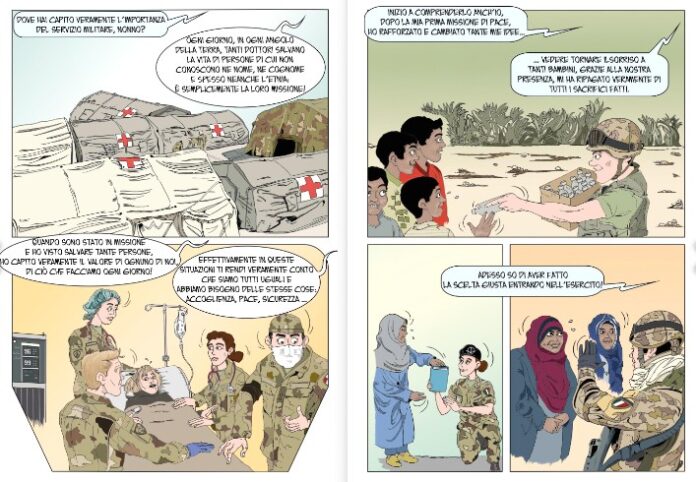
At Romics, the International Comic and Games Festival, held in Rome on April 9-12, plenty of army recruiters with drones, military vehicles, and… “Naja Comics”, a graphic novel where a grandfather in uniform explains the joys of military service to his recently enlisted grandson (‘naja’ is an Italian slang term for the draft).
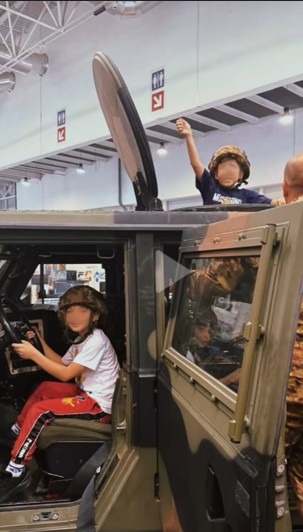
With 200,000 visitors a year and appearances by stars such as the leftist comic artist Zerocalcare and the Italian voice actors of international cartoons, Romics—the International Festival of Comics, Animation, Cosplay, Cinema, and Games—now in its 36th edition, is a major showcase for those looking to reach young people and children. Amid international tensions, wars, and debates over the reintroduction of mandatory military service, the Italian army couldn’t pass up such a golden opportunity to try to convince some young men and women to enlist. “A sea of people in uniform,” says a young visitor, drawn to Romics by Japanese anime series, looking a bit dumbfounded at the drones, military jeeps loaded with young men, and flight simulators set up in the Army’s space in Hall 6 of the Fiera di Roma. “That booth at a comic and video game expo was about as out of place as cabbage at snack time,” her mother comments.
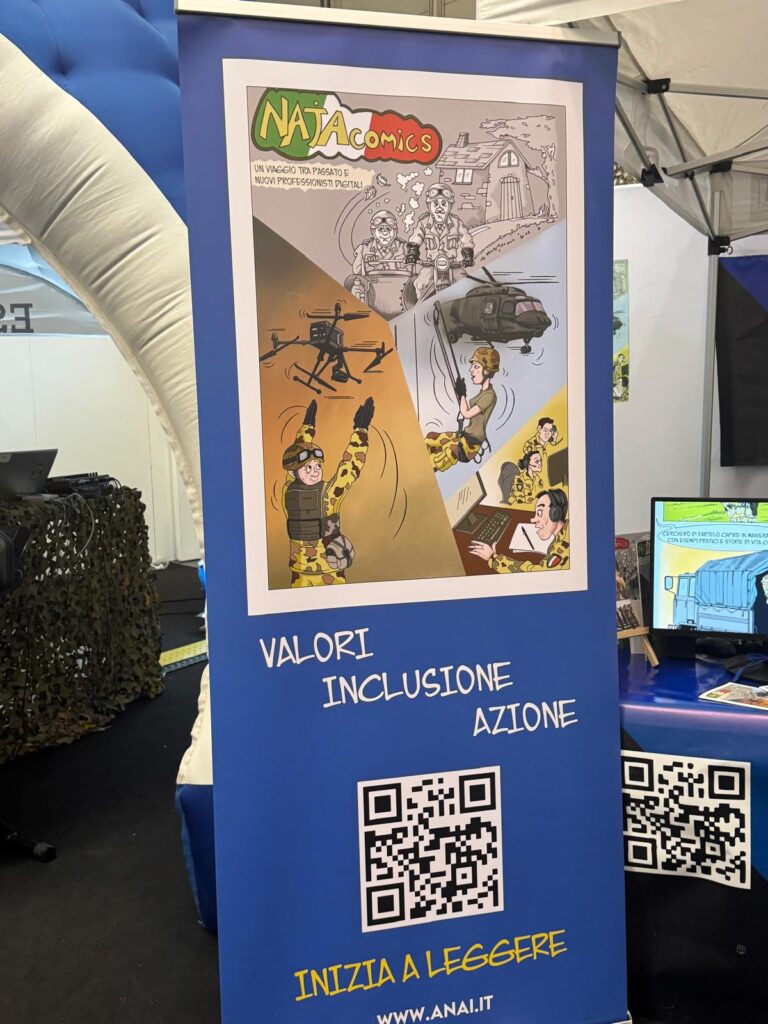
The recruiters’ message is simple and straightforward: military life is like a video game. Last year, the army rolled out robot dogs and cosplayers dressed as superheroes posing on armored vehicles. This year, in addition to drones, jeeps, and the lighthearted reports from Radio Esercito—the channel dedicated to communicating with young people—the military is also unveiling a new “weapon of mass communication”: Naja Comics. A Journey Through the Past and New Digital Professionals is a graphic novel produced by the ANAI, the National Association of Italian Autieri (active members and veterans of the army’s logistics units), conceived, the authors write, “to reach those who have never heard of ‘mandatory military service,’ particularly our young people, and to rekindle the emotions of those who experienced years of camaraderie and daily challenges in the army,” crafted in a language designed “to meet the needs of young people: intuition, quick visuals, and minimal text, to capture attention immediately.”
To tell the truth, the result is less sophisticated than its grandiose self-promotion suggests. “Romics could have at least asked him for a properly drawn comic. This looks like ‘Tromba’,” remarks an illustrator to whom I show the PDF, comparing it to the epic adult comic series of the ’70s and ’80s set in a military context which in those days could be found at barbershops, conveniently hidden under a pile of magazines and tabloids, to the delight of adults waiting to get a haircut and teenagers eager to broaden their horizons.
What matters here, however, is the message: military life is like a cartoon, in which—to quote a Radio Esercito reel—“discipline, loyalty, a spirit of sacrifice, and constant service to the public are the superpowers of the men and women of the Italian Army.” In Naja Comics’ narrative, thanks to technology, you can now serve in the military while staying in touch with family and friends and cultivating values such as “helping others, hospitality, sharing, friendship, patriotism, family, respect, independence, economic stability, and leadership.” In the comic, Italian soldiers care for the sick, distribute water to children, and rescue those in danger with the help of “our four-legged friends,” while women in camouflage uniform assist other women wearing headscarves.
“One recruiter gave me a copy of the comic and told me to read it, because it shows that women can become generals too,” says a female student, who received a signed copy of the comic from a peer in uniform. For the creators of Naja Comics at the barracks, “many young girls quickly become women and attain prestigious roles in every field, valuing themselves and creating value for the system,” and they overcome “their own limiting beliefs through interaction with men.”
There is also the economic aspect: “the chance to return home with licenses and special certifications that will make it easy to find work is a major incentive.” And then: “Hundreds of people have built their happiness and satisfaction on the skills acquired during their years in the military, performing rewarding work every day.” Like Russo’s uncle in Calabria, who “works for a large company and repairs helicopters,” or Giovanni Colombo in Lombardy, who “recently left the army and works for a major TV network thanks to his drone certification.” Not to mention Furlan, who in Friuli “became a driver for a top executive” (all teenagers’ hidden desire, isn’t it?)
Finally, the relationships: “These are such powerful moments that you’ll never forget them! You make friends, you share experiences, you grow together, you have common goals and motivations, and when it’s time to leave, you know you’ll always have a friend waiting for you in their city! You’ll always have someone ready to help you because they know you better than anyone else and have been your family the whole time.”
The presentation concludes with an illustration by the ANAI featuring propaganda postcards from the Fascist era of the Army Motor Corps and the motto “Fervent rotae fervent animi” (The wheels burn, the spirits burn), coined by the Duke of Aosta after the Battle of the Piave in WW1, which the Regime adopted as the official motto of the motor corps in the 30s.
Of course, if the military thinks it can attract the digital native generation by appealing to the “values” of their ancestors and churning out pamphlets that are a cross between The Bible as Told by Grandma and trashy adult Italian movies of the 80s, it won’t achieve much, and sooner or later it will have to ask politicians to reinstate mandatory military service. It’s not enough even to claim that Italian soldiers on overseas missions go to bring peace, hold children in their arms, and care for the sick. It’s not enough to gloss over the gang rapes and torture committed by Italian soldiers of the Ibis Mission in Somalia—facts established by a parliamentary inquiry commission in the 1990s and never punished; nor is it enough to forget the video of the Battle of the Bridges in Nasiriyah, showing Italian soldiers urging one of their comrades to shoot an Iraqi while shouting “Wipe him out!” and, when he hits his target, cheering and telling him that “he won’t have to pay for the drinks anymore because he has killed the enemy”; nor, finally, should we claim that the war in Ukraine is the first in Europe since 1945, erasing the 78 days of bombing (including by Italy) of Yugoslavia in 1999, thousands of civilian casualties, outside any “international legality” as the current President of the Republic Mattarella would say today—though at the time he was the number two in the D’Alema (former CP leader) government.
Above all, this is not enough, because all around us, the signs of what the future holds for the younger generations are becoming clear. A month ago, the organizers of another major trade show—this time for firearms, the European Outdoor Show in Parma—decided to grant free admission to children under 12, and despite criticism from some student groups, certain schools took advantage of this to bring entire classes. Just 10 years ago, this would have been unthinkable. Today, it can happen and can even that protests from the union and some opposition parties have emerged just a month later. A sign of the times.