

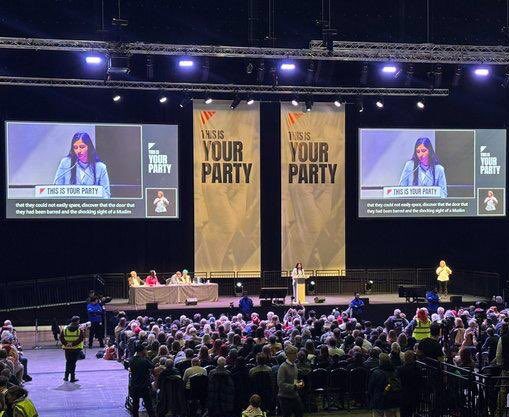
On the last weekend of November, Your Party (the organisation initiated by former Labour Party MPs Jeremy Corbyn and Zarah Sultana, held its founding conference. In this article, Nigel Smith takes up some of the issues that dominated the discussion and describes a way forward.
Read our analysis in the running up of the conference here and listen to an interview from the delegate M. Musse here
The Your Party inaugural conference was launched against a background of division. However, what the Conference did reveal was a unity of purpose and a comradely atmosphere from most of those present. There was a clear call for socialism and the building of a mass worker’s party made at the conference and calls for these aims were overwhelmingly agreed.
Prior to the event, the organising committee took the decision to expel several members of the Socialist Worker’s Party. This was despite the fact that a motion to allow dual membership was on the agenda. This completely undemocratic decision revealed the already bureaucratic approach of the unelected Your Party leadership group at this stage. Zarah Sultana took the decision to boycott the first day of the Conference in protest.
***
The Conference structure itself reflected a top-down approach with all five MPs and one councillor being given time to address the Conference. Only two other UK speakers were given the platform. One was Jeanine Hourani, a youth activist and the other, Maium Talukdor, Deputy Mayor of Tower Hamlets and a member of Aspire (a local political party). Members of the organising Committee also had time to speak when introducing the documents, expressing in doing so a partial view on aspects of the documents to be voted on. Jeremy Corbyn was given 20 minutes for his opening address, and the other speakers were allowed ten minutes each. Most speakers over-ran, therefore restricting the time for debate. Jermy Corbyn was also given time to introduce his fellow Alliance MPs and ten minutes at the start of the second day as well as making the closing address to the conference. He alone was therefore given over 10% of the Conference time. This approach to Conference elevated Corbyn to the position of some kind of de-facto leader and was in complete contrast to the sworn aim of making Your Party a member-led party. It seems incredible that Corbyn and his team thought this approach acceptable, when it contrasted so dramatically with that aim. The lack of judgement around this shows a leadership group stuck in past methods and with little trust in wider members.
Contempt for the Left from the presidium was clear, with various “left speakers” being silenced for not speaking to motions, but other speakers being allowed to do so. Time was also given to international speakers from Belgium (Benjamin Pestieau- Worker’s Party of Belgium), Germany (Eric Uden- Die Linke) and France (Nadege Abomangoli- (La France Insoumise).
***
Conference sessions also began late, further limiting time for debate. If Your Party is therefore in the process of electing its leadership, then all we have seen is a limited range of personalities put forward on the platform to make up the 16-person Central Executive Committee, a title that in itself promotes a top-down approach. How will the Party be able to choose a leadership so small in number when most of the Party is unaware of the talents available? The leadership should be coming from the towns, cities and regions. The people in towns and cities are more likely to have a grasp of who might best represent them, rather than relatively unknown characters from across the UK, most of whom have been hand-picked by Corbyn and already shown to be antagonistic to other left organisations as well as incompetent organisers.
When it came to debating the amendments as well as the motions themselves, speakers were allowed three minutes each. Each motion or amendment had a maximum of three speakers for and against, sometimes only two. Speakers were chosen at random by the Chair from Conference attendees indicating they wished to speak, so a lot of time was wasted selecting speakers, many of whom were ill-prepared and unused to addressing large meetings. This in itself of course is not an issue, but there was a tendency for speakers not to address the motion and for many to share lots of personal information with the Conference that was not relevant. The Chairs did not give clear guidance to speakers as to what the speaker’s role was and so vague or rhetorical contributions, which were very often off the point, were commonplace.
There was also a tendency for speakers to make wider political points in response to the undemocratic processes leading into the conference, in particular the exclusion of some SWP members.
***
The top-down methods of the Conference organisers and the interim leadership brought a reaction that probably resulted in votes that moved away from the idea of bureaucratic leadership. The decision of the Conference to reject the single Party leader option in favour of a sixteen-person leadership team, which was itself a vague and unsatisfactory formulation, was an example of this. Even though details around how the leadership team would be elected were unclear except that it would not contain any of the MPs, it was still preferred to the single leader option. Dual leadership was not put forward as an option.
Voting on the remaining amendments all veered away from notions of a top-down model, putting power with the regions and branches and favouring motions coming from branches and delegates. It was voted that Conference delegates would be elected from branches with an additional element of sortition in order to balance the demographic nature at the Conference. The vote to allow dual membership was passed decisively and other votes aimed at greater member-led control were passed.
The general direction of voting is seen as a big blow to the interim leadership whose manoeuvrings for power have been exposed. They are also a blow to Corbyn who was clear that he wanted to lead the Party and the Conference structure promoted this aim.
***
There are significant issues to address. How to find the “Central Executive Committee”, a committee whose title negates its supposed function as being member-led is one such issue. How to set up regional structures is very unclear. This was presented by the organisers as a long-term aim but has been prioritised by the members. Who will speak for Your Party is a grey area too, as up until now this principally has been left to Corbyn, Sultana and the Alliance MPs.
The mood of the current membership is one of resolve. Their will has to be taken seriously in the short term. In the medium and long term there are still serious democratic deficits. The management speak with terms like “director,” “executive” and “Central Executive Committee” has to be modernised, in order to project a member-led perspective.
How branches, regional and national structures communicate is a huge area for development and Your Party has only a vague and incomplete Code of Conduct, which is a serious concern because how to promote an inclusive culture and allow members to feel safe in meetings and across the Party is crucial. This is a Party that will come under attack from the outside but also from bad actors who will infiltrate it in order to disrupt its functioning. Currently, anyone can join Your Party. The Chat Stream accompanying the YouTube video of the conference was dominated by disruptive and abusive comments that prevented any attempt at an exchange of ideas.
***
Branches need forming urgently and comrades need to talk one-to-one with those who have joined the Party in their area. Membership interviews of some description need to take place. There was a clear call for socialism and the building of a mass worker’s party made at the conference and calls for these aims were overwhelmingly agreed.
The political nature of the party needs to be developed in some detail across the following months and this will enable branches to unify around socialist themes. Those who don’t want socialism will migrate to the Greens or elsewhere. There was a mood for running in the local elections in May as widely as possible so some kind of political manifesto will need to be in place well before that time.
There is a lot to do. This is a good opportunity for radical, socialist ideas to be promoted and developed. These are the ideas that will win the working class and win support from the previously disheartened and confused majority. Your Party also needs to make links with socialist parties and groups internationally, especially in the USA. This will allow for a sharing of ideas and a unity of methods to better promote the struggle for socialism and, in time, the overthrow of capitalism.