

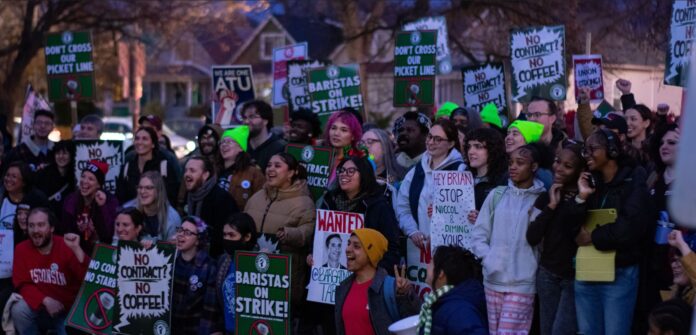
Since the first stunning victories in Buffalo, NY, the union drive to organize Starbucks stores in the US has been an inspiration for the labor movement. Over the last years, young workers have expanded the campaign nationally with strikes, actions, and shop-to-shop organizing. The drive has shown exceptional rank-and-file energy and leadership, while also pioneering organization in a sector with almost no history of a union presence. From this past November to February Starbucks workers organized their largest sustained national strike yet.
Nick Wozniak, a union activist (SEIU 73) and socialist with Socialist Refoundation, interviews Connor Brennan, a rank-and-file strike captain, store organizer, and campaign activist with Starbucks Workers United (SBWU). Both reside in Chicago, IL.
1. Can you describe how this most recent strike fits into the longer union organizing drive at Starbucks?
Starbucks stores across the US have been organizing with Starbucks Workers United (SBWU–a campaign of the union Workers United, which is itself an affiliate of the much larger SEIU) at a relatively steady rate for over four years–since December 2021. There are now over 650 unionized Starbucks locations, which make up around 5-7% of all corporate-operated Starbucks retail locations in the US.
For over two years, Starbucks effectively refused to recognize the union and bargain in good faith despite the steady increase in election victories. Starbucks also accumulated an enormous number of unfair labor practice (ULP) charges during this time, including for firing hundreds of workers and closing dozens of stores illegally, as well as making unilateral changes to union shops without bargaining. SBWU organized many smaller actions including one- and two-day ULP strikes, with as many as 300 stores participating. These actions protested Starbucks’ aggressive union-busting and demanded the company come to the table and negotiate in good faith.
In February 2024, Starbucks and SBWU finally agreed to a framework for collective bargaining across all union stores. Starbucks appeared to have caved to the consistent increase in election victories and escalating actions even in the face of their union-busting, and the overwhelming number of ULP charges they were facing, as well as additional pressure from a spontaneous boycott that arose in response to Starbucks statements on October 7th and the Israel/Palestine conflict.
Several bargaining sessions then took place where Starbucks and SBWU reached tentative agreements on over 30 articles of a collective bargaining agreement (CBA), including on key issues such as grievance and arbitration, shop stewards, and improvements to the non-discrimination, health and safety, and dress code policies. However, bargaining stalled in December 2024 when Starbucks refused to make any meaningful economic concessions beyond guaranteeing annual 2% raises that they already typically offer non-union workers, meaning if SBWU settled a contract now there would be virtually no economic difference for union stores.
Since December 2024, there has been little communication between Starbucks and SBWU, and Starbucks has reverted to its earlier policy of stalling and aggressive union-busting. This strike was the union’s first major attempt to break that impasse, by building the biggest strike they could to inflict as much damage to Starbucks as possible to bring them back to the table with a reasonable offer.
2. How did you originally get involved in the campaign and what has your experience been like?
I started working at Starbucks as a barista in March 2022. I was looking for a stable job out of the COVID pandemic and had some previous food service experience so it was a pretty natural fit, but I did specifically apply to Starbucks because I was aware of the unionization effort there. Being a young socialist looking for work, I wanted to find a place to put down roots in the labor movement, and it seemed like this could be a chance to contribute to organizing a key workplace in the service industry.
Having little prior organizing experience, I did not expect to be able to organize my store immediately, but conversations arose naturally with coworkers considering the economic and political environment at the time (especially with the union effort making national news). Within six months a group of us began meeting regularly, and within a year we had successfully voted 12-0 to unionize.
After that I became active on the campaign, regularly attending Regional Organizing Committee (ROC) and Contract Action Team (CAT) meetings, helping lead a number of workplace actions including several short ULP strikes, and being elected as a delegate to the national bargaining committee in 2024. I also played a leading role on the ROC particularly with fundraising and organizing community support, and I was elected as one of three strike captains at my store this past August.
Unfortunately, my store was abruptly closed in September, just weeks before the strike began. This was part of a massive corporate restructuring where Starbucks closed over 400 stores with only two days’ notice, and laid off the majority of the workers including myself and nearly all of my coworkers. While most of the stores that closed were non-union, a disproportionate number were union (14% as opposed to 5-7% of all stores), suggesting union-busting was part of the calculus of this decision.
Having my store close and being laid off right on the cusp of this monumental action was devastating for me personally. However, while now unemployed I have still devoted the past few months to supporting the strike full-time, including by attending pickets and other actions almost every day, as well as remaining in my role as treasurer of the local strike fund and liaison to the support organizing committee.
3. So how would you evaluate this strike? Where does the campaign go from here?
This strike, while still modest overall, was far more impactful to Starbucks’ profits than any previous action. The strike was organized in waves, with 65 stores walking out on November 13th (a major promotional day for Starbucks known as Red Cup Day), and 30-40 more joining each week until Christmas. The initial plan was to end on Christmas, but a strategic decision was made for 40-50 stores to remain on strike through late January, with one final wave joining in mid-January.
Around 300 stores participated altogether, which fell slightly short of the union’s target. But compared to previous actions, the stores that did participate struck for far longer (ranging from one week to three months), with a higher degree of worker participation, while also experimenting with new tactics such as disrupting deliveries and asking customers not to cross picket lines at non-union stores, effectively calling for a boycott.
In the past, SBWU’s strategy has relied more on influencing the media and public opinion to exert pressure on Starbucks, as opposed to disrupting business to directly impact sales. Many have pointed to this as a weakness of the campaign, arguing that a corporate campaign like this can produce only limited results. I generally agree with this analysis and saw it as a positive that this time, the union seemed more interested in targeting profits directly.
Unfortunately, Starbucks is an incredibly rich and powerful company, and CEO Brian Niccol seems committed to keeping his head down and ignoring the union at virtually any cost. While this strike was an impressive effort, it seems that it will take more than this to move Starbucks significantly in negotiations.
I think this strike needs to be seen as a capacity-building action that fits into an ongoing escalation strategy to bring Starbucks back to the table. As long as Workers United remains committed to this campaign, there is every reason to believe they can continue organizing more stores and build a larger strike threat, as they have done every year up to this point. The hard reality in my opinion is that it might take another year or two to get there, but viewed through that lens, I think this was an encouraging step in the right direction.
4. What was learned during this strike that can be useful in the future?
In a situation where the bargaining unit represents a minority of the workforce, it seems logical that a strong boycott would be one of the most promising ways for the union to exert pressure on the company. As I mentioned, the Pro-Palestine BDS movement temporarily targeting Starbucks was a key factor in bringing them to the table, even though it was not directly initiated by the union.
During the strike, SBWU used the language “Don’t Buy Starbucks while workers are on strike”, and workers and supporters flyered outside of non-union Starbucks asking customers not to cross their picket line. Most customers had not heard about the strike, but many agreed to go elsewhere in these instances. But in order to really be effective, the message to not buy Starbucks must be heard on a national scale and last until a settlement is reached.
One glaring issue is the union’s reticence to explicitly call for a ‘boycott’ in so many words–presumably for fear of legal repercussions. This seems very cautious considering that primary boycotts are legal, and only secondary boycotts prohibited under the Taft-Hartley Act (1947), which famously restricted many effective labor tactics in the US. Even if there are legitimate legal concerns, the unwillingness to use the word ‘boycott’ certainly limits how loudly and clearly the message is heard.
Logistics disruption is another promising tactic used extensively for the first time during this strike. Starbucks stores receive daily deliveries of many essential products from a transport company called QCD, where drivers are organized under the International Brotherhood of Teamsters (IBT). Teamsters are authorized not to cross active primary picket lines, which includes pickets at non-union Starbucks stores (since all corporate Starbucks are under the same employer).
Many striking workers blocked deliveries to their own stores, and Chicago was one of several areas that had modest success organizing flying pickets which blocked sometimes as many as 15-20 deliveries in a single night. There were also blockades organized at high-traffic locations in downtown areas, and even at major distribution centers on a couple occasions.
By intercepting deliveries and getting customers to support a boycott, it’s possible to impact sales at a far larger number of stores than those on strike. Expanding and refining these tactics seems like the key to impacting revenue and profits on the scale needed to get Starbucks to make real concessions. This will require careful planning to navigate legal obstacles, coordination with other unions, and training a large number of workers and supporters–but the experience gained during this strike is a good start.
5. What was the community support like during the strike in Chicago?
Most communities around Chicago are liberal or left-leaning and/or have a relatively working-class composition, meaning customers are generally more supportive than not–although there are notable exceptions particularly in wealthy suburbs and downtown areas. But even where customers are sympathetic, mobilizing people to support in meaningful ways requires more work.
Myself and a few other workers reached out to some of our closest allies in Chicago prior to the strike to establish the SBWU Support Organizing Committee. This committee met regularly to organize a strong support network, including by reaching out to a wide variety of organizations and unions asking them to sign a public letter of solidarity and commit to supporting the strike in various ways.
Overall in my view, this proactive effort made the community support in Chicago significantly more widespread and reliable than in years past. Some organizations prioritized picket support, others adopted non-union stores where they flyered regularly to promote the boycott, others joined flying pickets or helped raise money for the local strike fund. Chicago Democratic Socialists of America (DSA) organized a strike kitchen along with dozens of flyering actions, and many other socialist and left-leaning organizations contributed in various ways. The support committee collectively organized a concert fundraiser which raised thousands of dollars for strikers and helped solidify this community of workers and supporters that I hope can last into the future.
Notably, while many union members supported in a personal capacity, the leadership of major unions was largely absent when it came to mobilizing members to support. This failure to prioritize solidarity between unions is a major shortcoming of the labor movement in the US and Chicago specifically, and is something that socialists and labor activists urgently need to correct.
6. Briefly, what’s your view on what this struggle shows about prospects for rebuilding a fighting labor movement?
The continued determination of Starbucks workers, the support of the left and of society broadly, and the shift toward a more class-struggle mindset including experimentation with bold new tactics during this recent strike should all be reasons to remain hopeful. But the fact that Starbucks workers remain without a contract after four years is a testament to just how steep of an uphill battle this is for all workers.
As of today, around 90% of the US workforce remains without a union. Massive investments of time and resources are needed to change that, and so far major unions have not risen to the challenge. Additionally, the fact that the National Labor Relations Board (NLRB) even under the Biden administration (let alone the dire situation under Trump) was unable to keep up with the overwhelming number of ULP charges against Starbucks shows why relying on the law for fair redress is not a viable strategy for unions.
The SBWU campaign stands as evidence that not only time and resources are required to rebuild the labor movement, but also a willingness to take risks including working outside the confines of the law. The corporate campaign can only get us so far, and in order to win must be combined with powerful strikes and other tactics that directly target profits. If established unions are afraid to venture into this territory, workers have no choice but to take things into their own hands, and the socialist movement has a responsibility to help make this possible.