

Statement by the ISp affiliate in Romania, Socialist Action Group (GAS)
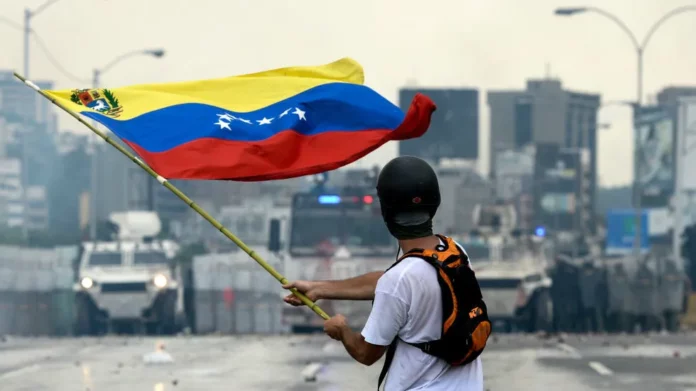
After months of increasingly serious bombings and escalations (in effect, undeclared acts of war), the imperialist aggression of the United States against Venezuela reached its peak with the direct attack on the capital, Caracas, the deployment of special forces, and the kidnapping of President Nicolás Maduro together with his wife. Far from being the first U.S. intervention in Latin America, this represents the latest chapter in a long history of successful and unsuccessful coups, support for fascist paramilitary groups, and attacks on local labour movements aimed at keeping the region within the North American sphere of influence—the high point of these interventions having been reached during the Cold War.
The supposed systems of checks and balances of American bourgeois democracy, which liberal ideologues routinely invoke in an effort to preserve its legitimacy, once again proved impotent in the face of a war of aggression. On December 25, Rubio’s team reported to the U.S. Senate on actions taken against Venezuela over the previous year. Following the discussions, Democratic Senator Chris Murphy condemned the attacks in harsh terms—primarily in relation to their cost to the American state rather than out of any principled commitment to the sovereignty of a people or an equally principled opposition to war crimes—concluding that they were illegal and lacked any national security justification.
Obviously, the opposition of Congress or of the Democratic Party, insofar as it existed, was not a sincere one, but rather a conjunctural response to Trump’s Bonapartist excess of launching an invasion without seeking their approval. Conflicts over the constitutional limits of presidential power, and their repeated circumvention, have been a leitmotif of the Trump administration to date. Otherwise, the economic sanctions imposed by Washington and the pursuit of regime change in Venezuela are policies that have enjoyed the support of the most important political figures in the United States for many years.
What Happened in Venezuela?
The Maduro administration, after a period of relative social peace at the beginning of its term, has faced a shrinking base of supporters (including from the Chavistas camp) and the emergence of street movements directed against it. One of the main factors has been the collapse of living standards, largely due to the criminal sanctions imposed by the U.S., Canada, the EU, and Switzerland against the country. At the same time, it is also necessary to note Maduro’s own contribution through the liberalisation policies he has adopted, in what some commentators have described as a “Thermidorian reaction”: the wave of privatisations in 2015, the “dollarisation” of the economy, tax exemptions for investors, and the maintenance of a minimum wage equivalent to around two dollars a month. Although some of these measures were taken under the pressure of sanctions, they nonetheless represent the response of the national bourgeoisie to those sanctions—one that Maduro allowed to reverse a series of important gains achieved under Chávez.
Venezuela’s economic crisis was further exacerbated between 2017 and 2019, when the first Trump administration intensified economic sanctions against both private and state-owned enterprises. The most significant measures targeted the state-owned oil company, with oil accounting for around 90% of the country’s export revenues. In this context, the political and military-police repression used by Maduro and the bureaucrats around him to remain in power—including the confiscation of electoral logos and the blocking of several opposition candidates, among them the communist Manuel Isidro Molina, from appearing on the ballot in the July 2024 elections—was bound to provoke a reaction of rejection among the masses.
Some of these legitimate grievances were exploited by the employers’ opposition grouped around the Unitary Democratic Platform (PUD), founded by Juan Guaidó and led by María Corina Machado, which managed to channel the “anti-regime vote” toward the consolidation of its own power. The PUD counterposes bourgeois democracy to Chavismo and has repeatedly benefited from the support of U.S. imperialism, in exchange for promises to implement neoliberal measures and grant U.S. corporations access to the country’s resources. Using the same rhetoric with which it denounced “socialism” for Venezuela’s catastrophic living standards, this right-wing opposition called for further sanctions against its own country. Machado is a supporter of the far-right European bloc Patriots for Europe and of Netanyahu’s genocidal regime, whom she personally called to congratulate on his “decisions and firm actions during the war.” Moreover, she echoed the Trump administration’s xenophobic claims about “criminals hired by Maduro to commit crimes” in the United States, at a time when Venezuelan asylum seekers and immigrants were under attack by the American far right.
The nauseating exchange of praise and gratitude last autumn, when Machado received the Nobel Peace Prize and dedicated it to President Trump, was a sinister prelude to the criminal actions of the United States. However, it appears that this was not enough for Washington to entrust her with the state apparatus of a future proxy regime. According to Trump’s own statements, Machado “does not have the support and respect of the country,” and former Vice President Delcy Rodríguez would be preferred to assume power. Such a preference sends a signal to the regime’s bureaucracy: it could retain a range of privileges derived from its positions within the state apparatus, provided it betrays the former leadership and agrees to do “whatever the U.S. asks of it,” as Trump claimed Rodríguez had promised. This discourages the bureaucracy from opposing U.S. control over the country or participating in potential resistance movements, demonstrating that it is possible to reconcile its interest in preserving its position as an administering caste with those of U.S. imperialism.
For this reason, it becomes clear that the only force capable of initiating and sustaining such resistance is the armed working class.
War – a Consequence, Not an Error of Capitalism
Regardless of the intentions of the politicians of bourgeois states, as long as the capitalist mode of production dominates society, the policies they are compelled to adopt will be those that favour the accumulation of capital. As Venezuela’s working class lost confidence that Maduro could represent its interests—made evident by the opposition of local labour forces—U.S. capital was confronting Venezuela’s national capital over access to resources and control of capital flows. In fact, the intervention, initially justified through accusations that Venezuela was supporting “narco-terrorists” who send fentanyl to the United States, soon came to be presented in far simpler and more honest terms by the Trump administration and the American press: namely, that Venezuela’s oil supposedly belongs to the United States.
We cannot expect any bourgeois state to wage a decisive struggle against imperialism, because imperialism is not an unfortunate policy pursued by a handful of politicians or by a particular branch of production. As Lenin explained, imperialism is a stage in the development of the global capitalist system, which arises when capital is forced to cross national borders in search of new markets. Once the world has been divided among the major capitalist powers and capital finds no further room for expansion—when the crises faced by capitalist states can no longer be postponed or mitigated through capital exports and colonial policies (a convenient mechanism for managing surplus population)—militarisation becomes an assumed policy of the bourgeois state. It rescues sections of capital from bankruptcy by converting civilian productive capacity into military production and constitutes a necessary step in preparing for war and crushing workers’ resistance.
This dynamic explains the broad consensus in favour of militarisation within the European Union across the entire spectrum of bourgeois parties, from Social Democrats and Liberals to the far right (which has opposed arms investments only insofar as they judged national capital to be insufficiently favoured). Opposition has been voiced almost exclusively by the limited forces of the so-called radical left in the European Parliament.
For this reason, opposition by certain states to U.S. military intervention in Venezuela, insofar as it emerges, cannot be equated with the opposition of the working class. The former defends the interests of its own bourgeoisie, regardless of how much “emancipatory” rhetoric it employs; the latter represents a principled resistance to the lowering of living standards and the destruction produced by militarisation and imperialism.
What Do We Have to Do?
As a working-class organization, with the stated aim of contributing to the creation of a mass workers’ party in Romania, we hold that the struggle of the proletariat for emancipation is inseparable from the struggle against imperialism and the militarisation of society that it engenders. The working class is the only force capable of overcoming the capitalist system, once it becomes conscious of its position in society and, consequently, of its own power. To achieve this, opposition to war must go beyond the limits of bourgeois pacifism, which mystifies the real causes of war and is powerless in the face of it, as well as beyond the merely declarative support of one state against another.
It is necessary to demystify the causes of war and militarisation, and to demonstrate to the working masses in Romania and internationally that only in a society run by those who make it function—where production is determined by social need rather than by the anarchy of the market—can lasting peace be achieved. On this basis, we believe that socialists in Romania face the following immediate tasks:
- Solidarity with the Venezuelan working class even if armed struggle is needed for self-determination. A U.S. seizure of power—whether through full-scale invasion and occupation, or through a puppet regime installed with the assistance of servile forces—would represent a major defeat, with a deeply demoralising effect on the working masses. The struggle waged by millions of Venezuelans in 2002, when they repelled the coup attempt against Chávez through mass mobilisation in the streets, must be continued in defence of their own class interests, which are incompatible with those of U.S. imperialism.
- Intensifying the struggle against militarisation. The slide toward a new global military conflict is inevitable unless the capitalist system is overthrown in time. Only the working class, on an international scale, can prevent this by deciding to halt production and take control of it.
- Internationalising the struggle. The workers of the aggressor countries, as they have repeatedly demonstrated through courageous street mobilisations and strikes against the genocide in Gaza, must refuse any complicity in the destruction wrought by the wars of the bourgeoisie.
In the face of the pathos-laden, nationalist, and cynical speeches of the bourgeoisie—which call on workers, explicitly or implicitly, to abandon class struggle in the name of the “national interest”—our response must be unambiguous: no hours of work for instruments of destruction, no lives sacrificed for profit.