


Article by the US-based political organization Solidarity Now!
On January 13th a coalition of unions and community organizations put out the call for a day of “no work, no school, no shopping” across Minnesota on January 23 in order to drive ICE out of Minnesota. Even though it’s not being called one by union leaders, this is widely and rightly seen as a call for a general strike. The working class’s most powerful weapon. Solidarity Now believes this is exactly the direction the movement has to go to defeat Trump’s mass deportations and brutal, authoritarian methods.
Trump’s real goal with ICE’s deployment to the Twin-Cities was summed up by CWA 7250 President, Kieran Knutson, in an interview with labor reporter Steve Zeltzer. “[The Trump regime wants] to target one of the more militant, self-organized working-class communities in the Twin Cities and try and divide and terrorize that community against the rest of the population.”
Trump’s rise to power rested on the lie that his agenda aimed to restore “greatness” to the American working and middle class. Instead he has focused on massively increasing the wealth of the super rich at the expense of everyone else. His tariff policies have caused layoffs in manufacturing and contributed to rising inflation. They have also caused great embarrassment for US big business as China has gained from America’s growing isolation. His attacks on Medicaid and other government programs has hurt his base in poor rural communities. His expansionist policy has the lowest support, even among his own base, with only 8% supporting his bizarre goal of acquiring Greenland. Trump also promised to go after the “swamp” of elites in Washington but has turned out to be their best friend and protector, as demonstrated by his handling of the Epstein Files. In order to distract from these failures, with hopes to divide the working class along racial lines, Trump has felt compelled to deliver on mass deportations.
ICE’s parent agency, the Department of Homeland Security (DHS), was set up in the wake of 9/11 to be directly answerable to the President. As with the rest of America’s growing police state, the agency has received greater funding every year from both Democrats and Republicans. Obama still holds the record for deportations and Biden spent more on ICE’s concentration camps than Trump did in his first term. Now, ICE and CBP (Customs and Border Patrol) are being used as Trump’s personal police force, massively increasing the extent of his power.
The stated goal, by Stephen Miller, to deport 3,000 immigrants every day is an impossibility within their current framework. So far, despite tripling the budget and more than doubling its number of agents, ICE has been unable to come close to these numbers. Consequently the administration has had to lean into terror campaigns to drive immigrants out of the country. These efforts were resisted in LA and Chicago, causing even more humiliating defeats for the administration as they were forced to retreat from all out invasions. Trump had to regain the initiative and settled on Minneapolis. He likely picked Minneapolis hoping that recent attention brought to the city by racists like Nick Shirley—who have accused the Somali community of fraud—reflected the mood of rural and white Minnesotans. If Trump could divide the community, it could allow him a victory which would weaken the anti-Trump movement and set precedent for future operations.
Instead, Trump has accomplished the opposite, as Knutson goes on to describe, “I don’t think it’s working. I think that people see through it. I think the Somali community has built a lot of alliances with unions, community groups, churches, mosques, synagogues, so that people have stepped up to call it out for what it is.”
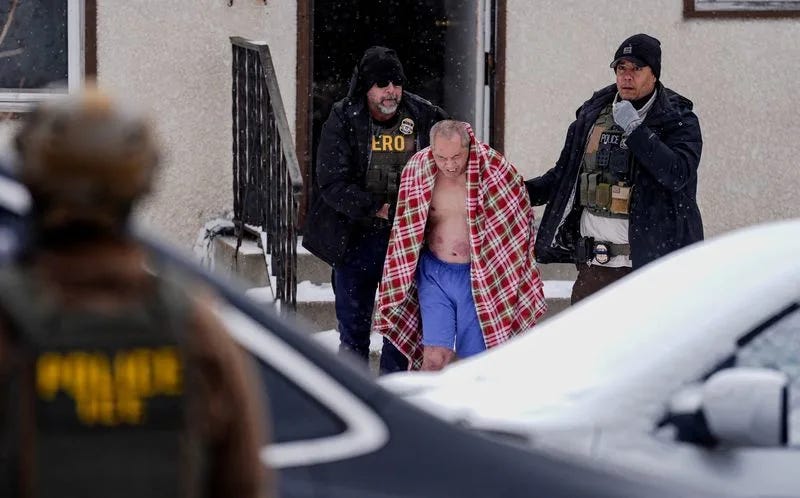
In the Twin-Cities masked agents, reminiscent of Hitler’s Gestapo and home-grown American vigilantes like the KKK, have swept through, racially profiling suspected immigrants and anyone they see as protesting them. Dragging people from homes, workplaces, and schools. They have brutalized and arrested countless members of the community leaving the metropolitan area strewn with destroyed cars and broken glass.
Overnight on January 14th, ICE sought to carry out hundreds of abductions at once. Already it has been confirmed that ICE shot another person as the community mobilized to defend their neighbors. This time a Venezuelan refugee was shot in the leg as he fled into his home where his family lives.
Renee Nicole Good’s murder by ICE officer Jonathan Ross sparked massive protests, but her role in community defense goes to show that Operation Metro Surge was already flopping. The mounting wave of racist ICE attacks on Somalis, Latino/as, and Native Americans was already being repelled by the wider working class.
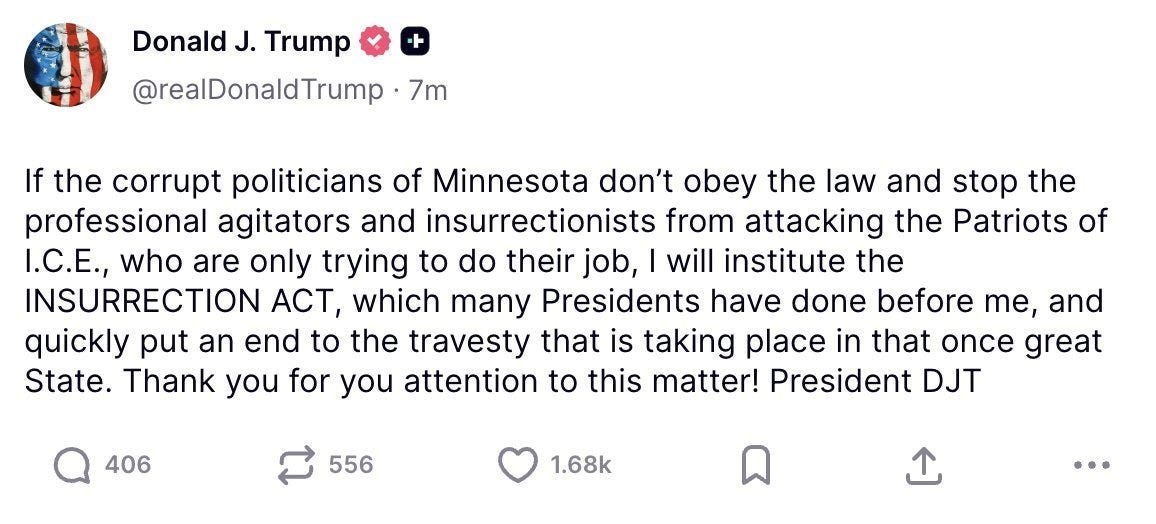
Trump is desperate not to suffer another humiliating defeat and has shown no sign of being ready to back down. As cracks in MAGA have weakened his grip on power, Trump has had to lean into his most reactionary supporters, hoping they can create the energy needed to sustain his broader agenda. But even this goal is faltering. His threats to invoke the Insurrection Act and deploy active-duty military are not signs of strength, but of desperation. Now is the time for the movement to press forward.
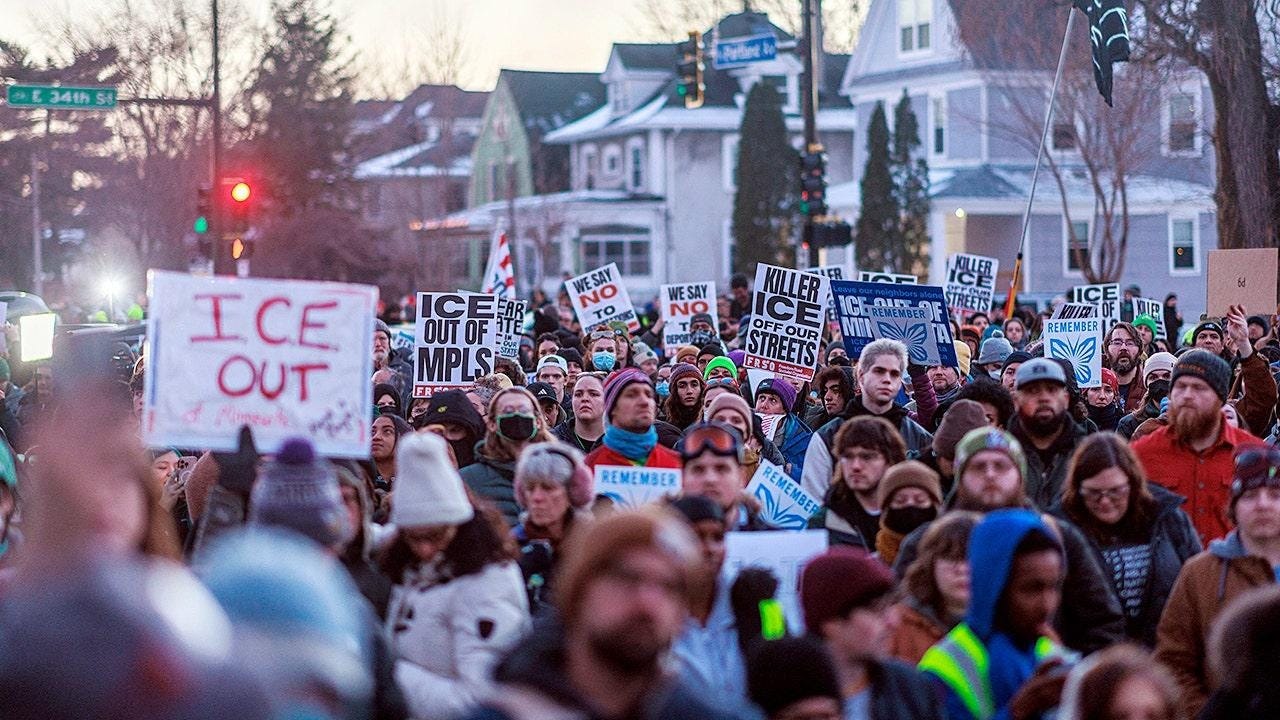
Wielding the General Strike
The idea for a general strike has gained rapid popularity in the US since Trump’s first term, but it has been little discussed outside of left circles. The increasingly desperate situation created by the super rich and the Trump administration, and the utter failure of government officials and the leadership of the Democratic Party to stop them, has pushed millions to look for more effective means of struggle. This pressure has found echoes among some, mostly lower level elected Democrats.
At the October “No Kings” rally in Chicago, Mayor Brandon Johnson called for a nationwide general strike. General strikes require organizing, and he did nothing to follow through on this. But now this call is being put up by working class organizations with deep roots in their community. Friday’s action in Minneapolis could be a jumping off point for a larger, nationwide struggle against ICE and the Trump regime.
By shutting down the economy, a fully implemented general strike would cut off the flow of profits to the super rich, Trump’s real bosses. It is their support of Trump’s authoritarian agenda which is responsible for his rapid consolidation of power. While Trump’s policies have created economic turmoil for the vast majority of Americans, in the last year US billionaires increased their wealth by $1.5 trillion. This, more than Trump’s cult of personality, explains the loyalty of most Republican politicians, as well as the “roll over and play dead” strategy of Democratic leadership.
Only the organized and mobilized working class can defeat the agenda of Trump and the Oligarchy. We make their economy run, we can shut it down. We create their profits, we can take them away.
While we should demand our government officials uphold the democratic rights won through bloodshed over generations, we should not rely on them to save us nor lead the fight. Under pressure from their constituents, Governor Tim Walz and Mayor Jacob Frey have spoken out against ICE, demanding they leave. But other than press conferences they’ve stayed safely in their respective mansions, limiting their protests to public pleas for sanity and filing a lawsuit.
In fact, they have done more to harm the movement than help. The Minneapolis PD, which was responsible for the murder of George Floyd, has even assisted ICE by repressing protests. And Gov Walz has put the National Guard on standby in case of “unrest”, which is exactly what happened, with disastrous results, following Floyd’s murder.
Working class communities in cities where Trump has deployed his Gestapo goons have instinctively responded to protect themselves and their immigrant neighbors. From LA to Chicago to Minneapolis, communities have organized networks to respond to ICE sightings. These networks, utilizing whistles and cell phones to warn and call neighbors to defense, have become increasingly brave in their confrontations with ICE. In many instances they have acted quickly enough to prevent ICE kidnapping of civilians or even to de-arrest.
Even though defense networks have not yet succeeded in driving ICE out, they are creating the organizing framework that is needed. As with the Justice for George Floyd movement before, these efforts have been key in raising the fighting spirit and organizing power of the Twin-Cities working class. The participation of unions and other community organizations can provide a critical extension of this organizing power.
The community-labor coalition has been joined by 90 organizations and counting. The Minneapolis Regional Labor Federation—which includes major unions like Amalgamated Transit Union (ATU) Local 1005, SEIU Local 26, UNITE HERE Local 17, CWA Local 7250, Minneapolis Federation of Educators AFT Local 59 and St. Paul Federation of Educators Local 28—has now endorsed the call for the “Day of Truth and Freedom.” The coming together of the leadership of these organizations to call for such a significant escalation in the movement speaks to the immense pressure they feel from their base and the wider public.
As SEIU Local 26 President, Greg Nammecher, put it, “the community made the call for this day… Members began telling us in large numbers that they were going to honor that call… 95% of them said they were planning not to go to work.”
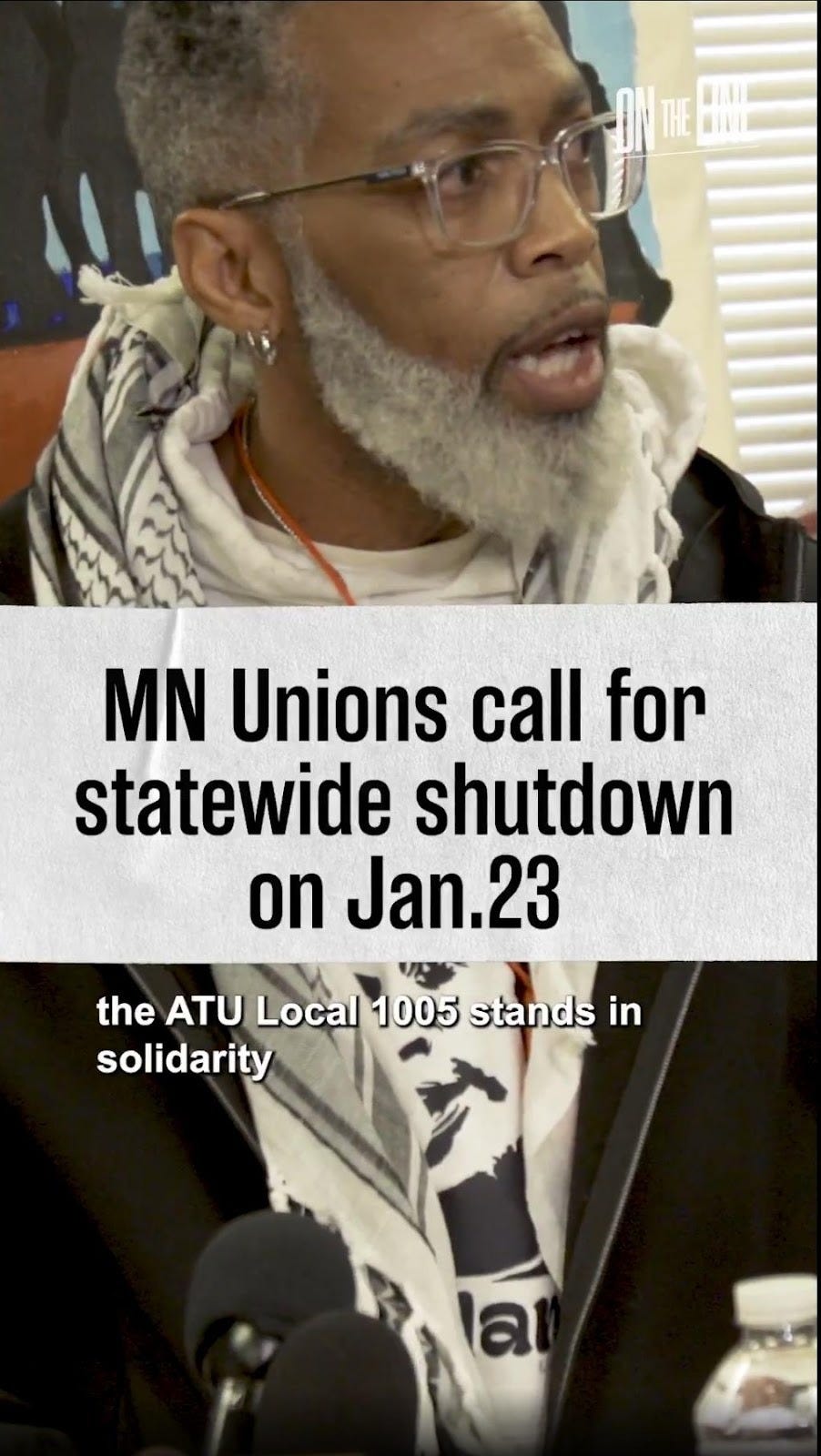
In one of the many ways the legal system limits the power of organized labor, most unionized workers are banned from taking strike action except when their contracts expire. For this reason many of the union leaders have made a point to say that while they have endorsed the call to not work, they are not officially calling on members to strike. Historically, general strikes have had to break the law in order to be successful; so far, no union leader in Minneapolis appears ready to take that step publicly. Some unions have found workarounds by pressuring businesses and schools to close on January 23, but inevitably the confusion will have an impact on the effectiveness of the strike. All the more so as these bans affect the most strongly organized sections of the working class!
General strikes also require organized outreach to the vast, non-unionized majority of the working class. Over the last decade unions and social movements have grown closer, and this has been especially the case in Minneapolis since the Justice for George Floyd movement. Organized labor calling for an official strike and preparing its members for it would strengthen the coalitions ability to organize the wider working class by leveraging these connections.
To fully harness this potential, the movement needs to come together in a democratically organized way to sustain itself and direct its energies most effectively. A centrally organized, citywide movement would overcome the fear and isolation that limits participation in risky actions like general strikes and mass civil disobedience.
Events will show what the response will be and whether this call to action, stopping short of “general strike”, will be enough to drive ICE out of Minneapolis. Regardless it will be a turning point in the movement. The example of labor, community organizations and neighborhood defense networks uniting into a single coalition and for a single day of action will be a point of reference in future struggles against ICE and Trump. We should take time now to study what is being done, draw lessons from it and prepare for the next battle.
Will Trump Back Down?
Trump’s hold on the Republican base is weakening as we’ve seen from the defection of Marjorie Taylor Green, with more defections on the way. As the vast majority of people have expressed their disgust with Trump’s agenda of mass deportations, his support has grown increasingly passive. Friday’s day of action could drive wedges in the cracks already beginning to form within ICE and MAGA.
It is very important to note that the far Right has proved unable to mobilize any serious forces on the streets. This was clearly demonstrated by the laughable attempt of convicted January 6th’er and wannabe “Christian Crusader” Jake Lang to organize a pro-ICE protest in downtown Minneapolis on Saturday. The anti-ICE movement showed up in force to drive him out and he had to be rescued by individual demonstrators – led, with magnificent irony, by a young Black activist – in order to get back to his hotel. Another MAGA influencer, Nick Sortor, suffered a similar humiliation a few days later.
Failing to mobilize the far right into the streets with a Stephen Miller-driven racist propaganda campaign, Trump has had to lean further into the use of top-down, state driven violence. He has threatened to invoke the Insurrection Act and sent orders for 1,500 active-duty soldiers to prepare for deployment. If Trump does send in actual troops, it will be incumbent on the movement to prepare for an indefinite general strike until they are withdrawn. We believe that the labor and community movement needs to take a stand now, publicly stating that the response to a military intervention will be a city in which nothing moves without its permission.
What comes after January 23rd?
January 23rd follows days of protests throughout the country on January 19th, (Martin Luther King Jr. Day), and the 20th (the anniversary of Trump’s inauguration). It is vital that the energy of these demonstrations followed up with sustained organizing. A key weakness of the anti-Trump movement so far has been its lack of sustained organization, strategy and clear demands. This is not the fault of the movement itself, which is seeking day by day to create these things, but of many of the organizations which have put themselves at its head. The organizers of No Kings have in no way broken with Democratic Party leadership. Most leaders of these movements have defaulted to “vote Blue in November.” Most union leaders have also made this a primary focus, when they aren’t actively sucking up to Trump as Teamsters President Sean O’Brien has done, or sending mixed messages like UAW president Shawn Fain.
Solidarity Now recognizes that opposition to Trump will mean a Blue wave in November, but recent history makes it very clear that the Democrats won’t actually stop his attacks. When pressed on how they intend to defeat Trump, party leaders repeatedly refuse even to engage the prospect of impeachment. As the demand to abolish ICE has rapidly gained traction, with 46% of the population and almost 80% of Democrats now supporting abolition they shamefully call for better training and – scandalously – more funding for it.
We cannot rely on these politicians, but we can rely on our own organized power. It is possible that escalating the struggle in the form of political strikes and mass civil disobedience can force the hand of the Democrats and of the Trump administration. The general strike of enslaved Black people in the 1860s, mass labor battles from the 1870s through the 1930-40s, and the Civil Rights and anti-war movements of the 1950-70s showed how this can work. But we need a way to organize, plan and mobilize a unified movement.
Knutson also made the case for what is needed moving forward when he said. “I think we have to fundamentally build organizations that are controlled by our communities, by working-class communities, by working-class organizations, and where there can be strategic discussion and debate and decisive action, unified action as needed.”
The coalition in Minneapolis should be emulated in Chicago, LA, Portland and everywhere that grassroots organizing is taking place. Many of the organizations and networks already exist, we need to link them and begin systematically preparing for future citywide and national days of action. City-wide general assemblies can be a powerful tool for the movement to democratically organize itself and determine the best strategies, tactics and demands to implement.
United Front coalitions like that in Minneapolis should take the lead in creating these. Community defense will also require even greater participation and discipline. Neighborhood assemblies can be used to refine tactics and organize their implementation. They can also be used to elect members of the community to represent them in the larger citywide assemblies. There are thousands of activists who are being tested and trained in struggle. Our movements need them to become active organizers and leaders, held accountable to our own democratic structures while preserving lessons of how best to build the movement.
Solidarity Now believes the demands of the movement need to broaden and go further than simply Abolish ICE. We believe the following list should be taken up:
- An end to abductions and deportations.
- The return of all those already deported who want to return.
- The release of all detainees, the permanent closure of ICE detention camps and an open, public investigation of every contract awarded by ICE, with criminal prosecutions for corrupt practices.
- A full investigation of every report of ICE or CBP abuse.
- Prosecute Jonathan Ross, and every other DHS agent who is guilty of murder or abuse of immigrants, other detainees, observers or protesters.
- Investigate and prosecute Kristi Noem, Greg Bovino and Tricia McLaughlin for their cover-ups of ICE and CBP abuses.