

Nearly five decades ago, the death of an urban marginalized worker during the demolition of an unlicensed housing in Garmdareh, near Karaj, ignited the first spark of a long-suppressed rage among Tehran’s marginalized urban populations. These communities were largely composed of former villagers displaced by the Shah’s land reforms. The small plots allocated to them proved economically unsustainable, forcing mass migration to urban centers.
In the cities, these displaced peasants became industrial workers in factories imported as part of capitalism’s Third World industrialization project—designed less to develop peripheral economies than to alleviate crises of overproduction and structural unemployment in the West.
These factories relied on cheap labor detached from the land to produce consumer goods for domestic markets, while the bulk of surplus value was siphoned off through licensing fees, factory pricing, and profit repatriation to Western capital. Another portion enriched former landlords now reborn as domestic capitalists.
The same marginalized workers constructed opulent mansions in northern Tehran for nouveau riche elites whose wealth stemmed from oil rents and proximity to the royal court. These palaces featured gold-plated fixtures, Italian bathtubs, and imported European stone, while their builders lived in slums without access to clean water or sewage systems. Their children grew up amid mud and deprivation, with minimal access to education and healthcare.
These accumulated injustices formed the objective conditions for revolution. What was lacking were the subjective conditions. The Iranian left—young, fragmented, and heavily influenced by Fanonist and Guevarist guerrilla paradigms—was preparing for armed struggle. By the time mass anger erupted in 1978–79, much of that movement had already been crushed and eroded.
Early protests emerged in universities and spread among intellectual circles, but the core revolutionary force—industrial workers and marginalized urban poor who still retained elements of rural culture—remained largely disconnected. When these layers finally entered the struggle, they did so as a deeply insurgent force unwilling to tolerate continued exploitation and deprivation. With an organized leadership of politically vanguard workers grounded in Marxist-Leninist theory, this movement could have produced a second workers’ revolution of the twentieth century. Alas, no such leadership existed.
As the movement intensified, the possibilities for radicalization and organization grew. Oil workers—drawing on a history rooted in the struggle for nationalization—posed a particular threat. At this point, imperialist intervention became decisive. A leader was manufactured, drawing on the religious consciousness of the masses. Decades later, extensive evidence has revealed the role of the United States in shaping the leadership of the 1979 revolution.
A cleric long exiled from Iran—whose opposition to the Shah emerged from a reactionary ideological foundation—was relocated from Iraq to Turkey and then to Neauphle-le-Château near Paris. Western media saturated global audiences with images of an elderly man with a white beard sitting under an apple tree, promising freedom even for communists. For parts of the European left, he appeared as an anti-imperialist figure. However, in reality, this “Santa Claus” became the executioner of communists, intellectuals, and militant workers.
Under Khomeini and later Khamenei, hundreds of thousands of young people were executed by firing squads, hanged, tortured and imprisoned, or deceived into sacrificing themselves on battlefields as expendable instruments of capital and state power. In reality, they were sacrificed on the front lines as mere cannon fodder for capitalism.
The United States successfully marketed a leader who would become one of the most violent dictators of the twentieth century, and the cost was paid not only by Iranians but by the entire region, as political Islam was exported through proxy forces.
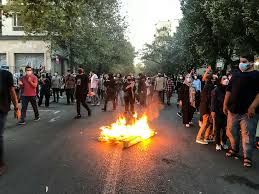
Forty-six years later, history appears to be repeating itself, this time as a comedy. Iranian society, now far more exhausted, impoverished, and desperate, has again erupted in protest. Once more, the United States—under a figure such as Trump—flirts with the fantasy of leader-manufacturing. This time, religious legitimacy has been replaced by nostalgia for the monarchy.
A royal heir with no history of leadership, labor or struggle—whose political résumé is limited to casino culture and inherited wealth—has been repackaged as a national savior. In his “Notebook for the Transition Period”, the prince promises military rule in 20 cities as soon as he gains the power.
He is the king of kings and the three branches of government: the judiciary, the executive, and the legislature will be under his control. He is the head of the army and security forces.
Western media platforms amplify his image, while Trump, a former casino magnate himself, deploys the “Shah card” as leverage in negotiations with the Islamic Republic. If concessions are secured, repression inside Iran becomes irrelevant. “This is an economic arrangement, not a matter of human rights sentimentality.”
Should negotiations fail, the card retains utility. Domestic elites eager to preserve their rents are prepared to play it. Meanwhile, monarchist supporters—still out of power—already threaten mass violence, assault leftist demonstrators abroad, and openly promote physical elimination of political opponents. The logic of authoritarian restoration is visible even before power is attained.
Once again, the Iranian left and vanguard workers have failed to enter the struggle as a unified, organized force—a failure rooted in historical fragmentation and repression, to be examined elsewhere.
This essay focuses on Western—particularly U.S.—intervention against Iran’s progressive movements. Through imperial interference and the opportunism of Soviet-aligned Stalinism, Iranian workers have repeatedly been denied even the most basic right: independent organization. Dictatorship has followed dictatorship, each narrowing the space for class-conscious, anti-capitalist struggle.
The British installed Reza Shah and removed him when he outlived his usefulness. The 1953 Anglo-American coup restored the Shah and overthrew Iran’s first democratically elected prime minister. Decades later, the same powers forced the Shah into exile and denied him entry to American soil, even for medical treatment. In 1979, they helped cook Khomeini’s state in Iran’s cauldron. Today, as its utility declines, they search for a replacement.
Given this history, how can Iranians view relations with the United States with optimism? While sections of a desperate middle class fantasize about U.S. military intervention, the experiences of Afghanistan, Iraq, and Libya demonstrate that imperialism serves only its own interests.
A century of struggle has shown that no external power can liberate Iran, and no dictatorship has fallen without being replaced by another—often more brutal. The search for a savior, whether cleric or king, merely reproduces the ideology of individualized power.
Only power organized through councils—democratically elected, transparent, accountable, and recallable—can express the collective will of a diverse society. Such structures alone prevent the severing of communication between rulers and ruled. Without open and independent channels of criticism and feedback, any project claiming emancipation merely reproduces domination.
Iranian Revolutionary Marxists’ Tendency