


Interview by Matt Wylder
As union organizers, Emma Fletcher and Ramy Khalil helped organize 200 workers at Hennepin County Medical Center to participate in the historic city-wide work stoppage on 1/23/2026. Ramy is an organizer for AFSCME 2474, and Emma is a member of CWA 1032. Emma and Ramy also helped lead a protest against Target’s enabling of ICE on 1/31/2026. They are both members of Democratic Socialists of America and supporters of Labor-Power Publications. They are speaking in a personal capacity.
This interview was conducted before the Trump administration claimed it would withdraw from Minneapolis.
News of the events in Minneapolis have been covered internationally. Most people are familiar with the basics. What does it feel like to be in Minneapolis during this ICE occupation? What has your experience been?
Emma: I have so many emotions in any given day, ranging from horror, fear, anger, inspiration, and power. ICE will just roll down a street and indiscriminately ask black and brown people for their citizenship papers. As a white person who has citizenship, I don’t feel the terror that my black, brown and immigrant neighbors in the Twin Cities feel. But no protestor is safe. We’ve seen people like Renee Good and Alex Pretti be murdered while legally observing. I’m in awe of how quickly the working class moves when ignited. I’ve never been part of such a massive working class movement or strike before. That’s been inspiring here on the ground.
Ramy: It’s been really scary on one hand, but also I’ve also been truly inspired to see working class people coming together overcoming racial, religious, and nationality divisions to unite against Trump and ICE. Many immigrants are locked up in their homes, terrified to leave because there have been 3,000 ICE agents roaming the streets snatching people up out of coffee shops and schools – even children. I carry my passport around with me and we’re all carrying whistles around with us to alert each other to ICE’s presence. But there’s been a massive outpouring of mutual aid, protest, and people supporting their neighbors.
How would you say most people are responding to the situation? How is the average person taking part in the movement?
Emma: A huge number of people are in rapid response Signal chats. They alert people on where ICE is, what they’re doing, and asks of mutual aid. There have been some very large protests like the mass protest on January 23rd, there have been smaller strikes and big protests like on January 30th, the following Friday. There have been neighborhood vigils following Alex Pretti’s murder. There have also been pickets and sit-ins at Target, who has facilitated ICE’s occupation.
Ramy: The main way most people seem to be participating is through supporting their neighbors. A lot of white folks are helping immigrant kids get rides to school or picking up groceries for immigrant neighbors who are locked up in their apartments terrified to go out. There have also been over 30,000 people trained to be “legal observers”: trained to record ICE and what they’re doing.
There’s been a real shift in consciousness also, particularly when ICE was caught on video murdering Renee Good and Alex Pretti. A narrow majority of Americans are in favor of abolishing ICE, 47% in favor, 45% against. There’s also this growing demand for an eviction moratorium, because a lot of immigrants can’t afford rent because they’re not able to go to work, and the money is coming due. So far Governor Tim Walz has not agreed to that, but the movement for it continues to grow.
Some have called the protests of January 23rd a general strike, others disagree with the use of that term. What do you think?
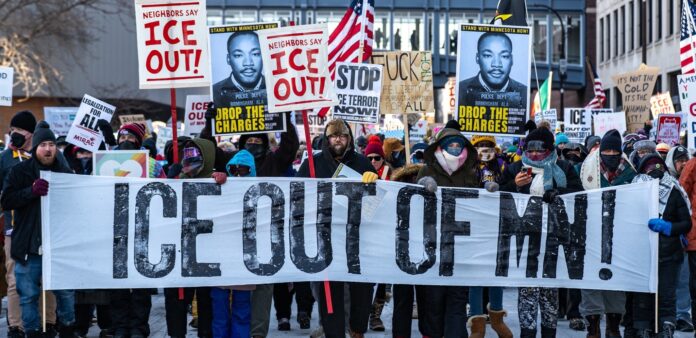
Emma: January 23rd was a powerful, historic, mass work stoppage, to use the language of the coalition leaders who called it. It was a really big strike. An estimated 38% of Minnesota voters participated, based on some polls that came out a week or so later. The US lacks a recent tradition of general strikes, unlike a lot of other countries, so the fact that so many people participated with just 10 days notice is pretty extraordinary.
But the 23rd was not a true general strike in my opinion. Most major businesses stayed open. Most of the businesses that closed were small businesses: restaurants, non-profit organizations. Schools did close, which was powerful. But it was mainly small businesses. I think we risk weakening the term “general strike” if we call every collective strike a general strike. A general strike means that a vast majority of workers in the city, state, or country are not working.
To pull that off requires real labor leadership, not just a call for workers to call in sick for the day. Members of unions need training and political education from their labor leadership to build a general strike. People need to understand what we have to gain and what we stand to lose. I don’t want to lessen the effects that it had, but I think it’s important that we identify it for what it was: which was a mass strike rather than a general strike.
Ramy: I agree, I think “mass strike” is a more accurate term to describe what took place on January 23rd. I know St Paul public schools were shut down, some museums and cultural institutions were shut down. The airport was disrupted with a lot of workers not working, along with 100 clergy who did a sit-in in the terminal. It was somewhat of a mass sick-out. One example I’d add: Emma and I work together as organizers at Hennepin Healthcare. We weren’t able to get our union to go on strike legally but we did organize a “unity break” where we got 200 workers to take our lunch together as part of the citywide work stoppage. I felt proud of what we were able to accomplish there.
I think it’s a historic step forward, and think it’s really positive that workers and activists are thinking about what it takes to pull off an actual general strike. It’s estimated that 50,000 to 75,000 people marched that day in negative 35ºF with windchill factor! It was awesome.
Did the school closures come from the teachers unions?
Ramy: For months beforehand the school district had planned that as a non-teaching day, just a grading day. But many of the teachers went to the march instead of grading. But in St. Paul there was a movement from the ranks to pressure the union leaders to take a stand. But they were being pretty wishy-washy. The union leadership put out an email urging members to participate, but said to “do what you think is best.” Amalgamated Transit Union local 1005 did something similar. But despite the mixed messages, a lot of workers went on strike anyway.
What do you think was the role of the mass strike in forcing Trump to make concessions? How have the Democrats responded?
Ramy: I think we have the Trump administration backpedalling to some extent. Trump has launched an investigation into the killing of Alex Pretti, which he initially refused to do, he’s canceled an operation in Maine targeting the Somali community, and he’s replaced Greg Bovino with Tom Homan, who has reined in the ICE agents to some extent. 700 agents have been drawn down. Trump has said he won’t send troops into Democrat-led cities unless the authorities ask nicely and say “please” [laughs]. ICE agents will have to wear body cameras. The movement accomplished all of that. But they still have 2,300 and they are still detaining and terrorizing people.
Emma: The threat of a broader general strike causes concern among the ruling class, and that’s a big reason we’re starting to see these concessions. The Democrats have begun to use the language of “defund” ICE. They’re also behind this partial government shutdown over DHS funding, because they’re pushing Republicans on some, in my opinion, weak concessions like body cameras and more training. Now is really the time to push labor leadership to call an even larger mass strike, tied to a national day of action against ICE and authoritarian policies. We’re seeing the movement in Minneapolis losing steam – people are tired – and we need this to spread nationally, and we need labor leadership to really lead on that, because they’re already starting to concede things.
Ramy: The Democrats are supporting some of the movement’s demands – that ICE needs to leave Minnesota now, and that the agents that killed Renee Good and Alex Pretti need to be held legally accountable – but I think they might end up caving on the funding question, we’ll see. They have not agreed to two other demands that the movement has raised: Minnesota national companies should refuse ICE entering using their property to stage operations, and at least Governor Walz has not supported the demand for a moratorium on tenant evictions.
What do you think are the next steps for the movement? There have been some debates on the left, some organizations like Socialist Alternative or the Party for Socialism and Liberation (PSL) are calling for a national general strike. What do you think, and what are you doing on the ground to organize?
Ramy: I wish that a national general strike would come out of this. But I think at this stage that’s unlikely, unless ICE gets caught on camera murdering more people. I think it’s running ahead of ourselves the way that Socialist Alternative and PSL are calling for a general strike. In Labor Power Publications and in the labor branch of DSA we’re pushing for a strike local to the Twin Cities combined with a national day of protest across the whole country. That could take the form of protests, sit ins, student walkouts, and strikes where possible.
A coalition called Workers Solidarity Circle is being put together because the labor leaders have so far failed to call another mass strike – and it would happen if they called for it. We’ve had three unions endorse it, members of rank and file caucuses, various radical groups have endorsed it, as well as BLM groups. We expect hundreds of activists to show up at an assembly. We are likely to pass a resolution we’ve drafted to demand the labor leaders call a strike in the Twin Cities and set a date for it, linked to a national day of protest.
However, some of us are deeply skeptical that the labor leaders will feel enough pressure from the left to actually call another mass strike. So maybe we’ll have to do a few small strikes. But definitely we should do a day of national protest. Because of this, there’s been a debate over whether we should be bothering to pressure the labor leaders. Some, who I would call ultraleft, have asked: should the left on our own call a strike without the labor leaders? I think it’s well intended. But the danger is that if we do it on our own, it would probably be small, it could backfire, and people could lose confidence in mass strike action. Even though the labor bureaucracy is sitting on their hands, we can’t avoid dealing with them. We have to organize opposition caucuses within the unions to pressure them to take action or we need to run better labor leaders for office.
Emma: Despite that late and not-full-throated endorsement of the labor establishment the strike on the 23rd was still a lot larger than the strike the following week, which emerged from socialists and worker activists. It was relatively small. It did have a national component of protests, which was great to see. But the first one was the biggest because it had that labor establishment backing.
How has the DSA been involved in the movement? What debates have taken place within it? What do you think the upsides and downsides to being within DSA?
Ramy: DSA recently elected Zohran Mamdani and we’ve now reached 100,000 members for the first time. Despite Trump’s historic rise, DSA has been hesitant to be in the fight against Trump. Emma and I have engaged in a debate to get DSA locally and nationally to orient to the fight against Trump. It’s taken a long time, but finally they are. We’ve been advocating we don’t do it with the liberal politics of the leaders of No Kings, which people are rightly skeptical of, but to intervene with our own, independent, socialist working class politics.
Now that DSA is involved in the fight against Trump I think they’re too focused on mutual aid and rapid response, which has its limitations. But DSA also has played a very important role in pushing the demand for the moratorium on evictions, however they’ve been doing that mainly through the Democratic Party. DSA also hasn’t been very oriented to labor action, despite the recent strike. However Marxists like us were able to engage in DSA and lead a protest against Target that was really positive. We also got the DSA labor branch to make this workers assembly and pushing for a mass strike their top priority. We even got the steering committee of our chapter to agree to a resolution to promote a mass strike, though they complained there was nothing actionable in the resolution. They don’t seek to understand why DSA should be building support for it. There are also DSA members who are extraordinarily hesitant to put pressure on labor leaders, they’re scared of damaging relationships, that it’ll backfire, it’s too rushed and illegal. DSA does a good job supporting the movement, but it often fails to intervene in the movement to promote a better strategy to achieve its goals, raise workers consciousness, and promote socialist politics.
But I think Marxists are able to move DSA in that direction, but it is frustrating. DSA is a predominantly reformist organization, so it takes enormous patience. Those of us who come from a Marxist tradition used to building a single-tendency, revolutionary, organization struggle to engage in DSA because you have to deal with reformists and people with different politics. But I think it’s important to learn to do it, and lead socialists towards the class struggle. It’s the same challenge we face in our unions, where class struggle is really low. So I think it’s absolutely worth it.
Ultimately we need to build an independent working class party in this country. The Democrats are not effectively fighting for the working class in this country, the needs of the planet, or oppressed groups. DSA is currently very attached to the Democratic Party, but there is a very lively debate where Marxists can advocate for breaking from the Democrats. DSA itself may or may not become a Democratic Socialist party but many of the people in DSA will play a role in helping to build an independent socialist party or larger workers party, so I think it’s important for Marxists to be part of those struggles.