

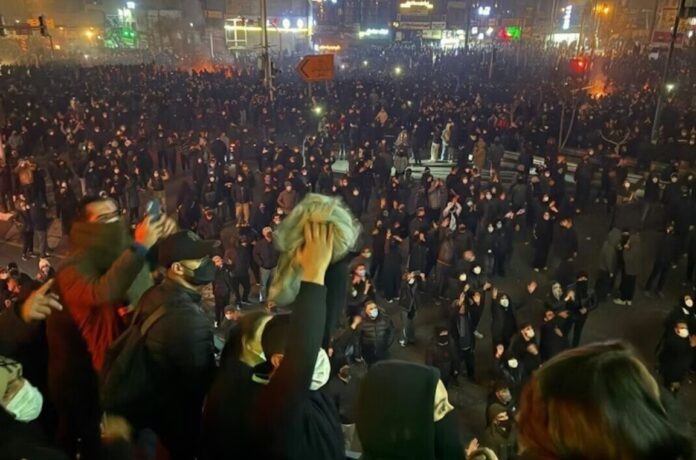
The uprising that began on December 28th, 2025, was the latest in a series of revolts that have occurred in Iran every two or three years. Although it began as a protest by merchants in Tehran’s Grand Bazaar, it soon escalated into the most serious and violent rebellion against the Iranian regime. The accumulating and deepening economic and social crises, compounded by the ongoing sanctions and the 12-day war with US imperialism and Israel, drove hundreds of thousands of people onto the streets in towns and cities in all of Iran’s 31 provinces.
The latest information about the scale of casualties is that between 16,500 and 18,000 have been killed and 330,000 to 360,00 have been injured (Sunday Times, 18.1.26). Families of the dead are often asked to pay for the bullets before their loved one’s body is released, or to agree that he was a member of the security forces, or to bury the person in a remote place at night. After nearly three decades of pretending that it is open to ‘reform’ and ‘moderation’, the Iranian regime was forced to resort to the same methods that brought it to power! This massive killing spree exposed the true character of this reactionary regime to the youth who did not witness its role as the leader of the counter-revolution in 1979-81.
Despite the atrocities, all the economic and social crises, the sanctions, the uncontrolled corruption and nepotism that led to this popular upsurge, remain untouched. US imperialism still demands hefty concessions to normalise relations and allow Iran’s capitalist system the trade, technology and investment it needs to modernise. And, above all, any illusions about the regime’s ‘reformists’ and the bourgeois opposition in exile – i.e., the people who encouraged the masses to sacrifice their life and limb for their bankrupt politics from the 1970s – lie shattered.
***
The Iranian Revolutionary Marxists’ Tendency (IRMT) is the only Iranian Trotskyist organisation. It has its roots in the Iranian Socialist Workers’ Party (HKS) that was launched during the 1979 revolution. The IRMT’s orientation is towards helping vanguard workers in Iran to build their own revolutionary party based on clandestine cells that will lead the mass movements of workers, women, national minorities and the youth. The heritage of the first four congresses of the Comintern forms the basis of its main theoretical principles and the IRMT uses the method of the Transitional Programme to pose slogans and tactics that bridge the gap between the current level of workers’ consciousness and their strategic perspective of overthrowing capitalism and forming their state based on soviets.
Internationalist Standpoint interviewed Morad Shirin of IRMT, the ISp affiliate in Iran
All eyes worldwide are on Iran currently. Taking into account the overload of information, what do you think are the main characteristics/facts of the current uprising based on what you have learned from within the country?
There has been a 13-day total shutdown of the Internet (since January 8th). This blackout – which at times has also included the mobile network and even landlines – means that we have very little information from inside Iran, particularly from workers’ organisations. In their place, we’ve had a deluge of irresponsible self-promotion by the monarchist and other rightwing bourgeois opposition groups.
Since the June 2025 war with US imperialism and Israel, the Iranian rial has plummeted. This has hit all layers of society, and even middle-class people can’t afford basic items like meat and fruit. And, of course, these protests started with merchants whose profits from imported electrical goods had shrunk. While in December 2025 the official rate of inflation was 42 per cent, food inflation was 72 per cent and the increase in the price of bread reached 113 per cent. Although journalists have been able to voice the grievances of the petty-bourgeoise, we can be sure that the pain that working-class families have had to bear would have been much worse.
The regime’s response has been brutal, repressing the protests as it has always done. Can you describe the character of the regime and the repressive apparatus it has built over the years?
This is a regime that drowned a revolution in blood. It smashed the independent organisations of workers, women and national minorities. To do this, it had to build new repressive organisations, particularly the Pasdaran and the Basiji thugs, to supplement the regular army and police that any capitalist state has. During the past two decades or so, as its social base has eroded, it has built up the riot police, the plain-clothes thugs of the Intelligence Ministry and so on as well.
Inevitably, as the capitalist oligarchy becomes ever more dependent on the Pasdaran to continue its rule, their role in the economy has kept growing. Also, in terms of ideology, the regime has resorted to more standard nationalism – rather than religion – to justify its continuing reign.
There is a lot of talk about the issue of foreign intervention and the role of Mossad and US secret services during current events. What is your assessment of this?
Although Mossad is believed to have been behind the assassination of Iran’s nuclear scientists since 2007, most significantly Mohsen Fakhrizadeh in 2020, I don’t think it had a significant role in this uprising. The vast majority of the population want to get rid of this regime, and they came out night after night, in huge numbers, despite the continuing heavy-handed repression. They forced the regime to resort to levels of barbarity it hadn’t used since crushing the revolution. So I don’t think that a few hundred spies or provocateurs could have changed the events significantly.
Instead, there is some evidence that Hashd al-Shaabi (from Iraq) and the regime’s other proxies played a role in massacring people in the streets.
Trump has threatened military action against Iran, saying “help is on the way”, only to declare later that the executions have stopped and he is reconsidering. Do you think there is a possibility of military action against Iran, and what could be its character?
Although military action cannot be ruled out completely, its likelihood is low. The important thing to remember at all times is that US imperialism absolutely does not intend to overthrow or change this regime. Right now, there is no alternative that can guarantee the capitalist status quo in Iran and beyond. If US imperialism wanted to overthrow this regime, then the best time would have been during the 12-day war. Just a few missiles on Beit- Rahbari, the Office of the Supreme Leader (which is Khamenei’s home as well as housing all the important military, bureaucratic, economic and political offices of the regime) would have brought the blood-soaked regime to an end.
Any military action will be aimed at extracting mores concessions from the regime (on nuclear enrichment, the nuclear stockpile, missiles and the proxies) at the negotiating table.
The son of the former Shah seems to invest a lot in the fall of the regime. What is his political program and what do you think his appeal is inside the country?
Reza Pahlavi is just a puppet of US imperialism and, politically speaking, a total joke. He left Iran as a teenager to train as a fighter pilot in Texas. That is why Donald Trump has not endorsed him, and many officials from his first term as president, like Mike Pence, Mike Pompeo, John Bolton and Rudy Giuliani, actually support the People’s Mojahedin.
But Reza Pahlavi is very useful as a figurehead to represent an alternative to the current blood-soaked regime. A lot of people with a low level of political consciousness, particularly teenagers who have never lived under the Shah’s dictatorship, project their own vague ideas of ‘freedom’ and ‘democracy’ onto this playboy.
In contrast, while the far right seems to have a unifying figure, Iran’s so-called ‘left’ – i.e., what is left of the various Stalinist and guerrillaist organisations – cannot even organise a conference to have a democratic debate about their differences and how they can unite in a front that supports the struggles in Iran. The January 10th conference in Stockholm, where they effectively prevented the IRMT from speaking, shows the deep degeneration of the Stalinists.
So, in the absence of anything half-credible from the ‘left’, to the masses in general – not the strike leaders and militant workers – Reza Pahlavi can look appealing. And US imperialism can easily afford to bankroll the satellite TV stations of the monarchists and other right and far-right groups as ‘cards’ that will further strengthen its negotiating position when they make a new deal with the regime.
The regime has organised some mass demonstrations in Tehran. What do you think of these demos? Do they represent a change in the mood, or is it a show of force that is consistent with the regime’s grip and support inside the population?
The regime’s social base isn’t as big and solid as when it smashed the revolution or during the war with Iraq. But over the past 15 years or so, its base has held steady at about 10 per cent in the cities and 15 per cent in the countryside. These are people who are in some way tied to the regime, especially its paid servants and their relatives. Therefore, it’s no surprise that the regime can mobilise tens of thousands to demonstrate in the streets. Being a demonstrator when you know that all the regime’s goons (including your friends and relations) are protecting you is very different to when you are being mowed down with a submachine gun! The regime’s supporters celebrated their victory to show they’re in charge – knowing that no one is going to overthrow them.
Do you have any information about the response by the working class in these events? What would be needed in order for this uprising to challenge the regime and rebuff a possible imperialist intervention?
With the continuing Internet blackout, we simply don’t know what is going on in Iran, especially in working-class areas. There is martial law in most areas, where even though the killing spree has largely stopped, the regime’s thugs are stopping people in the street to check that they don’t have any injuries from the pellets (or birdshot) that were used widely, or to go through the images and videos on their phones and so on.
For Marxists, it should be absolutely clear that street demonstrations, no matter how widespread or violent, cannot overthrow this regime. It is important to remember that it took a general strike, particularly the oil workers’ strike that posed many political demands, and an armed insurrection to overthrow the Shah’s dictatorship in 1979.
Until the working class can organise a general strike, in particular, the workers in the oil, gas and petrochemical industries – the regime’s lifeline – we will keep seeing the protest movements getting smashed by the military-security apparatus of the capitalist oligarchy.
Iran’s socialist vanguard workers need to keep building and developing their clandestine cells in readiness for the inevitable revolutionary situation. Then they will be ready to overthrow not just this regime but the capitalist system as well. As the socialist leadership of the revolution, they will be able to solve all the democratic tasks that the capitalist class was incapable of addressing. And this can be the first step towards a workers’ revolution that spreads throughout the region (which will definitely provoke an imperialist attack on the workers’ republic, as happened in Russia).
Through arming the working class and international workers’ solidarity, imperialism’s plans in the region can be defeated.