

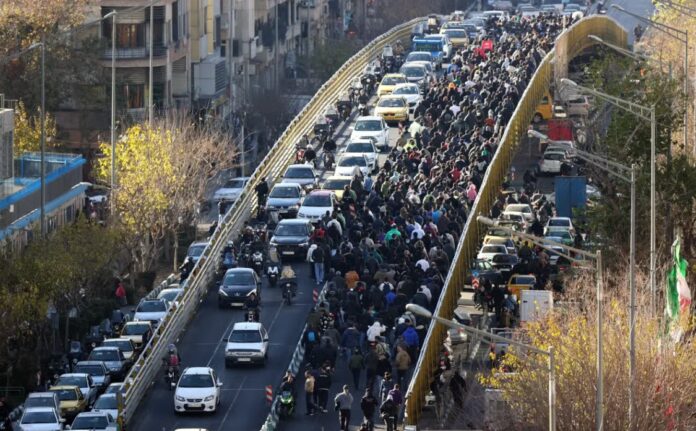
The following is the statement of the Iranian Revolutionary Marxists’ Tendency in support of the latest uprising in Iran. These protests, started by merchants selling imported electrical goods in Tehran on December 28th, have now spread to many towns and cities across Iran. Following the 12-day war with US imperialism and Israel, the value of the Iranian rial has nose-dived, reaching new and unbelievable records – exacerbating the already dire economic situation. Although in December 2025 the official rate of inflation was 42 per cent, food inflation now stands at 72 per cent and the increase in the price of bread has reached 113 per cent.
The regime’s response has been, as ever, beatings, tear gas, water cannon, live rounds and arrests. By the ninth day of the protests (January 5th), the regime had murdered at least 29 protesters and arrested over 1200 people. Many of the detainees are teenagers.
Although the protests against this cost-of-living catastrophe have mobilised many thousands, so far, they have not included Iran’s workers as an organised class. Workers in many industries, including oil and gas, have been protesting and even striking on issues like low pay, job security, eliminating subcontractors, conditions and so on.
The outcome of the present protests, as with all previous movements against this regime, depends on the Iran’s workers intervening in all struggles as a class: both for their own victory and to pose a revolutionary leadership for all other exploited classes and oppressed layers. Only a revolutionary workers’ vanguard party – i.e., the party of the strike leaders and most militant and conscious workers – can organise and lead all classes and layers to overthrow capitalism. Revolutionary working-class leadership is, and always will be, the decisive factor in any mass movement in Iran. Only a genuine Leninist party can overcome both the current stalemate and the recurring defeats of the mass movements and strikes.
***
Last week’s protest by Tehran’s bazaar merchants against the excessive increase in the price of the dollar suddenly became an excuse to vent the pent-up anger of various segments of society. What the bazaaris saw as only a relative reduction in the huge profits they have made over the past years from within this poor and worn-out society, for the majority of the people meant increased poverty, emptier tables, and a deeper livelihood crisis. This increase, along with the high cost of petrol, increased taxes, and the unbridled rise in the prices of basic goods, has brought the lives of millions of people to an unbearable level.
Therefore, the society, which has been living from humiliation and poverty, which after the bloody suppression of the “Women, Life, Freedom” uprising, has every day felt the increasing pressure of unemployment, economic insecurity, and hunger, was quickly attracted to the merchants’ protests and took to the streets, and the protest, which could be said to have been indirectly encouraged by President Pezeshkian in one of his recent speeches and was supposed to be used in the service of discrediting the fundamentalists and hardliners, suddenly became a spark in the gunpowder of the people’s accumulated anger; people who have been struggling for years amid inflation, repression, and a future without a future.
The scope of these protests quickly expanded to other segments of society, especially the youth, women, students, and workers who were on strike and protesting, and spread to different cities in the country. Reports show that in many large cities, people are expressing their dissatisfaction with the overall ruling order with greater boldness and are directing their anger at the regime’s symbols and military and law enforcement officers. In contrast, the government has tried to contain this wave of protests by intensifying repression, using official and unofficial forces, and making widespread arrests.
Today, we are witnessing a society in which rampant inflation has removed basic items such as bread, rice, beans, meat, and chicken from the food basket of a large portion of families, and goods such as fruit, sweets, and nuts have become luxury items. Unemployment, homelessness, the spread of addiction, various social harms, and the collapse of family ties are the naked reality of this economic-political order. It is clear that changing the head of the National Bank, or any other change in the regime’s personnel and factions, will not solve the structural crises of the capitalist system.
Faced with this situation, the class gap is deepening every day. A privileged minority has amassed fabulous wealth by exploiting the hardships of the majority and plundering public resources, while millions of people have taken up insecure and humiliating jobs to survive. As the children of the poor sell flowers and hawk other goods on the streets to help support their families, the children of those in power are enjoying luxury and pleasure abroad. The country’s capital, mineral resources, and natural resources have been plundered by those close to the government, the IRGC, the Supreme Leader’s Office, and various religious foundations and shrines, and sold at the lowest prices, and with the proceeds transferred to foreign banks for the day of reckoning.
The Iranian Revolutionary Marxists’ Tendency, while fully and unconditionally supporting the people’s just struggles, emphasises the need to learn from the experience of the uprisings and protests of the past few decades. Historical experience has shown that without conscious, continuous, and deep-rooted organisation, even the most widespread protests will wither in the face of systematic repression. The government has always tried to exhaust movements that lack organisation and a clear horizon by eliminating known figures, creating fear, making temporary promises, and suppressing them later.
Therefore, the connection between street protests and workers’ struggles is of decisive importance. This connection can bring livelihood and class demands into the context of public protests and give continuity, coherence and perspective to the struggles. The experience of past uprisings has clearly shown that neither of these two arenas alone can reach any sustainable achievements, and only their synergy can change the balance of power in favour of the people.
In this situation, we would like to share a few suggestions with you:
The progressive youth in Iran should start preparing to confront the military and security thugs and the plainclothes goons. The creation of small clandestine “self-defence” committees is at the centre of these preparations. These committees, while strictly observing security issues, can organise underground militias consisting of trusted individuals, so that during protests or social uprisings, they can disarm the government thugs and goons with purposeful planning. From our perspective, these clandestine committees will also be responsible for co-ordinating and organising between different social movements. Gathering accurate and extensive information about the officials and all personnel of the repressive apparatuses, and the organisers of the institutions that perpetuate the capitalist dictatorship regime, will be an important matter for the continuation of the current struggles and preparation for the next waves of revolts and uprisings of the exploited and oppressed masses.
The slogan of arming the masses (which is heard these days), without forming youth and workers’ militias in advance, is not only incorrect but also imaginary utopian. Marxist activity differs fundamentally from anarchist, pseudo-anarchist and guerrilla methods. In our opinion, the struggle is not limited to one or two periods of street uprisings, but will continue until the complete victory of the workers’ councils. Consequently, the formation of clandestine committees and militias is also not limited to a specific period, and the goal is to continue their activities in future periods as well.
Obviously, self-defence is the legitimate right of combative workers and social activists, and they must be ready at all times to protect their own lives and those of others involved in the struggle. The complete arming of the masses will occur during the period of revolutionary upsurge, when the councils and the ruling regime take form as two competing forces, but this does not exclude legitimate and limited defence in conditions such as the present.
The ruling capitalist government has built its survival on intimidation, repression, and structural violence. The constant reliance on these tools is not a sign of authority, but rather a crisis of legitimacy and the rulers’ deep fear of a society that has nothing left to lose. In such circumstances, social solidarity, independent organisation, and organised resistance play a key role in maintaining our fighting spirit and continuing the protests.
We salute the brave youth, honourable workers, women, teachers, and pensioners who are fighting against the thugs and mercenaries of the regime all over Iran these days in the streets, factories, schools, and universities, and we declare our support for this courageous resistance. The lessons of this resistance will be recorded in the history of Iran.
Let us form a workers’ vanguard party and its military wing based on armed popular militias!
Let us prepare for the overthrow of the capitalist system and establishing a Soviet government in Iran.
Iranian Revolutionary Marxists’ Tendency
2 January 2026